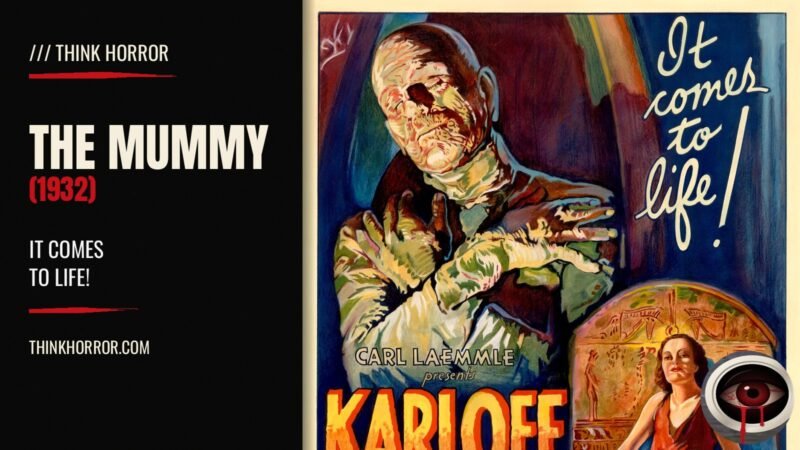
London, 1933. You are standing in a drowned temple with a bracelet of black gold locked around your wrist, and it will not come off. Every time you close your eyes it shows you the road — a golden pyramid, a hidden oasis, seven days to get there before the sunlight kills you. Behind you: a cult, a resurrected priest, and the parents whose adventures put it on you. Run, fiend. The whole film is the running.
The Mummy Returns (2001) is Stephen Sommers’ bigger, louder sequel, in which the O’Connells race a resurrected Imhotep to the lost oasis of Ahm Shere.
It is 1933, seven years after Hamunaptra. Rick and Evelyn are married, rich, and raising an eight-year-old son, Alex, who has his mother’s curiosity and his father’s talent for touching exactly the wrong artefact. The artefact this time is the Bracelet of Anubis, which locks onto the boy’s wrist and starts projecting the road to a golden pyramid — with a deadline attached: reach Ahm Shere in seven days or die when the sunlight does. Meanwhile a cult has dug up Imhotep again, because the man who kills the Scorpion King inherits an army of jackal-headed gods. Fiends, subtlety has left the tomb. What remains is a carnival — and carnivals have their own honest pleasures.
The sequel exists because the first film detonated. Universal approached Sommers about a follow-up the very weekend The Mummy opened in 1999, and his brief to himself was simple: outdo it. More money ($98 million against the original’s $80 million), more creatures, more continents, a child in peril, a prologue in 3067 B.C., and a climactic monster played — in a sense — by the most famous wrestler alive. The critics of 2001 mostly filed it under “more, but less.” The audience made it the second-biggest opening weekend in history to that point and the fastest-selling DVD America had ever seen. Both verdicts are defensible. Harper’s is below, with the evidence.
Watch the Trailer

Quick Specs
- Director: Stephen Sommers
- Screenplay: Stephen Sommers
- Starring: Brendan Fraser (Rick O’Connell), Rachel Weisz (Evelyn O’Connell / Princess Nefertiri), John Hannah (Jonathan Carnahan), Arnold Vosloo (Imhotep), Oded Fehr (Ardeth Bay), Patricia Velásquez (Meela Nais / Anck-su-namun), Freddie Boath (Alex O’Connell), The Rock (Mathayus, the Scorpion King), Alun Armstrong (Baltus Hafez), Adewale Akinnuoye-Agbaje (Lock-Nah), Shaun Parkes (Izzy Buttons)
- Music: Alan Silvestri
- Cinematography: Adrian Biddle
- Editors: Bob Ducsay and Kelly Matsumoto
- Producers: Sean Daniel and James Jacks
- Production Company: Alphaville Films
- Distributor: Universal Pictures
- Premiered: April 29, 2001 (Universal Amphitheatre, Los Angeles)
- Released: May 4, 2001
- Runtime: 129 minutes
- Rating: PG-13
- Budget: $98 million
- Box Office: $433 million (original run; $444.1 million lifetime)
- On This Site: The Mummy Returns in the wiki · The Mummy (1999)
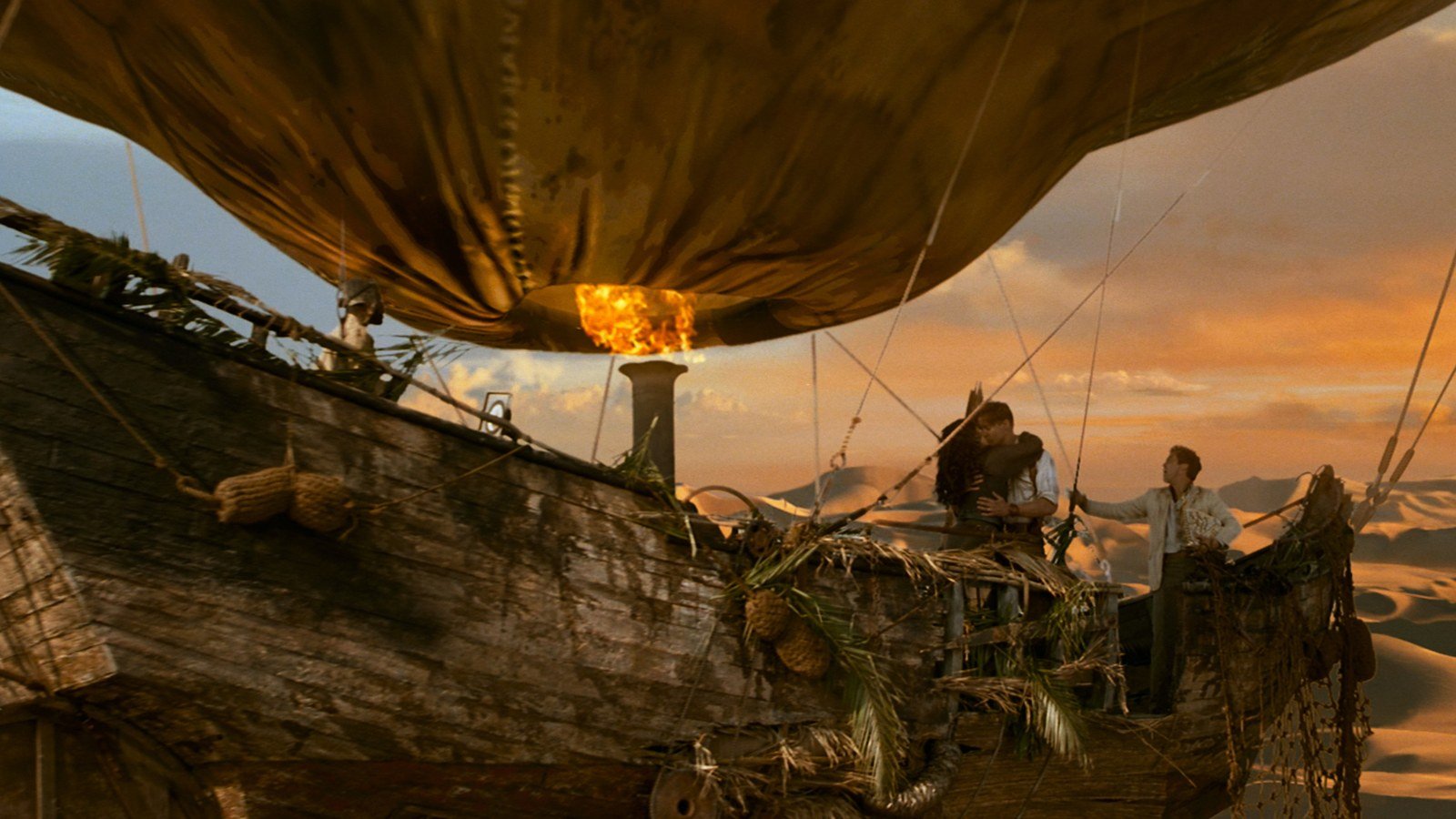
The Review
Begin with the charge sheet, because it is accurate and because the defence begins by pleading guilty. Roger Ebert wrote its epitaph in advance: “The mistake of The Mummy Returns is to abandon the characters, and to use the plot only as a clothesline for special effects and action sequences.” He is not wrong about the structure. The plot is a relay race — bracelet, vision, kidnapping, pursuit, oasis, pyramid — engineered so that no ten minutes pass without a set piece, and Sommers cuts like a man being charged by the minute. But a clothesline is judged by what hangs on it, and what hangs on this one is the most likeable company of adventurers the modern blockbuster ever fielded, a villain whose love story is more sincere than the heroes’, and set pieces built with a Saturday-matinee joy that the film’s betters could not manufacture. The criticism and the pleasure are the same fact viewed from different seats.
The family is the first pleasure. Fraser and Weisz play married the way they played courting — as a partnership of equals who finish each other’s archaeology — and the sequel’s best running idea is that domesticity has not slowed them down at all: they excavate as a household, bicker in hieroglyphs, and hand their son the family trade along with the family curse. Freddie Boath’s Alex is a plot engine with a face — the bracelet makes him a map, the cult makes him a hostage, and the film makes him resourceful rather than merely imperilled, leaving a trail of clues out of temples the way other children leave breadcrumbs. And John Hannah’s Jonathan, armed this time with a golden spear he insists is a scepter, carries the film’s best joke all the way to its climax — where the joke pays off in the single most satisfying shot of the picture. What exactly it turns out to be is waiting in the spoilers below; only Sommers would hide his deus ex machina inside a sight gag and dare you to laugh when it fires.
The set pieces, then, since they are the film’s argument. The double-decker bus fight through London is the sequel in miniature: absurd, practical, perfectly staged, with Imhotep’s resurrected soldiers coming through the roof and the O’Connells fighting as a family unit in a vehicle that should not survive the scene and doesn’t. The wall of water bearing Imhotep’s face — the 1999 film’s sandstorm visage, restaged at sea — is the signature shot, and it earns its scale. But the sequence Harper files as the film’s finest is the one nobody puts on the poster: the pygmy mummies of Ahm Shere, skeletal miniatures with blowguns pouring through the jungle dark in stop-motion-flavoured swarms. It is the one passage where Returns out-horrors its predecessor — genuinely feral, genuinely frightening, and the cult’s redshirts die in it screaming. Adventure films are supposed to have one scene that makes children hide. This is that scene, and it is in a film with the decade’s most notorious digital creature waiting at the end of it, which tells you everything about the tonal high-wire Sommers walks.
And then there is Imhotep, the sequel’s secret masterpiece. Arnold Vosloo plays him, again, as a lovesick tyrant rather than a monster: a high priest who waited three thousand years for one woman and measures every power on Earth against getting her back. The film arranges its whole moral architecture around a mirror — two couples, two resurrections, two women pulled back from death — and then, in its final minutes, it pays the architecture off.
The craft around the flaw is muscular. Alan Silvestri replaced Jerry Goldsmith and — a real loss, honestly logged — did not reuse Goldsmith’s themes; what he brought instead is propulsion, a score that treats the film as a two-hour cavalry charge and is not wrong. Adrian Biddle shoots Morocco and Shepperton like a storybook that keeps catching fire. Bob Ducsay’s editing is the film’s true special effect: the pace is not fast so much as continuous, a design choice that is also the chief complaint, and both sides of that sentence are true. This is a film that never once sits down. Whether that is a flaw depends on what you came for; it is never an accident.
What it launched is its own ledger: a Scorpion King spin-off the following spring (Johnson’s first lead, on a record $5.5 million debut-star salary — he made $500,000 here), an animated series, and eventually a third O’Connell film in 2008 that this review will treat with merciful brevity. And now the story resumes in earnest. A direct sequel, The Mummy: Book of the Dead, reunites Brendan Fraser and Rachel Weisz as Rick and Evelyn O’Connell — with John Hannah, Oded Fehr and Kevin J. O’Connor also returning — under directors Matt Bettinelli-Olpin and Tyler Gillett (Radio Silence), from a script by David Coggeshall. The film, which ignores Tomb of the Dragon Emperor, began shooting in London in September 2026 and is dated for October 15, 2027. Universal has released no plot details. The O’Connells are coming back, fiends, and the twenty-five-year audience verdict on this film is a large part of why.
Spoilers — The Ending, Discussed Plainly
Spoilers settle here, fiends — the ending is discussed plainly.
The scepter pays off first. The golden spear Jonathan has insisted all film is a scepter is the Spear of Osiris — the one weapon that can kill the Scorpion King — and when the moment comes he throws it across the pyramid chamber to his brother-in-law, who drives it home and sends the King and his army back to the underworld. The best joke in the picture was its deus ex machina all along, hidden in a sight gag, exactly as promised.
Dangling from the ledge of the underworld pit, Rick is saved because Evelyn runs across a collapsing floor to haul him up, risking the fall herself. Imhotep, hanging beside him, begs Anck-su-namun to do the same — and she looks at the man she was resurrected for, calculates the odds, and runs. He watches her go. Then he lets go. Nobody kills Imhotep in this film; he examines the entire meaning of his three-thousand-year devotion, finds it was one-sided, and opens his hand. It is the most human moment in either Mummy picture, achieved by a bald digital-era villain in the middle of a collapsing CGI pyramid, and it retroactively dignifies every scene Vosloo played before it. Anck-su-namun, fleeing, falls into a pit of scorpions — the film’s bookkeeping is swift — but the image that stays is the priest’s face as he chooses the fall. Sequels are not supposed to contain the best scene in their series. This one does, in its last five minutes, almost as an apology for the noise.
The apology is needed, because the noise has a name and a face, and the face is the problem. Dwayne Johnson — billed as “The Rock,” in his acting debut — appears in person only in the 3067 B.C. prologue: a few lines of ancient Egyptian, real screen presence, and gone. What returns at the climax is a fully computer-generated scorpion-centaur wearing an approximation of his face, and it remains the textbook uncanny-valley exhibit of its era. ILM’s John Berton has explained why: Johnson’s wrestling schedule kept him unavailable for the detailed facial reference photography the effect needed, so the digital face was built from insufficient reference — in Berton’s framing, the equivalent of drawing a face from memory. The returning Imhotep effects were widely judged an improvement on 1999; the film’s single most publicised creature is its single worst image, and it arrives at the exact moment the film can least afford it. Harper scores the film with the flaw priced in, the way you must.
The Verdict
Rating: 3 ravens out of 5.
Honestly counted, then. The Mummy Returns is thinner in character than its predecessor, thicker in incident, capped by the worst famous effect of its decade — and built around the best five minutes its series ever produced, carried by a company of players it is simply a pleasure to ride with. It is a runaway carnival of a sequel: everything louder, nothing deeper, and an ending that earns it anyway. Sommers set out to outdo the first film and succeeded mainly in out-shouting it. But shouting, done with this much affection, in this company, in front of that water-wall and under that pyramid, remains a perfectly good night at the pictures.
Trivia & Facts
- Ordered before the ink dried. Universal approached Stephen Sommers about a sequel the same weekend The Mummy opened in 1999; he was developing ideas for it within a day, with the stated intention of outdoing the first film.
- Billed as The Rock. Dwayne Johnson’s acting debut is credited under his ring name, and he reportedly earned $500,000. A year later The Scorpion King made him the highest-paid first-time leading man in history at $5.5 million — the two figures are routinely smeared together; keep them apart.
- He does have lines. The claim that Johnson has no dialogue is wrong — he speaks a few lines of ancient Egyptian in the 3067 B.C. prologue. But he performs in person nowhere else in the film: the climax’s Scorpion King is entirely computer-generated.
- The face from memory. Per ILM supervisor John Berton, Johnson’s WWE schedule prevented the team from capturing detailed facial reference, so the Scorpion King’s digital face was modelled from insufficient material. The oft-repeated claim that the creature was “finished eight days before release” is trivia-circuit lore, not established fact.
- Too scary for the Grinch. The November 2000 teaser trailer, attached to How the Grinch Stole Christmas, was pulled from that film after parents complained it was too frightening for children.
- The boy who chose the mummy. Freddie Boath, then ten, chose to audition for Alex rather than audition for Harry Potter — he was never offered the Potter role, whatever the fan wikis say. He earned a Saturn Award nomination for the part.
- A two-week record. On October 2, 2001, the film became the fastest-selling DVD in US history to that point — two million copies in its first week, passing Gladiator. The crown lasted a fortnight, until Star Wars: Episode I – The Phantom Menace sold 2.2 million.
- Mind the princess. Evelyn’s past-life identity is Princess Nefertiri, daughter of Seti I and sworn keeper of the Bracelet of Anubis — not Nefertiti, the famous queen with the bust, who lived centuries earlier and has nothing to do with this film. Reviews confuse the two constantly.
- The score changed hands. Jerry Goldsmith did not return; Alan Silvestri composed the sequel’s music without reusing Goldsmith’s themes. The soundtrack album, released May 1, 2001, closes with Live’s “Forever May Not Be Long Enough.”
Harper’s Extras
- The Mummy Returns in the Think Horror wiki — the film’s full file, cast and production history.
- The Mummy (1999) — the wiki file on the adventure that started the Fraser era.
- Crank it: Alan Silvestri’s score. No Goldsmith themes, all forward motion — the sound of a film that has decided, on principle, never to sit down.
Where to Watch
As of November 9, 2026, in the US: The Mummy Returns streams free on Pluto TV. You can also rent it (from $3.99) on Amazon Video, Apple TV Store and Fandango At Home, or buy it — from $7.99 on Amazon Video, and $14.99 on Apple TV Store and Fandango At Home. As a Universal title it also rotates on and off Peacock — check before you settle in. Blu-ray and 4K UHD editions are in print.
FAQ
How much is The Rock actually in it?
Less than the poster promises. Billed as “The Rock” in his acting debut, Dwayne Johnson performs in person only in the 3067 B.C. prologue, speaking a few lines of ancient Egyptian. The Scorpion King who returns in the climax is entirely computer-generated. The spin-off, The Scorpion King (2002), is where he actually stars.
Who kills Imhotep at the end?
Nobody — and that is the point of the scene. Stripped of his powers and dangling from the ledge of the underworld pit, Imhotep begs Anck-su-namun to pull him to safety, as Evelyn has just risked her life to save Rick. She refuses and flees. Heartbroken, he lets go of the ledge himself. Anck-su-namun dies moments later, falling into a pit of scorpions.
Do you need to see The Mummy (1999) first?
You should. Returns assumes your affection for Rick, Evelyn, Jonathan, Ardeth and Imhotep from the first film, resurrects its villain inside ten minutes, and builds its emotional climax on the Imhotep–Anck-su-namun love story established there. It is watchable cold, but it plays far better as the second half of a double bill.
Is another sequel coming?
Yes — a real one, in production now. The Mummy: Book of the Dead reunites Brendan Fraser and Rachel Weisz, with John Hannah, Oded Fehr and Kevin J. O’Connor also returning, directed by Radio Silence (Matt Bettinelli-Olpin and Tyler Gillett) from David Coggeshall’s script. It ignores Tomb of the Dragon Emperor, began filming in London in September 2026, and is dated October 15, 2027. Universal has released no plot details, so treat any synopsis you see as invention.
How scary is it, compared to the first?
Bigger, louder and mostly less frightening — except in the jungle of Ahm Shere, where the pygmy mummies deliver the single scariest sequence in either film. Harper rates it 3 ravens: a runaway carnival of a sequel — everything louder, nothing deeper, and an ending that earns it anyway.
The weekly roundup
One letter a week, from the crypt.
- New reviews, with the ravens
- New wiki entries and news
- Cool stuff worth your night
Weekly. No spam, unsubscribe in one click.