
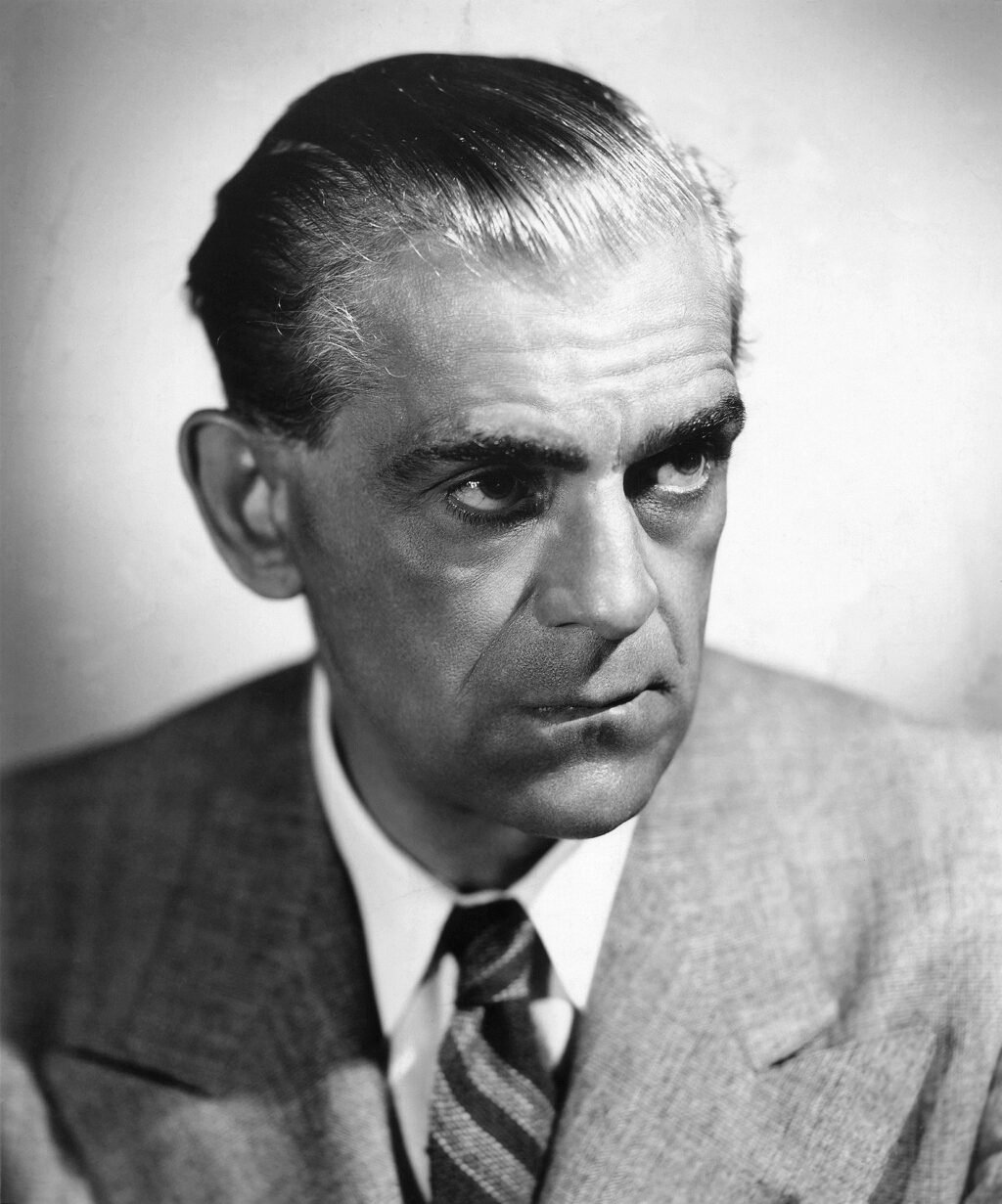
Boris Karloff (1887 to 1969) was the English actor who played Frankenstein’s Monster and the Mummy, and narrated the Grinch.
Quick Specs
| Born | November 23, 1887, south London, England (as William Henry Pratt); the district is disputed |
| Died | February 2, 1969, King Edward VII Hospital, Midhurst, Sussex, England, aged 81 (pneumonia) |
| To North America | Left England for Canada in 1909 |
| Breakthrough | Frankenstein (1931), at 43 |
| Frankenstein’s Monster | Frankenstein (1931); Bride of Frankenstein (1935); Son of Frankenstein (1939) |
| Other key horror | The Mummy (1932); The Black Cat (1934); The Raven (1935); House of Frankenstein (1944, as Dr. Niemann); The Body Snatcher (1945); Isle of the Dead and Bedlam (1945 to 1946); Targets (1968) |
| Stage | Originated Jonathan Brewster in Arsenic and Old Lace on Broadway (opened January 1941) |
| Television | Host and star of Thriller (1960 to 1962) |
| Voice | Narrator and the Grinch in How the Grinch Stole Christmas! (1966) |
| Honours | Two stars on the Hollywood Walk of Fame (1960); Grammy Award for Best Recording for Children, for the Grinch album |
| Last film released in his lifetime | Curse of the Crimson Altar (1968) |
| Family | Married five times; daughter Sara Karloff (born 1938) |
Who He Was
Boris Karloff was born William Henry Pratt on November 23, 1887, in south London. Exactly where is disputed, including by Karloff himself. The district he named was Dulwich. Other accounts place the birth at 36 Forest Hill Road, Honor Oak, in the Camberwell area, the house that now carries a blue plaque. In the standard account he was the youngest of nine children, and his father, Edward John Pratt, worked in the consular branch of the Indian Civil Service. His great-aunt was Anna Leonowens, the governess whose memoirs became Anna and the King of Siam and The King and I.
He was bow-legged, and as a child he stammered badly. He conquered the stammer, but he kept a lisp all his life, and it became part of the voice. The gentle, lisping diction is the Karloff sound.
In 1909 he left England for Canada. He worked as a farm labourer and at other manual jobs and joined a touring repertory company. That began roughly a decade of stage touring across Canada and the northern United States before he reached Hollywood at the end of the 1910s. Hollywood gave him another decade of bit parts and extra work, and between engagements he survived by labouring, including driving a cement truck, a detail he told himself.
He took the name Boris Karloff around 1909 to 1910, in Canadian repertory theatre, and performed under it from then on. Where the name came from is not documented. He himself suggested it came from his mother’s side of the family; biographers have proposed other sources, including a character in a novel. No version is proven. In the 1930s Universal billed him by the surname alone: KARLOFF.
He married five times and had one child, his daughter Sara Karloff, born in 1938 to his fourth wife during the Son of Frankenstein period. Sara has been the custodian of his legacy and the source of much of the modern record about him.
Off screen he was, by every account, a gentle man and a thoughtful actor. He was a cricketer, a gardener and a founding-era union man at the Screen Actors Guild, and he was unfailingly courteous on set. He disapproved of modern movie monsters, which he saw as “dehumanized creatures presented without sympathy.” The monsters were the job. The gentleness was the man, and it explains the performances.
He received two stars on the Hollywood Walk of Fame, one for motion pictures and one for television, in the original 1960 induction. The record of How the Grinch Stole Christmas! won him the Grammy Award for Best Recording for Children.
By the late 1960s he had emphysema. Only half of one lung still functioned, and he needed oxygen between takes on his final productions. He contracted bronchitis in 1968 and died of pneumonia at the King Edward VII Hospital in Midhurst, Sussex, on February 2, 1969, aged 81.
The Work, and What He Did in It
Frankenstein (1931) was the breakthrough, and it came at 43. James Whale directed for Universal, and the role came to Karloff after Bela Lugosi passed on it. The film opened on November 21, 1931, two days before Karloff turned 44. By his own oft-repeated count, it was his 82nd film, after a decade of bit parts. The breakthrough was a decade of invisible work paying off at once.
What he did with the Monster, specifically:
- He played the Monster as a child: reaching for the light, delighted by the flower game with little Maria, bewildered by fire and by cruelty.
- He did it under Jack Pierce’s makeup, in weighted, stiffened costuming with leg braces, so that the Monster’s walk was itself an effect.
- He did it billed as “?”. The opening credits list the Monster’s player as a question mark, and only the closing credits name Karloff. It was a deliberate publicity device, and it created a star whose name the studio was hiding.
The Monster is not called Frankenstein, and Karloff did not play Frankenstein. Henry Frankenstein is the creator, played by Colin Clive. Karloff played Frankenstein’s Monster.
The Mummy (1932) brought Imhotep, and the ordeal. Karl Freund directed. It is really two performances. Karloff is in the famous bandages for only a few minutes at the opening. The rest of the time he plays Ardath Bey, the parchment-skinned priest who has waited 3,700 years for his reincarnated love. The makeup is the documented ordeal of his career. Pierce began at 11 a.m., applying cotton, collodion and spirit gum to his face and clay to his hair, then wrapped him in acid-treated linen that had been burned in an oven. He finished at 7 p.m. Karloff then shot until 2 a.m., and removing it all took two more hours. Karloff called it “the most trying ordeal I have ever endured.” His verdict on Pierce stands beside that: “He was nothing short of a genius, besides being a lovely man… After a hard day’s shooting, I would spend another six or seven hours with Jack.”
Bride of Frankenstein (1935) is where the Monster speaks. Whale directed again. The Monster learns language from a blind hermit (“Friend? Good.”), demands a mate, meets the Bride, and in the lever-pulling finale rejects the world that rejected him: “We belong dead.” He was billed now as KARLOFF alone. Most critics rank it as his finest performance, and the Monster with words is more tragic, not less. He was 47.
Son of Frankenstein (1939) was the third and last Monster. Rowland V. Lee directed. Karloff played the Monster largely mute again, opposite Basil Rathbone, Lugosi’s Ygor and Atwill. After this he refused to play the Monster again in a feature, because he believed the character had been fully explored. He returned to the costume only once, decades later, for a 1962 television appearance on Route 66.
He protected the Monster, and the credits prove it. When Universal staged its later monster rallies, Karloff appeared as other men. In House of Frankenstein (1944) he plays the mad Dr. Niemann, and the Monster is Glenn Strange. In the 1940s sequels Strange and Lon Chaney Jr. carried the Monster, not Karloff.
The Lugosi teamings ran from 1934 to 1945, eight films in all:
- The Black Cat (1934): Karloff as the satanic architect Poelzig, top-billed over Lugosi in their first pairing.
- The Raven (1935): Karloff as the escaped killer deformed by Lugosi’s Dr. Vollin.
- The Body Snatcher (1945): their last film together, made for the producer Val Lewton and the director Robert Wise. Karloff plays the cabman and grave-robber John Gray, charming, witty and utterly corrupt, singing a folk song while he commits a murder. It is treated as one of his greatest performances, and it is the summit of the teamings. He was 57.
The 1940s workload was heavy. He played Mord the executioner in The Tower of London (1939), Niemann in House of Frankenstein, and then the Lewton trilogy at RKO: The Body Snatcher, Isle of the Dead and Bedlam, all made in 1945 and 1946. The Lewton films are the connoisseur’s Karloff, with horror played as psychology and period dread.
On Broadway he originated the murderous Jonathan Brewster in Arsenic and Old Lace, which opened in January 1941. The joke of the play is that Jonathan looks like Boris Karloff, and Karloff was playing him. His stage contract kept him in the production, which is why Raymond Massey plays Jonathan in the 1944 film.
Television made him the genre’s elder statesman. He hosted and starred in the anthology series Thriller (1960 to 1962) and guested across 1950s and 1960s television. He became the public grandfather of horror, the man interviewers went to for the genre’s history because he was so much of it.
How the Grinch Stole Christmas! (1966) is the voice. In Chuck Jones’s special Karloff narrates and voices the Grinch. He did not sing “You’re a Mean One, Mr. Grinch.” The song was sung, uncredited, by Thurl Ravenscroft, the voice of Tony the Tiger, and Dr. Seuss, Theodor Geisel, felt so bad about the missing credit that he wrote to columnists across the country to correct it. The album won Karloff his Grammy. For millions of children who never saw a Universal film, this is Karloff, and it is a first-rank credit, not a footnote.
Targets (1968) is the summation. In Peter Bogdanovich’s first film Karloff plays Byron Orlok, an ageing horror star who believes his kind of horror is obsolete beside the real violence of a sniper’s America. It is essentially himself, and the critic Steve Vertlieb said it won him “the best, most respectful notices of his later career.” Orlok ends by confronting the gunman. Karloff was 80. It is his last major role.
The last releases need exact chronology:
- Curse of the Crimson Altar (1968), also known as The Crimson Cult, was the last Karloff film released in his lifetime.
- In spring 1968, in Los Angeles, he shot his scenes for four low-budget Mexican horror films back to back: The Snake People, The Incredible Invasion, Fear Chamber and House of Evil. Jack Hill directed his scenes for the producer Luis Enrique Vergara, and the films were completed in Mexico. All four were released after his death, the last, The Incredible Invasion, not until 1971.
- The Spanish-shot Cauldron of Blood (1967) was also released after his death.
He worked those final shoots on oxygen.
Cool Verified Facts
- In the opening credits of Frankenstein, the Monster is played by “?”. Karloff’s name appears only in the closing credits.
- By his own count, Frankenstein was his 82nd film.
- He was 43 when Frankenstein opened.
- The Mummy’s makeup took eight hours to apply, from 11 a.m. to 7 p.m., and two hours to remove.
- His great-aunt was Anna Leonowens, the governess behind The King and I.
- He originated Jonathan Brewster in Arsenic and Old Lace on Broadway, a character whose running joke is that he looks like Boris Karloff.
- Thurl Ravenscroft, not Karloff, sang “You’re a Mean One, Mr. Grinch.”
- He has two stars on the Hollywood Walk of Fame, one for film and one for television.
- His four Mexican films were all released after his death, the last in 1971.
Signatures, Habits and Behind the Scenes
Sympathy for the monster is the signature. The Monster reaching toward the light, Imhotep’s 3,700-year love and Gray’s courtesy in The Body Snatcher all work the same way: the horror comes from recognising the person inside the monster. It was a deliberate, career-long choice, and it separates him from every imitator. It is the same conviction behind his complaint about monsters “presented without sympathy.”
The makeup chair was an endurance record. Eight hours to become the Mummy, wrapped in acid-treated linen, unable to move freely, shooting to 2 a.m. and two more hours to get out. For Frankenstein there was Pierce’s build with the heavy costume and the leg braces shaping the walk. His public line was gratitude, not complaint. Pierce, he said, “was nothing short of a genius.”
The voice came after the face. With the lisp intact, he became one of the great speaking voices of the century, on records and radio, on Thriller and as the Grinch. The same instrument that made the Monster’s grunts heartbreaking in 1931 was reading Dr. Seuss to children in 1966.
He would not cheapen the Monster. He felt the character was complete after 1939 and feared that repetition would diminish it, so he played other men in the monster rallies that followed. That refusal is why any listing of Karloff as the Monster in the 1940s sequels is wrong.
Why He Matters
Karloff is the genre’s first great actor in the modern sense, the proof that a monster could carry a film’s emotional weight. The Monster’s pathos, Imhotep’s longing and Gray’s charm define three different registers of horror acting, all before 1946. Lugosi defined the vampire’s style. Karloff defined the monster’s soul, and horror acting has lived in those two houses ever since.
The endurance is the argument. A decade of small parts and labouring jobs, a breakthrough at 43 billed as “?”, summit performances at 47 in Bride of Frankenstein and at 57 in The Body Snatcher, a career-crowning self-portrait at 80 in Targets, and final work shot on oxygen: no other horror career makes the case for craft over stardom so completely.
The proof kept arriving after his death. The Grinch special plays every December. Targets grows in reputation as the genre’s own meditation on itself. And the four Mexican films he shot in a few weeks in 1968 kept being released into 1971, so the industry was still premiering Boris Karloff two years after he died.