
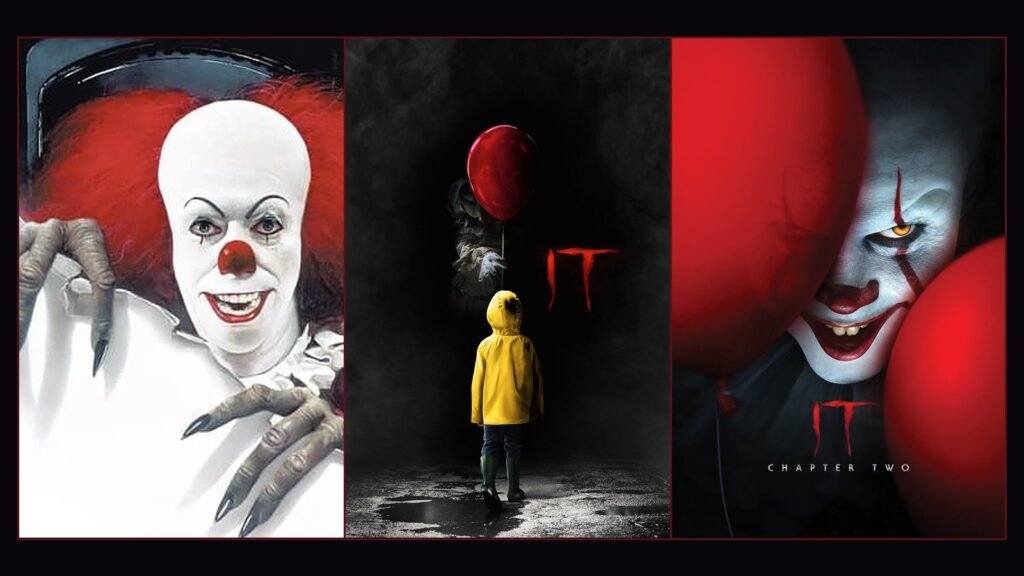
The It franchise is Stephen King’s Derry saga on screen: the 1990 miniseries, two blockbuster films, and the Welcome to Derry prequel series.
One novel. One cursed town. Four screen lives and counting, boils and ghouls — and every twenty-seven years or so, something in Derry, Maine, wakes up hungry and puts on a clown suit. This is the hub for all of it: the book that started the float, the two-night TV event that terrified a generation in 1990, the Andy Muschietti films that turned Pennywise into the biggest horror draw on Earth, and the HBO prequel now digging into the cycles that came before. Each era gets its own deep-dive page on this site; this is the map of the sewer system.
Fair warning before we descend: the adaptations do not agree with each other. The years move, the cycle changes length, whole pieces of King’s mythology exist only on the printed page. Part of the fun of this franchise is keeping the versions straight — so let’s keep them straight.
Quick Specs
- Source novel: It by Stephen King (Viking, 1986)
- Setting: Derry, Maine
- The cycle: It feeds roughly every 27 years — stretched to 30 in the 1990 miniseries, the only version that changes it
- Screen entries: Stephen King’s It (1990 miniseries), It (2017), It Chapter Two (2019), IT: Welcome to Derry (2025– )
- Pennywise played by: Tim Curry (1990); Bill Skarsgård (2017– )
- The Losers Club: Bill, Beverly, Ben, Eddie, Mike, Richie and Stanley — meet them on our Losers Club page
- Combined film box office: about $1.18 billion worldwide across the two Muschietti films (The Numbers)
The Novel (1986)
King conceived the story in 1978 and began writing in 1981 — his first image, by his own account, was a troll under a bridge, in the “Three Billy Goats Gruff” mode, moved into a Maine town’s sewer system. The troll grew. It was published by Viking in hardcover on September 15, 1986: 1,138 pages in the first edition (later editions run from 1,104 to well over 1,300 pages, so beware anyone quoting one page count as gospel). It was King’s 22nd book and his 18th novel under his own name, Publishers Weekly listed it as the best-selling book in America for 1986, and it won the British Fantasy Award in 1987, with Locus and World Fantasy nominations the same year.
The structure is the famous part: a nonlinear weave between two summers a generation apart — childhood in 1957–58, adulthood in 1984–85, usually summarized as 1958 and 1985. Seven kids, the self-named Losers Club, discover that Derry’s long history of massacres and disappearances runs on a cycle of roughly 27 years, and that the thing underneath the town takes the shape of whatever its prey fears most. Its favorite shape is Pennywise the Dancing Clown. Between the two timelines, King’s “interludes” — Mike Hanlon’s research into Derry’s bloody past — quietly build a century of cyclical horror. Hold onto those interludes; the newest entry in this franchise is built out of them.
And one honest note for the adaptation sections below: pieces of the novel have never reached any screen. The Ritual of Chüd, the cosmic Turtle, and the book’s most controversial sequence exist only in print — the 1990 miniseries left them out under broadcast standards, and no later version has picked them up. Everything below is what actually made it to the screen.
Stephen King’s It (1990) — The Miniseries
The first adaptation was nearly a very different animal. Stephen King‘s novel was first developed as an eight-to-ten-hour production with George A. Romero attached to direct; ABC cut the commitment to four hours across two nights, Romero exited — officially a scheduling conflict, though writer Lawrence D. Cohen later speculated the lost scope took the magic out of it for him — and the job went to Tommy Lee Wallace, who cheerfully admitted he had not read the novel and worked from Cohen’s screenplay. Cohen wrote the teleplay — Part 1 alone, Part 2 with Wallace, whatever some reference infoboxes still print — on a $12 million budget, double the going rate for TV movies of the day. It shot in Vancouver over about three months.
It aired on ABC on Sunday, November 18 and Tuesday, November 20, 1990, intercutting the child and adult timelines across both nights rather than splitting them into blocks. The casting is the stuff of TV legend: Richard Thomas, John Ritter, Annette O’Toole, Harry Anderson, Dennis Christopher, Tim Reid and Richard Masur as the adult Losers; Jonathan Brandis, Seth Green, Emily Perkins and Brandon Crane among their younger selves; and Tim Curry, billed as a special appearance, inside Bart Mixon’s “living cartoon” Pennywise makeup. The audience came: Part 1 drew an 18.5 rating, and Part 2 out-rated it — a 20.6 rating, the #2 program of the week, the most-taped show of November 1990 — roughly 30 million viewers across the two nights and, in Cohen’s precise phrase, the biggest success of 1990 for Capital Cities, ABC’s owner. Richard Bellis won an Emmy for his Part 1 score and the editing took an Eddie Award.
Two honest asterisks, because this site keeps them. Georgie’s death is implied, not shown — the terror is in the boy’s eyes and the dark of the drain, not in gore 1990 television could never have aired. And the finale’s giant spider, built by Mixon’s Fantasy II team, arrived on set leaner and meaner than the design Wallace had approved, with no time or money to rebuild it. Nobody involved pretended otherwise: Curry himself later called it “not very scary. Or convincing.” The clown endures; the spider is forgiven. Our full page on the miniseries — including the strange afterlife of the merged home-video edit, which first appeared on a single VHS cassette in 1998 (not on the 2002 DVD, whatever the fan wikis say) and quietly costs Part 2 its opening minutes — is here: Stephen King’s It (1990).
It (2017) — Chapter One
Twenty-seven years after the miniseries — yes, exactly, and no, nobody at Warner Bros. planned it that neatly — Pennywise came back as a blockbuster. Andy Muschietti’s It, written by Chase Palmer, Cary Joji Fukunaga and Gary Dauberman, premiered at the TCL Chinese Theatre on September 5, 2017 and opened across the US on September 8. It keeps the novel’s 27-year cycle but slides the childhood half to 1989: Jaeden Martell (credited then as Jaeden Lieberher), Sophia Lillis, Finn Wolfhard, Jeremy Ray Taylor, Chosen Jacobs, Jack Dylan Grazer and Wyatt Oleff are the young Losers, Jackson Robert Scott is Georgie, and Bill Skarsgård — our full profile is linked there — rebuilt Pennywise from the ruff out: older, stranger, hungrier.
The numbers still startle. A $123.4 million domestic opening weekend; about $704 million worldwide by The Numbers’ count — Box Office Mojo’s all-releases figure, which folds in re-releases, reads $719.8 million, and honest reporting names its tracker. The budget was $35 million by The Numbers (some references put it at $35–40 million). Critics landed in the mid-80s on Rotten Tomatoes with a 70 on Metacritic and a B+ CinemaScore, and by the end of its run the film stood as the highest-grossing horror movie of all time, unadjusted for inflation. The deep dive: It (2017).
It Chapter Two (2019)
The adults’ half arrived two years later. It Chapter Two — Muschietti directing Gary Dauberman’s screenplay — premiered August 26, 2019 and opened September 6, running 169 minutes. The year is 2016, twenty-seven years on, and Mike Hanlon, the one Loser who never left Derry, makes the phone calls. James McAvoy, Jessica Chastain, Bill Hader, Isaiah Mustafa, Jay Ryan, James Ransone and Andy Bean play the grown Losers, with the 2017 kids woven through in flashback, Teach Grant as the adult Henry Bowers, and King himself behind a pawn-shop counter in a cameo. The story keeps the novel’s hardest beats: Stan’s posthumous letters reframing his suicide as a way to give his friends a chance, Eddie’s death in the final confrontation, Ben and Beverly finally together, and Mike leaving Derry at last.
It opened to $91 million domestic and $185 million worldwide, and finished at $473.1 million worldwide on both The Numbers’ and Box Office Mojo’s original-release counts — against a budget printed as $79 million by Wikipedia and Box Office Mojo, $70 million by The Numbers; again, the sheet names its tracker. Reviews were cooler than the first film’s — Hader and Skarsgård drew the praise, the runtime drew the complaints — but $473 million is $473 million: combined, the two films grossed about $1.18 billion (The Numbers). The full page: It Chapter Two.
IT: Welcome to Derry (2025– )
The franchise’s fourth life is a prequel — to the Muschietti films only, not to the miniseries. Developed by Andy Muschietti, Barbara Muschietti and Jason Fuchs, with Fuchs and Brad Caleb Kane as showrunners, the HBO series was greenlit in February 2023, began filming that May, paused for the SAG-AFTRA strike, and wrapped in August 2024. Season 1 is set in 1962, one cycle before the films’ 1989: a couple and their son arrive in Derry just as a young boy disappears. Eight episodes premiered on HBO on October 26, 2025, concluding December 14. Jovan Adepo and Taylour Paige lead as Leroy and Charlotte Hanlon — the family name is no accident — with Chris Chalk, James Remar and Madeleine Stowe, and Skarsgård back in the paint, this time also as an executive producer. Reviews were generally positive: the direction, production values and performances (Skarsgård and Chalk especially) drew the praise; the writing and visual effects took the hits.
The series was renewed for a second season in August 2026, and the design is elegant: each season steps back a further 27 years. Season 2 moves to 1935 and the Great Depression, built around the Bradley Gang massacre — bank robbers who stopped in Derry for ammunition and became one of the town’s cycle catastrophes, straight out of the novel’s interludes — with Kane continuing as sole showrunner. Two fences, firmly posted: Skarsgård’s return for Season 2 has not been confirmed, however likely it looks; and a third season stepping back to 1908 is a reported plan, not a confirmed order. On this site, announced and aired are different countries.
Two Pennywises
Every era of this franchise hangs on the same question: who is in the makeup? Curry’s Pennywise — designed and sculpted by Bart Mixon to look like a living cartoon — was a vaudeville charmer with teeth: all grin, patter and sudden stillness, played by a beloved actor who died on August 25, 2026, at 80, and whose performance turned a two-night TV movie into a generational childhood trauma. Skarsgård’s is a different species of dread — a thing wearing a clown the way a lure wears a light, voice pitched wrong on purpose, eyes never quite agreeing with each other — carried across both films and into Welcome to Derry. The role has exactly two owners in forty years of adaptations, and the argument over which one owns your nightmares is the franchise’s favorite bar fight. Compare them properly on the Pennywise page.
The Timelines, Side by Side
- The novel: childhood 1957–58, adulthood 1984–85 — a 27-year cycle.
- The 1990 miniseries: 1960 and 1990 — the cycle stretched to 30 years, the only adaptation that changes it.
- The Muschietti films: 1989 and 2016 — the 27-year cycle kept.
- Welcome to Derry: Season 1 in 1962; Season 2 announced for 1935 — stepping backward one cycle at a time, inside the films’ continuity.
Keep those four rows straight and you will never be fooled by a sloppy franchise infographic again. The single most common error out there merges the miniseries’ 1990 with the novel’s 1985, or hands the films’ 1989 to the book. Derry runs on cycles; the least we can do is count them correctly.
Legacy
What King built as a troll under a bridge became the rare horror property that conquered every format it touched: the best-selling book in America in its year, an Emmy-winning broadcast event watched by some 30 million people, the highest-grossing horror film of its era, and now a prestige prequel excavating its own mythology one cycle at a time. The story spawned a documentary of its own — Pennywise: The Story of IT, co-directed by John Campopiano and Chris Griffiths, premiered at Sitges in 2021 and released in the US in July 2022 — and the argument it started in 1986, about what exactly is under Derry and why the town lets it stay, is still the argument. He thrusts his fists against the posts, fiends. The posts are holding fine.
Start anywhere: the 1990 miniseries for television history, It (2017) for the blockbuster, Chapter Two for the farewell, the Losers Club for the seven who keep saving the world, and Pennywise for the reason none of us look at storm drains the same way. You’ll float too. They all float down here — and on this site, they float in release order.