
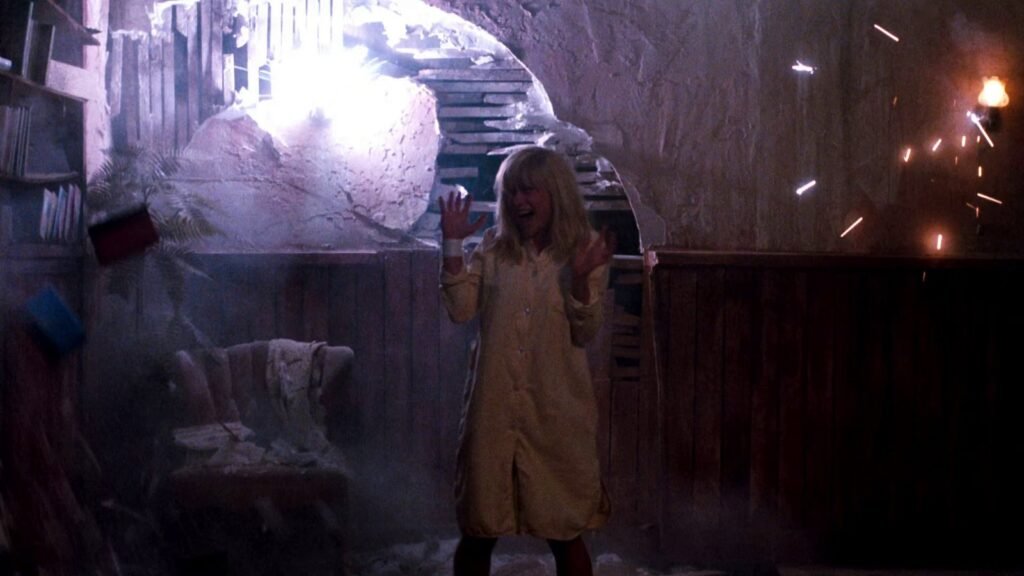
Kristen Parker is the Dream Warrior who could pull sleepers into her dreams — Nancy Thompson’s protégée, and the bridge Freddy burned to reach Alice.
Quick Specs
- Portrayed by: Patricia Arquette (Dream Warriors) and Tuesday Knight (The Dream Master)
- Created by: Wes Craven and Bruce Wagner
- Appears in: A Nightmare on Elm Street 3: Dream Warriors (1987) and A Nightmare on Elm Street 4: The Dream Master (1988)
- Home: Springwood, Ohio
- Mother: Elaine Parker (Brooke Bundy)
- Dream power: Pulling other people into her dreams; in dreams, an Olympic-level acrobat
- Status: Deceased — burned alive in Freddy’s boiler in The Dream Master (1988)
- Series: Nightmare on Elm Street franchise
Dream Warriors: the girl who could pull you in
Kristen Parker is the first face Dream Warriors shows you, and the film’s opening is a trap Freddy builds out of her own body: tormented in a nightmare, she is made to appear to slit her wrists, and her mother Elaine — who cannot see a bogeyman, only a daughter in crisis — commits her to Westin Hills. There Kristen joins the ward of the damned: Phillip, Joey, Kincaid, Will, Jennifer and Taryn, the last children of the parents who burned Freddy Krueger, written off by their doctors as mass hysteria and guilt. What Kristen has that the others do not — yet — is the gift the whole back half of the franchise runs on. Attacked in a nightmare by Freddy in the form of a grotesque giant snake, she panics and does something she has not done since childhood: she pulls — drags the one adult she trusts, new intern Nancy Thompson, bodily into the dream. Nancy, who fights the snake off with a shard of broken mirror, asks the question the next morning: “Have you ever done that before? Pulled someone into your dream.” Kristen had, at four or five years old, pulling her father in with her; by her account and the record’s, the gift went quiet when her father left the family. Hold the mechanism clearly, because the retellings blur it: the pull-in power is Kristen’s own, from childhood. Nancy gave her nothing but training and belief. Nancy’s power ran the other way — pulling things out — and it died with her.
Two items of small print, because this page keeps the record straight. In the original script her name was spelled “Kirsten” — fan references add that the novelization kept that spelling — and the Kristen of the final script arrived with the final draft. And her dream-self deserves its own line in any account of the Warriors: where the others get weapons, personas and brute strength, Kristen’s second gift is her body — in dreams she moves as an Olympic-level acrobat, the group’s gymnast, all wire and momentum where Freddy expects a cornered patient.
Nancy builds the war around Kristen’s gift: group hypnosis, shared dreaming, each patient’s dream-self armed. Then Joey is taken and left comatose, the doctors are fired, and Kristen — sedated, locked in the quiet room — goes in anyway, pulling the group down with her. Taryn and Will die in there. Nancy dies in there too, in Kristen’s arms, stabbed by a Freddy wearing her father’s face, and her last exchange with Kristen is a promise, not a power: Kristen will dream her into a beautiful dream. Kristen walks out of Dream Warriors a survivor next to Kincaid and Joey — the last three of the group standing — with a dead mentor, a living nightmare, and the most dangerous gift on Elm Street. The series would spend its next film taking all three away from her.
The Dream Master: the false protagonist
A year of normal life has not cured her. Kristen — played now by Tuesday Knight, on a recast this page takes up below — is back in school, dating Rick Johnson, friends with his sister Alice, and soothing herself with the cigarettes that will later explain her death to the coroner. Freddy is gone, everyone says. Kristen’s dreams say otherwise, and her gift has become a reflex she cannot switch off: frightened in the night, she pulls Kincaid and Joey into her dreams on instinct, and both of them — out, free, trying to live — berate her for it. Then Freddy resurrects himself in Kincaid’s dream on a night Kristen has forced herself awake, and takes Kincaid, and takes Joey, and Kristen is the last of the three surviving Dream Warriors left. She does what Nancy would have done: she tells the truth, all of it, to Alice and Rick and Dan, standing in the rotting house at 1428 Elm Street. Her mother calls her home to dinner. Her mother has put sleeping pills in her milk.
Print Elaine’s act the way the films present it, because it matters: a misguided attempt to help her daughter sleep, not malice — the last, worst version of every Elm Street parent who cannot see the thing killing their child. (The critical literature goes further; Tony Williams reads Kristen’s death as resulting from Elaine’s complicity, a “sacrificial offering” unconsciously initiated by the parental world. That is an argument about the film, carried here as its author’s, not a plot fact.) Drugged past resistance, Kristen falls — into her beautiful dream, a tropical beach, which Freddy corrupts under her feet. In the labyrinth behind it she panics and pulls Alice in, tries to wake her, apologizes, shields her — and Freddy throws Kristen into his boiler and burns her alive while Alice watches. In the waking world her family sees a body smoking in a bed: a careless smoker’s accident, the story her habit had already written for her. (Her gravestone in the film gives a birth year of 1969; other reference points disagree, and the films never settle it, so this page prints no year as fact.) Dying, Kristen gives Alice her power — but the gift passes through Freddy first, carrying a piece of him into Alice with it, which is the engine of everything Alice becomes: she absorbs Kristen’s traits down to the urge to smoke, and the souls Freddy holds, Kristen’s among them, are freed only when Alice beats him. Kristen’s death is the hinge of the middle franchise: the last Dream Warrior spends herself to arm the Dream Master.
The recast, in the record’s order
Patricia Arquette played Kristen first — at eighteen, in the role that made her name; it was not her debut, which was Pretty Smart a year earlier, at seventeen, and the distinction matters because Arquette was very nearly recast during Dream Warriors itself before director Chuck Russell recognized what she had and vouched for her. Russell, years later: “There was something so interesting, so haunting about her.” Why she did not return has three circulating answers, and this page ranks them the way the evidence does. First, her own: in 2017, Arquette said, “They asked me to come back for [part 4] but at that time I was starting to break into kind of meatier roles… I love the horror genre and the Freddy franchise but I was chomping at the bit to try other things as an actor.” Second, a theory: director Renny Harlin and co-star Rodney Eastman theorized her agent may have asked for too much salary — a theory, offered by men who also said no definite reason was ever stated to them. Third, a speculation that fails its own timeline: that she was pregnant during filming — but Dream Master shot in early 1988 and her son was born in January 1989, while she worked on other films in the same window. The returning cast were disappointed — Eastman and Ken Sagoes both said so — and producer Sara Risher called Arquette “an integral part to Nightmare 3.”
Tuesday Knight, a singer with a debut album already out, auditioned for Harlin, Bob Shaye and Rachel Talalay and was, by her account, hired on the spot. The producers told her to rewatch Dream Warriors and emulate Arquette; Knight thought the written Kristen too much of a “screamer” and victim, and made the role her own instead — a choice she later said Wes Craven himself praised when he called about a New Nightmare cameo, telling her (in her telling) that he had written Kristen as more of a fighter than the finished third film allowed. Knight also wrote the film’s opening theme — “Nightmare,” in the song’s usual title; at least one magazine’s account renders it “Running from this Nightmare” — recorded in two days, uncompensated at the time, a cult favorite finally released as a single in 2015. Sagoes, who had every reason to resent the change, gave the verdict that closes the argument: “I don’t think Tuesday Knight was given enough credit for what she had to do… she stepped in and made Kristen her’s with the highest respect.” Knight’s own summary of the character she inherited and defended: “Kristen encapsulates so much of what women should be today — not a victim, but someone who spoke up for what was right even when people thought she was crazy and, although she got it in the end, went down fighting.”
The bridge
The analysis of Kristen, attributed as analysis should be: she is the transitional figure of the Elm Street saga — the literature on the character notes that, likely because of that transitional nature, she never got the expanded-universe afterlife Nancy and Alice did. Structurally she is a false protagonist, and scholars have mapped the device precisely: Dream Master spends its first stretch driving its plot through Kristen, the survivor the audience naturally expects to lead again, before revealing Alice as the true heroine — a mirror, as Nat Brehmer puts it, of the original film’s Tina-and-Nancy feint, and a gambit others have compared to Psycho‘s murdered Marion Crane. The lists place her respectably — #18 on a BuzzFeed ranking of final girls, top ten in a digital horror magazine’s unranked list, which praised how Arquette “injects an impressive amount of gumption into the part” — and ScreenRant has called Kristen “one of the most beloved and well-remembered characters from the franchise,” in a role “as important as Heather Langenkamp’s Nancy Thompson.” She is not in the later films — not Dream Child, not Freddy’s Dead, not Freddy vs. Jason, and there is no Kristen counterpart in the 2010 remake; when Tuesday Knight appears in New Nightmare, she appears as herself, in a funeral crowd, not as Kristen. Beyond the films she survives mostly in glimpses — flashbacks and mentions in the comics continuations rather than storylines of her own — with two musical footnotes: Arquette’s Kristen headlines the video for Dokken’s “Dream Warriors,” summoning the band to fight Freddy for her, and clips of Knight’s Kristen run through Vinnie Vincent Invasion’s “Love Kills.” In the 1989 computer game she is playable, her ability reduced to a “power kick” — game shorthand for the girl whose real power was never the kick. It was the invitation. Read her in order: Dream Warriors, then The Dream Master — and meet the mentor who believed her first, on the Nancy Thompson page.