
The Satanic Rites of Dracula is Hammer’s eighth Dracula film, where Christopher Lee’s Count plots a plague apocalypse in modern London.
Most vampires want your blood. This one wants the species. By 1973 the Count had been staked, burned, drowned and resurrected so many times that Hammer needed a bigger threat than a sharp piece of wood — so they gave him a property empire, a bacteriologist on retainer, and a vial of bubonic plague aimed at the whole human race. It is the strangest Dracula film Hammer ever made, and it is also a goodbye: the last time Christopher Lee would bare the fangs for the studio that made him, and the last Hammer film he and Peter Cushing would ever make together.
Quick Specs
- Title: The Satanic Rites of Dracula (US release title: Count Dracula and His Vampire Bride)
- Year: 1973 (UK release 13 January 1974)
- Director: Alan Gibson
- Screenplay: Don Houghton
- Producer: Roy Skeggs
- Studio: Hammer Film Productions
- Starring: Christopher Lee, Peter Cushing, Michael Coles, William Franklyn, Freddie Jones, Joanna Lumley, Richard Vernon, Barbara Yu Ling
- Music: John Cacavas
- Cinematography: Brian Probyn
- Running time: 87 minutes (BBFC approx. 88m)
- Country / language: United Kingdom / English
- Series: Eighth of Hammer’s nine Dracula films; Christopher Lee’s seventh and final Hammer Dracula
Seventh and final: counting Lee’s Draculas honestly
Start with the arithmetic, because this is where the internet gets it wrong. Lee played Dracula for Hammer seven times: Dracula (1958), Dracula: Prince of Darkness (1966), Dracula Has Risen from the Grave (1968), Taste the Blood of Dracula (1970), Scars of Dracula (1970), Dracula A.D. 1972 (1972), and this film. Seven. The fan wikis that call Satanic Rites his sixth are miscounting, usually by quietly absorbing The Brides of Dracula (1960) into the run — a film in which Lee does not appear at all, its vampire being David Peel’s Baron Meinster while Cushing’s Van Helsing carries the picture. Brides belongs to the series; it does not belong to Lee’s filmography.
The series itself runs to nine films, which makes Satanic Rites the eighth entry — a different number from Lee’s seventh, and the two are not interchangeable. The ninth and last, The Legend of the 7 Golden Vampires (1974), recast the Count with John Forbes-Robertson after Lee declined; Cushing, notably, still showed up. And “final” needs its qualifier: this was Lee’s last Dracula for Hammer, not his last Dracula ever. He played the Count once more, in the French comedy Dracula and Son (1976). What ends here is the Hammer run — fifteen years, seven films, one definitive performance.
It is also the third time Cushing’s Van Helsing faced Lee’s Dracula, after the 1958 original and A.D. 1972, and the last Hammer film the two men made together. They would reunite once more, a decade later and outside Hammer, in House of the Long Shadows (1983) — but the double act that defined British horror closed its account in a hawthorn bush outside a London country house, which is somehow exactly right.
The story: a spy film with fangs
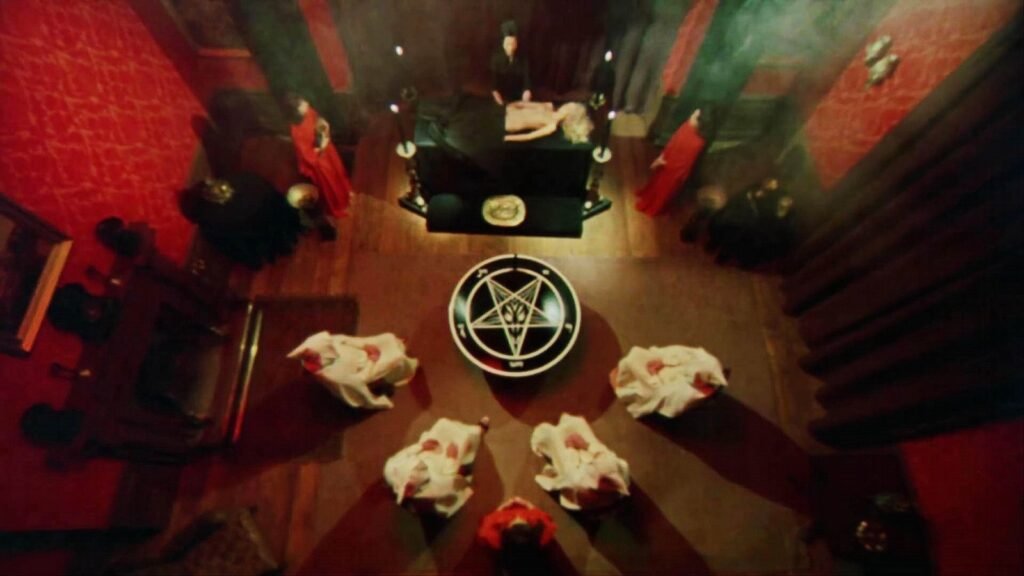
Don Houghton’s script — he wrote A.D. 1972 as well, and Alan Gibson directed both — deliberately mixes horror with science fiction and the spy thriller, and the opening plays it straight as espionage. Secret Service agent Hanson escapes from an English country house where Satanic rituals are being held, and dies of his wounds after naming four prominent cult members: government minister John Porter, Lord Carradine, General Sir Arthur Freeborne, and the celebrated bacteriologist Dr Julian Keeley, all led by a woman named Chin Yang. Of the photographs Hanson took, a fifth seems to show nothing but an empty doorway.
With a minister implicated, discretion matters. Colonel Mathews brings in Scotland Yard’s Inspector Murray to work the case independently, and Murray proposes consulting an occult expert: Professor Lorrimer Van Helsing — a descendant of the original Van Helsing, played by Cushing with the weary patience of a man who has explained vampires to policemen before. The cult, meanwhile, kidnaps the Secret Service secretary Jane and delivers her to Dracula’s bite. Murray, agent Peter Torrence, and Lorrimer’s granddaughter Jessica raid the country house, and Jessica finds Jane chained in the cellar, turned, among other imprisoned female vampires. Murray stakes her and gets the others out.
The threads converge on Keeley. Van Helsing visits his old friend and finds him mentally unstable, hard at work on a virulent new strain of bubonic plague. A guard shoots Van Helsing; he wakes to find Keeley hanged and the bacillus gone. Keeley’s notes point to the 23rd of the month — the “Sabbath of the Undead” — and to his funder, a reclusive property developer named D. D. Denham, whose headquarters stands on the churchyard where Dracula died in the previous film. Van Helsing works it out: the fifth photograph is empty because Dracula cannot be photographed, and Denham is the Count. But the real revelation is motive. Dracula is tired of existing. He means to die — and to take humanity with him.
The endgame: four horsemen and a hawthorn bush
This is the idea that lifts the film out of routine. Dracula’s plan is a suicide plague: his four acolytes — Porter, Carradine, Freeborne, and, in the Count’s design, Van Helsing himself — will carry Keeley’s bacterium out into the world as his “four horsemen.” Jessica, he announces, will be his consort, kept uncorrupted while the species dies around her. When the acolytes balk, Dracula compels Porter hypnotically to break the vial, and the minister is infected on the spot. A fight in the computer room starts a fire; Porter and the bacillus burn, Carradine and Freeborne escape, and Murray rescues Jessica. Earlier, Murray has already dealt with the cellar — Chin Yang is herself a vampire, and after staking her he destroys the remaining female vampires with clear running water from the fire sprinklers, folklore weaponised through office plumbing.
Then the ending everyone remembers, because nothing else in the series looks like it. Dracula pursues Van Helsing outside, and Van Helsing lures him into a hawthorn bush. The Count is entangled in the thorns — hawthorn, the wood of the Crown of Thorns, is old vampire poison — and Van Helsing drives a fence post through his heart. Dracula disintegrates, and Van Helsing retrieves the Count’s ring from what is left. Not the plague, not the fire, not the water: a bush and a fence post, folk magic beating the property empire. After seven films of escalating resurrections, Hammer kills its Dracula with gardening.
The cast: a reunion, a recast, and two men named Mathews
Lee was 50 when production began in November 1972, Cushing 59 — two masters nearing the end of a partnership that had begun fifteen years earlier, and the film leans on their gravity to sell a plot that includes Satanic board meetings. Michael Coles returns as Inspector Murray from A.D. 1972, and William Franklyn plays Secret Service agent Peter Torrence. Freddie Jones, as Keeley, gets the film’s most unsettling material: a brilliant man rotting from the inside, building the end of the world in a laboratory.
The one major cast change is Jessica. Joanna Lumley plays Lorrimer’s granddaughter here, a more mature version of the character Stephanie Beacham played in A.D. 1972 — a straight recast, so do not let anyone tell you Beacham is in this film; she is not. Barbara Yu Ling leads the cult as Chin Yang, Valerie Van Ost is the doomed secretary Jane, and Maurice O’Connell is Hanson, the agent whose death starts the plot. And watch the credits for a trap of Hammer’s own making: the Secret Service colonel is Colonel Mathews, played by Richard Vernon, while the minister John Porter is played by an actor named Richard Mathews. Two different men, both surnames spelled with one T — cast lists have been conflating them for fifty years.
Made under protest
Production began in November 1972 under a working title Lee could not stand: Dracula Is Dead… and Well and Living in London, a parody of the Jacques Brel revue title. It was never a release title anywhere — remember that when you see it attached to the American version, because that is an error in circulation; the American release title was Count Dracula and His Vampire Bride. Lee said so at a 1973 press conference announcing the film, in words that have followed the picture ever since: “I’m doing it under protest … I think it is fatuous. I can think of twenty adjectives – fatuous, pointless, absurd. It’s not a comedy, but it’s got a comic title. I don’t see the point.”
He got his way; the film was retitled, though the French release kept the joke as Dracula vit toujours à Londres. Film historian Jonathan Rigby dates the end of shooting to 3 January 1973 — fifteen years to the day, he notes, after the first Hammer Dracula finished filming. The picture was shot at Elstree, with London location work in South Kensington and Notting Hill, photographed by Brian Probyn and scored by television veteran John Cacavas. The British censor required cuts to the cinema version — the BBFC’s own record confirms cuts were demanded, and its 1973 submission ran 93 minutes before them; the film British audiences saw runs 87.
The long road to the screen
Here is the release history nobody believes the first time. The film premièred in West Germany on 3 November 1973, but British audiences did not get it until 13 January 1974, when Columbia-Warner Distributors put it out on a double bill with Blacula — so the “1973” in its name is its production year, not its British birthday. America waited far longer. Warner Bros. passed on a US release after a 1975 trade screening, the previous film’s soft American returns having cooled their enthusiasm, and the picture sat on a shelf until October 1978, when Max Rosenberg’s Dynamite Entertainment — his 1970s distribution company, not the modern comics publisher of the same name — released it as Count Dracula and His Vampire Bride, heavily edited, with about four minutes, mostly dialogue, removed, bringing it down to roughly 84 minutes. Trade accounts put the New York opening in October 1978; one reference gives a November day instead, and the month is where the honest record sits.
The American version later fell into the public domain in the United States, which is why this film, of all Hammer Draculas, spent decades circulating in rough, grey, multi-generation copies. That battered presentation is a rights accident, not the film’s original state — the BBFC’s modern records list Warner Home Video editions, the 2019 one running 87 minutes 45 seconds, which tells you the picture itself survived in far better shape than its reputation.
What the critics made of it
Reception was cool, then and since. On Rotten Tomatoes the film stands at 33% from six critic reviews, and the spread inside that number is the story: Ken Hanke gave it 0/5 — “Even for a Chris Lee Dracula flick, this is bad” — while other reviewers in the same small set went as high as 3.5/5. AllMovie called it the “least interesting” film in the Hammer Dracula series. Time Out found “a lot of weak action scenes and weaker lines, but still a vast improvement on Dracula A.D. 1972.” Derek Winnert’s modern assessment lands at two stars — “a really odd, weary misfire” — while still recording what the film is: the end of an era for Lee’s Dracula.
Weary is fair. This is a tired series entry, made by a studio in decline, with a leading man who said the quiet part into a microphone. But tired is not the same as empty. The plague plot — Dracula as an extinction event with a boardroom — was a genuinely new shape for the character, the Lee–Cushing scenes carry fifteen years of shared history in every exchange, and the hawthorn bush is the most folkloric death Hammer ever gave its Count. Satanic Rites is where the greatest Dracula run in cinema ends: not with a whimper, whatever the critics said, but with a fence post.