
Taste the Blood of Dracula (1970) is Hammer’s fifth Dracula film, directed by Peter Sasdy, with Christopher Lee as the Count in Victorian London.
The villains of this Dracula film wear top hats and go to church. Three respectable London fathers, bored with charity work and brothels, pay a young Satanist to show them something new. They get more than they paid for, and the vampire they bring back does not go after them. He goes after their children.
Three things to settle first. Lord Courtley, the young aristocrat who performs the ritual, is not Dracula; he is the Count’s disciple, and he dies before Dracula appears. This is the fifth Hammer Dracula film but only the fourth with Lee, because Lee was not in The Brides of Dracula. And there is no Van Helsing and no Peter Cushing: the hero is a young man named Paul.
Quick Specs
- Directed by: Peter Sasdy
- Screenplay by: John Elder (pseudonym of Anthony Hinds)
- Produced by: Aida Young
- Production company: Hammer Film Productions
- Starring: Christopher Lee, Geoffrey Keen, Linda Hayden, Peter Sallis, John Carson, Ralph Bates
- Cinematography: Arthur Grant
- Music: James Bernard
- Released: 1970
- Runtime: 95 minutes (UK); 91 minutes (US cut)
- US rating: GP on first release
- Series place: Fifth Hammer Dracula film; fourth with Lee as the Count
- Country: United Kingdom
The Cast
Christopher Lee plays Count Dracula for the fourth time. After the silent Count of Dracula: Prince of Darkness and a few lines in Dracula Has Risen from the Grave, he speaks here only briefly; one count puts it at around ten lines.
The three gentlemen are the film’s real centre. Geoffrey Keen plays William Hargood, a drinker and a tyrant at home. Peter Sallis is Samuel Paxton, and John Carson is Jonathon Secker (also spelled Jonathan). Gwen Watford plays Hargood’s wife, Martha.
Their children carry the second half of the film. Linda Hayden plays Alice Hargood, William’s daughter, and Anthony Higgins, credited as Anthony Corlan, plays Paul Paxton, Samuel’s son and Alice’s sweetheart. Isla Blair is Lucy Paxton, Paul’s sister, and Martin Jarvis is Jeremy Secker, Jonathon’s son and Lucy’s fiance.
Ralph Bates plays Lord Courtley, the young Satanist who sets everything in motion. Roy Kinnear is Weller, the businessman who finds Dracula’s remains, and Michael Ripper plays Inspector Cobb.
The Plot
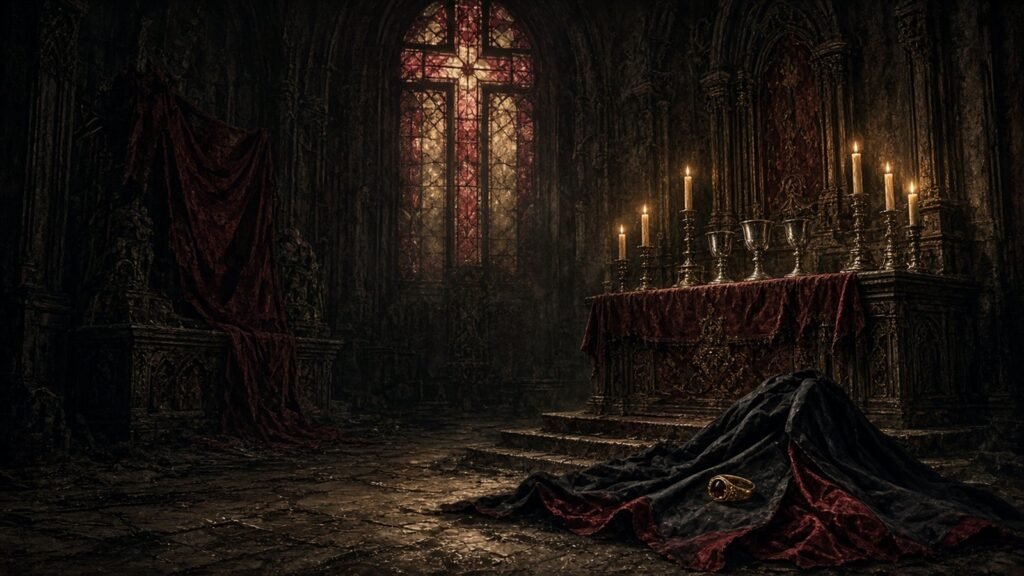
The film opens in Eastern Europe. A travelling businessman named Weller is thrown from his carriage and knocked out. When he comes round, he sees a caped figure screaming in agony with a large cross through his back, then crumbling to dust. Among the remains Weller finds a ring, a cloak, a clasp and dried blood. On the clasp is the name Dracula.
In London, three gentlemen, William Hargood, Samuel Paxton and Jonathon Secker, keep up a front of charitable work while secretly visiting a brothel. There they meet Lord Courtley, a young aristocrat and Satanist, who promises them experiences they will never forget if they buy Dracula’s relics from Weller.
They do, and they meet Courtley at a desecrated church for a Black Mass. He pours the dried blood into goblets, mixes in drops of his own, and tells the three men to drink. They refuse. Courtley drinks it himself, screams and falls. When he grabs at Hargood’s legs, the three men panic and kick and beat him to death, then run. Behind them, Courtley’s body is covered in dust, the dust cracks, and Dracula steps out of it. He vows that the men who killed his servant will die.
Hargood, drunk and furious that his daughter Alice is still seeing Paul, treats her harshly. She runs from the house, and Dracula takes control of her. Under his spell she kills her father with a shovel, and Dracula intones, “The first.”
At Hargood’s funeral Alice draws in Lucy, Paul’s sister. That night she brings Lucy to the church and introduces her to a dark figure Lucy takes for Alice’s lover. It is Dracula, and he makes Lucy a vampire. She is the only one of the young people he turns.
Paxton and Secker go to the church looking for the missing girls. Courtley’s body is gone, but they find Lucy asleep in a coffin with marks on her throat. Secker moves to stake her, and Paxton, unable to bear it, shoots him in the arm. Secker escapes. When Paxton finally finds the nerve to do it himself, Lucy wakes, Dracula appears, and Alice holds Paxton down while his own daughter drives the stake into him.
That night Lucy finds her fiance Jeremy, bites him, and sends him to kill his father; Jeremy stabs Secker to death. The film leaves open whether Jeremy has become a full vampire. A version of the scene in which he plainly does was filmed but cut. Lucy, eager for Dracula’s approval, gets something else: he drains her himself.
All three fathers are dead, and Paul is left to fight. He goes to the church, bars the door with a cross and restores the altar, turning the place back into a house of God. When Dracula arrives with Alice, Paul faces him with a cross. Alice, still under the spell, takes it from him. Dracula dismisses her and tries to leave, but the cross on the door stops him. Up on the balcony he backs into a stained-glass window in the shape of a cross. The church fills with the Lord’s Prayer in Latin, and the Count, overwhelmed by the holy place around him, falls onto the altar and crumbles into dust. Alice, free of Dracula at last, walks out with Paul.
A Dracula Film Written Without Dracula
Taste the Blood of Dracula was not meant to have Dracula in it. Lee was increasingly reluctant to keep playing the Count, and Hammer planned to replace him with Courtley: Ralph Bates’s character would rise as a vampire after his death and take revenge on the three men himself. Warner Bros., which was distributing, refused to release the film without Dracula in it. Hammer persuaded Lee to come back, and the Count took over the role of the resurrected Courtley.
The join shows. Dracula appears only after a long first act, and once he is back the story is driven by the people he controls more than by the Count himself. Reviewers have said so since 1970; one called him “reduced almost to an onlooker in the proceedings.”
The Fathers Are the Monsters
What makes the film different is where it puts the evil. For once the respectable characters are the problem. The three fathers are hypocrites who buy a Satanist’s thrill, kill him when it goes wrong, and run; their children pay for it. Critics have read it as a story about Victorian hypocrisy and about the generation gap of 1970, with the young people as the ones who finally walk free. One fiftieth-anniversary retrospective called it “perhaps the first of the Dracula pictures to reflect the era it was released in.”
It also moved the series. The earlier Lee films were set in Dracula’s homeland; this one takes him to Victorian London. And it brought in a new director, Peter Sasdy, making his feature debut. Sasdy went on to make Countess Dracula (1971) and Hands of the Ripper (1971) for Hammer.
Making It
Arthur Grant, who had shot Dracula Has Risen from the Grave, photographed this one too, but without that film’s coloured filters, so the look is closer to the classic Hammer style. James Bernard wrote the score.
Two pieces of the film were changed after shooting. The gentlemen’s visit to the brothel was heavily cut on the original release and restored for DVD. The alternative version of Lucy biting Jeremy, in which he clearly turns, was filmed but not used, probably to avoid adding a third vampire to an already crowded story.
Release and Reception
The film came out in 1970, on a double bill with another Hammer film, Crescendo, in Britain, and with Trog in the United States, where the double bill reached number one. Its British release is dated May 7 in some accounts and June 7 in others, and its American one June 7 or September 16. In the US it was rated GP, the forerunner of PG.
Opinion has always been split. Some reviewers count it among the best of Hammer’s Dracula films, and one retrospective ranked it “one of the best of the eight films in Hammer’s Dracula franchise.” Others, including some of its admirers, find the ending among the weakest in the series. Rotten Tomatoes lists it at 57 percent from 14 reviews.
What Came Next
Hammer followed it within months with Scars of Dracula, also released in 1970, with Lee back again and a new director, Roy Ward Baker. That film does not continue this one’s story. Taste the Blood of Dracula remains the series’ great swerve: a Dracula film where the Count is almost a guest, the fathers are the villains, and their children pay for their sins. For where Hammer’s Dracula began, see Dracula (1958).