
Scars of Dracula (1970) is Hammer’s sixth Dracula film, directed by Roy Ward Baker, with Christopher Lee as the Count in Transylvania.
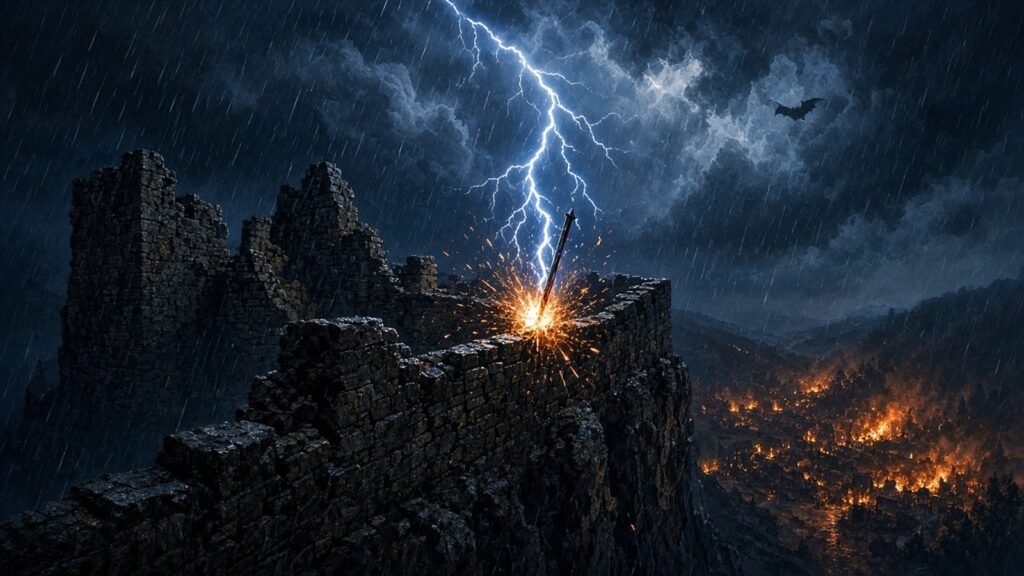
Most vampire stories end with a stake. This one ends with the weather. After a whole film of heated blades, bats, acid baths and a man trapped in a room with no door, Hammer’s Count is finally brought down by a bolt of lightning, drawn straight to the iron spike in his own hand.
Three things to settle first. This is the sixth Hammer Dracula film but the fifth with Lee, who was not in The Brides of Dracula. It does not carry on from Taste the Blood of Dracula, released earlier the same year; that film ended in a church near London, and this one opens in Dracula’s castle with no explanation of how he got back there. And there is no Van Helsing and no Peter Cushing. Dracula’s opponents this time are two brothers, a young woman and a village priest.
Quick Specs
- Directed by: Roy Ward Baker
- Screenplay by: John Elder (pseudonym of Anthony Hinds)
- Produced by: Aida Young
- Production company: Hammer Film Productions
- Starring: Christopher Lee, Dennis Waterman, Jenny Hanley, Christopher Matthews, Patrick Troughton
- Cinematography: Moray Grant
- Music: James Bernard
- Released: November 8, 1970 (United Kingdom); December 23, 1970 (United States, limited)
- Runtime: 91 minutes
- US rating: R, the first of several Hammer films rated R
- Budget: Between 186,000 and 200,000 pounds
- Series place: Sixth Hammer Dracula film; fifth with Lee; the last of his period Dracula films
The Cast
Christopher Lee plays Count Dracula, and this time he has a real part. After the silent Count of Dracula: Prince of Darkness and the near-cameo of Taste the Blood of Dracula, Scars gives Lee more to do and say than any Hammer Dracula film except the first, Dracula (1958).
Dennis Waterman plays Simon Carlson, the steadier of two brothers, and Christopher Matthews is the other, Paul, a libertine who runs into trouble. Jenny Hanley plays Sarah Framsen, Simon’s fiancee and the woman Dracula wants next.
Patrick Troughton plays Klove, Dracula’s servant. He shares a name with the servant in Prince of Darkness, but the film never says he is the same man, and a different actor plays him. Anouska Hempel is Tania, a woman Dracula keeps as his mistress and his prisoner. Michael Gwynn plays the village priest, Michael Ripper the landlord of the tavern, Wendy Hamilton the waitress Julie, Delia Lindsay the Burgomaster’s daughter Alice, and Bob Todd the Burgomaster.
The Plot
Dracula’s remains lie on a stone slab in a chamber high in his castle, reachable only through a window. A large bat flies in and drips blood onto them, and within seconds the Count is whole again. The film never explains how his remains got there.
The villagers below have had enough. Another young woman has been murdered, and with the priest’s blessing they march up and set fire to the castle. Dracula sleeps safely in his stone chamber. When the men get home, they find that every woman in the village has been slaughtered in the church by vampire bats.
Elsewhere, Paul Carlson is falsely accused of rape by the Burgomaster’s daughter and runs from the authorities. He escapes on a coach that turns out to have no driver, is thrown off, and ends up at a tavern, where he is thrown out. In the forest he finds the driverless coach again, and Klove drives it back to the castle.
At first Paul is welcomed by the Count and by Tania. She is in fact Dracula’s prisoner, kept as his mistress. Paul spends the night with her, and when it is over she tries to bite his neck. Dracula walks in, brushes Paul aside, and stabs Tania through the heart with a dagger for betraying him, then drinks from her wounds. Klove cuts up her body and dissolves it in a bath of acid. Paul is locked in a room high in the castle, and he is not seen alive again.
Paul’s brother Simon and Simon’s fiancee Sarah come looking for him, and the waitress Julie points them to the castle. Dracula has designs on Sarah at once. But Klove has fallen for her after seeing her photograph among Paul’s things, and when Dracula orders him to take away Sarah’s crucifix, he refuses and helps the couple escape. Dracula punishes him by burning him with a heated blade.
Simon goes back with the priest. The priest is killed by a vampire bat, and Klove, wavering again, betrays Simon into the same doorless room where Paul was held. There Simon finds the Count asleep in his coffin, but Dracula’s power overwhelms him before he can act. When he recovers, he finds Paul’s drained body hanging on a spike (some accounts say a hook), and through the window he watches Dracula climb the castle wall like an insect.
Klove lets down a rope, and Simon climbs out after Sarah, who has made her way to the battlements as a storm comes in. Dracula has his bat tear away her crucifix. Klove turns on his master at last and attacks him with the dagger that killed Tania, but Dracula throws him over the side of the castle.
Simon pulls a loose iron spike from the battlements and hurls it. It goes into Dracula’s body but misses his heart, and the Count pulls it out and raises it to run Simon through. Lightning strikes the spike. Dracula bursts into flames, staggers, and falls from the battlements to the ground far below, where his body goes on burning. Simon and Sarah survive.
The Most Stoker-Like Lee Film
Scars has a poor reputation, but it put back several things from Bram Stoker’s novel that the earlier Hammer films had left out. The Count is introduced as an icily charming host, he commands the animals of the night, and he scales the walls of his own castle like an insect, an image taken from the novel. Combined with the extra dialogue, it gave Lee his most complete Count since 1958.
It also brought back the castle setting after Taste the Blood of Dracula’s trip to London, and it was the last of Lee’s period Dracula films for Hammer. The next one, Dracula A.D. 1972, took the Count into the present day.
Making It
Scars of Dracula came out of a change of partners. Warner Bros., which had backed Taste the Blood of Dracula, would not finance or distribute it, so EMI Films paid for it and took over distribution in Britain, and a small company, American Continental, released it in the United States. Roy Ward Baker directed, Moray Grant shot it, and Anthony Hinds wrote it under his usual pseudonym, John Elder. It was made at Elstree Studios, with location work in Hertfordshire. The budget is put at between 186,000 and 200,000 pounds.
In the United States it became the first of several Hammer films to be rated R.
Release and Reception
Scars of Dracula opened in Britain on November 8, 1970, and had a limited American release on December 23, 1970. In some markets it played on a double bill with The Horror of Frankenstein, another Hammer film.
Critics were mostly unkind, then and later. Contemporary reviewers called it one of the weaker entries, too padded and too cruel, and later histories of the genre have often treated it as the point where the series’ decline became plain. It has defenders, too, who point to Lee’s larger role and the restored touches from Stoker. Rotten Tomatoes lists it at 67 percent from 12 reviews.
Where It Fits
Scars of Dracula is the hinge between two Hammer Dracula eras. It is the last of Lee’s gothic, period Dracula films that began in 1958, and it is the one that gave Lee the most to work with since the first. After it, Hammer sent the Count to modern London. Whatever its reputation, it has one of the most memorable endings of the run: a vampire who survives fire, a spike and his own servant’s dagger, and is undone by a storm. For the studio’s full story, see the Hammer Films page.