Poltergeist (1982) is Tobe Hooper’s suburban supernatural horror film about a family whose youngest daughter is abducted by ghosts through their television.
The most frightening room in horror is not a crypt, a castle or a cabin in the woods. It is a child’s bedroom in a nice new house, on a nice new street, where the television has been left murmuring to itself after the station signs off. Poltergeist understands that from its first quiet minutes. Before anything impossible happens, it gives us a family worth keeping: parents who tease each other, children who squabble, a dog with opinions, a pool half-built in the yard and a neighbourhood so fresh the trees have not yet learned to shade it. Then the static starts answering back.
Welcome back to the crypt. Some classics survive on reputation; this one survives because the machinery still works. The jokes land, the house feels lived in, and when five-year-old Carol Anne Freeling kneels before that bright, buzzing screen and announces the most famous weather report in horror — “They’re here” — the film has already done the hardest part of its job. It has made the impossible feel like it wandered in through the front door and sat down at the kitchen table.
Watch the Trailer
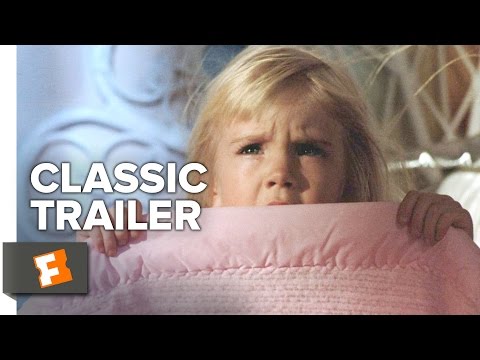

Quick Specs
- Director: Tobe Hooper
- Writers: Steven Spielberg, Michael Grais and Mark Victor
- Starring: JoBeth Williams, Craig T. Nelson, Heather O’Rourke, Zelda Rubinstein and Beatrice Straight
- Studio: Metro-Goldwyn-Mayer
- Release date: June 4, 1982
- Runtime: 114 minutes
- Rating: PG
- Verdict: 4.5 ravens — one razor blade short of perfection
The Review
The Freelings live in Cuesta Verde, a planned California community that Steve Freeling helps sell for developer Mr. Teague. Steve (Craig T. Nelson) and Diane (JoBeth Williams) have three children — Dana, Robbie and Carol Anne (Heather O’Rourke) — and the easy, noisy intimacy of a family that actually likes itself. The haunting begins at the scale of a prank. Carol Anne talks to the “TV people” in the post-sign-off static. Silverware bends. Chairs arrange themselves into a pyramid when Diane turns her back. The film lets Diane laugh at first, and that laughter is a trap for the audience as much as for her: we file the disturbances under “remarkable” a beat too long, the way she does.
Then a storm rolls over Cuesta Verde, Robbie’s two private terrors — the gnarled tree outside his window and the clown doll on his chair — come due in the same night, and Carol Anne is pulled into her closet and gone. What remains is her voice, small and frightened, travelling through the television. A university parapsychology team led by Dr. Lesh (Beatrice Straight) moves in with cameras and recorders and documents plenty, but documentation is not rescue. The rescue requires Tangina Barrons (Zelda Rubinstein), a medium who walks into the Freeling home, takes the measure of what is on the other side of its walls, and explains the film’s terrible geometry: the house is a passageway, Carol Anne is being held there, and something powerful is keeping her because her light is the brightest thing that has ever crossed its darkness.
What follows is the rare blockbuster haunting that keeps its eyes on the parents. Diane goes in after her daughter — literally, through the closet and out of the living-room ceiling, tethered by a rope and by JoBeth Williams’ refusal to play any of it as less than real. The family gets Carol Anne back. Tangina pronounces the house clean. And then Poltergeist performs its cruelest and best trick: it lets everyone believe her, settles the house into one more ordinary evening, and opens the ground underneath the whole subdivision. Cuesta Verde was built over a cemetery. The headstones were moved. What was under them was not.
What Works
- The family comes first, and everything terrible feeds on it. The opening stretch is domestic comedy — football on television, neighbours’ remotes warring through the wall, Diane remembering her younger, wilder self for a delighted Steve. None of it is throat-clearing. It is the fuel. Because the Freelings are drawn as people rather than victims-in-waiting, every later scene has something specific to threaten, and the parents’ grief in the middle act plays as grief, not as plot. Horror about children usually reaches for the parents’ panic. This film earns their love first, then spends two hours endangering it.
- The escalation is a masterclass. Static. Bent forks. Stacked chairs. A tree that has been rehearsing its menace in plain sight since the first reel. A clown doll the camera teaches you to check for, so that the one shot where the chair is empty lands like a thunderclap. Hooper and his collaborators build the haunting in increments small enough to deny and large enough to fear, and they keep finding the uncanny inside the ordinary — a television, a closet, a half-dug swimming pool filling with rain. By the time the closet opens into light, the film has retrained your eye so thoroughly that a bright doorway is the most frightening image in it.
- JoBeth Williams gives the performance the whole film hangs on. Diane begins as the household’s spark — funny, flirtatious, game for the impossible when it still looks like a parlour trick — and Williams walks her down into terror without ever switching characters. Her demonstration of the kitchen phenomena, half-giddy, is the film’s thesis in miniature: wonder and dread are the same door opening in two directions. When the door takes her daughter, her resolve is total and entirely unglamorous. Craig T. Nelson matches her with a slower burn — the salesman who sold this ground, learning what was buried under his own pitch — and his final confrontation with Teague carries the film’s moral weight in a single scene.
- The effects still have hands. However spectral the imagery gets — the hand reaching out of the static, the elongated apparition descending the stairs, the closet’s devouring light — it is photographed as something happening in a room, to furniture, to people. The set pieces have weight, weather and consequence: a rope pulled taut between worlds, a tennis ball that goes in one door of reality and drops out of another, mud, rain and coffins arriving with the blunt physics of a flood. Jerry Goldsmith’s score completes the spell, wrapping Carol Anne’s theme in the cadence of a lullaby and then letting the orchestra show its teeth underneath it. This is a haunting scored like a child singing to herself in a house that is singing back.
- Zelda Rubinstein walks off with the third act in a handbag. Tangina could so easily have been camp — the tiny medium with the enormous certainty — and Rubinstein instead plays her as a professional among amateurs: brisk, kind, unimpressed by death and absolutely unwilling to waste a sentence. Her house-cleaning monologue, describing a world between worlds and a beast holding a child’s light, is the film’s most quoted stretch after “They’re here,” and it works because she delivers metaphysics the way a surgeon delivers instructions. You believe the procedure because she plainly does.
What Doesn’t
- The middle act explains more than it needs to. Once the parapsychologists arrive, the film briefly trades dread for documentation — equipment, theories, recorded phenomena — and while Beatrice Straight’s weary authority keeps the scenes alive, the momentum dips. The investigation tells us the haunting is real long after the film has already proved it beautifully, and the machinery of proof is simply less interesting than the family it is parked inside.
- A few effects have gone translucent with age. Most of the film’s wonders hold because they were built to be photographed, but some of the spectral apparitions now show their optical seams — figures a little too transparent, edges a little too patient. It never breaks the film; the performances refuse to let it. But on a modern screen the best sequences and the most dated ones sit side by side, and the difference is visible.
- The climax rescues Carol Anne twice. The crossing is the emotional summit, and the film knows it — which makes the final night’s second siege feel, in part, like an encore the story has to justify. It justifies it with the cemetery revelation and the finest sustained chaos in the picture, coffins through the floorboards and the house folding into its own light. But the shape is still a repeat: the beast returns, the parents fight it in the same rooms, the family flees a house we had already watched them win back.
- Teague arrives late to his own villainy. James Karen is perfectly cast — all developer’s sunshine and plausible deniability — but the film holds its human villain at arm’s length until the closing minutes, so the revelation about the cemetery lands as a superb twist rather than a theme the film has been prosecuting all along. The pieces are on the board from the start: Steve sells these houses. A version of this film that leaned on that guilt a little earlier might have cut even deeper.
The ledger, for the record: made for $10.7 million, Poltergeist took in about $76.6 million at home and about $121.7 million worldwide — the highest-grossing horror film of 1982 and the eighth-highest-grossing film of the year in any genre. It earned three Academy Award nominations, for Jerry Goldsmith’s score, for sound effects editing and for visual effects, and it has been scaring the furniture around ever since. Numbers like that usually describe a product. This one describes an ambush: audiences walked in expecting a summer ghost story and walked out checking their own closets.
A word on the credit, because no honest file on this film can skip it. Tobe Hooper is the director of record — that is the credit on the film, and it is the credit the Directors Guild examined and left exactly where it was. Steven Spielberg produced the film, co-wrote it, and was on the set a great deal, at a moment when his contract kept him from directing another picture while E.T. was in production; crew accounts of who shaped which scenes have disagreed ever since, and the only formal ruling anyone ever made on the matter concerned the size of a trailer credit. The dispute is real. What it is not is a verdict. The film on the screen is the film Hooper is credited with directing, and the crypt’s own Tobe Hooper file tells the longer story of the strangest argument in horror.
Full disclosure, as the crypt’s rules require: Think Horror’s verdicts are the desk’s own, from our own screenings, with the wider critical and audience weather consulted for calibration. The weather on this one is warm and has been warm for forty years — and for once the crypt’s only quarrel with it is a matter of degrees. That is also why this Poltergeist 1982 review lands where it lands: the wonder is real, and so are the seams.
The Verdict: Poltergeist earns 4.5 ravens — one razor blade short of perfection. A family film in the way a bear trap is a piece of furniture: warmly made, beautifully performed, engineered to close on the people you love most. Its investigation sags, its climax doubles a rescue it had already perfected, and a handful of apparitions have faded at the edges — and none of that dims the central achievement. For long stretches, this is as well as a haunted-house film can be built. The static still sounds like somebody breathing on the other side of it.
Trivia & Facts
- It nearly wore an R. The ratings board first gave Poltergeist an R; Spielberg and Hooper appealed, and the rating was lowered to PG. The PG-13 category did not exist until 1984 — this film, with its face-peeling hallucination and its child in the walls, is one of the titles that taught the industry why it needed one.
- “They’re here” belongs to Carol Anne. The line is Heather O’Rourke’s, delivered to the television static in the small hours — two words and a plural that turned a household appliance into horror’s most famous doorway. Treat any retelling that hands the line to anyone else as a haunting by error.
- The director dispute had exactly one formal price tag. When the credits quarrel reached an arbitrator, the ruling was narrow: the size of Spielberg’s credit in the trailer. MGM/UA paid Hooper $15,000 over it. The directing credit itself was examined by the Directors Guild and stayed with Hooper.
- Goldsmith scored it as a lullaby first. Carol Anne’s theme is built to sound like something sung to a child at bedtime, which is why its returns throughout the film feel less like cues than like the house humming. The score brought Goldsmith one of the film’s three Academy Award nominations.
- The villain is a shortcut in a real-estate file. No ancient curse drives the plot — a developer moved the headstones and left the bodies, and sold the ground over them to families. The haunting is paperwork with a body count, which is why Steve’s guilt, the salesman confronted with his own inventory, gives the climax its bite.
- It started a three-film series — and the “curse” is a superstition. Poltergeist II: The Other Side followed in 1986 and Poltergeist III in 1988. The darker legend that later grew around the series is a superstition the production never endorsed, built on real tragedies and repeated as folklore. The crypt records it as folklore, and leaves it there.
Harper’s Extras
- The full file is open. Our Poltergeist (1982) wiki file carries the complete plot, cast and production record — including the rating fight and the credit dispute laid out in full.
- Two films, one director of record. Pair this with our Texas Chain Saw Massacre review and you have the strangest double bill in American horror: the same director, eight years apart, making the rawest film of the seventies and the glossiest haunting of the eighties — and both of them, underneath everything, about families and the houses that eat them.
- What the crypt is watching. The television in this film is a doorway, a babysitter and a threat all at once, in 1982, before the screen moved into every pocket. Rewatch the static scenes with your own dark television behind you and try not to glance at it during the quiet parts. Nobody manages it. That reflex is the film’s real special effect, and it has not dated a day.
Where to Watch
As of November 8, 2026, Poltergeist streams free on Pluto TV in the US. It is also available to rent or buy on Prime Video, the Apple TV Store and Fandango.
FAQ
Who actually directed Poltergeist?
Tobe Hooper is the credited director, and the Directors Guild examined the credit at the time and left it with him. Steven Spielberg produced and co-wrote the film and was unusually present during production; accounts of exactly who shaped individual scenes differ, and the honest answer is that the dispute is part of the record while the credit is a settled fact.
Is Poltergeist too scary for children?
It is rated PG — a rating it received on appeal in 1982, before PG-13 existed — and it contains a child abduction, intense supernatural attacks and one notorious hallucination sequence involving a bathroom mirror. Many families treat it as a first “real” horror film; the crypt’s advice is to know your child, because the film’s scares are aimed directly at the fears children actually have: the dark, the closet, the toy on the chair.
Is the “Poltergeist curse” real?
No. It is a superstition that grew up around the series after real losses, and the production never endorsed it. The tragedies were real; the curse is folklore, and the two should never be confused.
Do I need to see the sequels?
No. The 1982 film is complete on its own. Poltergeist II: The Other Side (1986) deepens the mythology of the Beast and Poltergeist III (1988) moves the haunting to a Chicago high-rise, but everything essential — the family, the house, the light — is here.
That is tonight’s file, fiends: the house that ate the American dream and left the television on. Until next time — turn your screens dark when you sleep, be kind to the static, and if the youngest voice in the house starts answering somebody you cannot hear, believe her the first time. Sleep tight.
The weekly roundup
One letter a week, from the crypt.
- New reviews, with the ravens
- New wiki entries and news
- Cool stuff worth your night
Weekly. No spam, unsubscribe in one click.