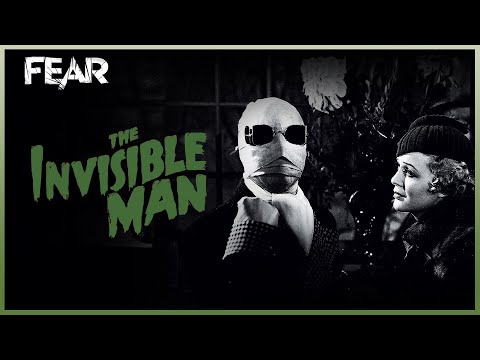
The snow is coming down sideways in Iping, and you are cold to the bone. You push open the door of the Lion’s Head Inn, and the warmth hits you like a hand — firelight, pipe smoke, the smell of beer and wet wool — and then you see him. A man in the corner, face swathed in bandages, eyes hidden behind dark goggles, gloves on his hands, a scarf wound up to his nose. He does not look up. He does not speak. The landlady leans in and whispers that he turned his room into a chemistry laboratory, that he wants to be left alone. You take your seat by the fire anyway. You should not have.
He is going to show you what is under those bandages, horror lover. And when he does, you will wish you had stayed out in the snow.
Welcome to the Lion’s Head. Pull up a chair. This is the one where the monster is standing right in front of you, and you still cannot see him.
The Invisible Man (1933) is James Whale’s pre-Code Universal classic about a chemist whose invisibility drug drives him mad.
Quick Specs
- Director: James Whale
- Screenplay: R. C. Sherriff (credited screenplay)
- Starring: Claude Rains (Dr. Jack Griffin), Gloria Stuart (Flora Cranley), William Harrigan (Dr. Arthur Kemp), Henry Travers (Dr. Cranley), Una O’Connor (Jenny Hall), Forrester Harvey (Herbert Hall), Dudley Digges (Chief of Detectives), E. E. Clive (Police Constable Jaffers), Dwight Frye (Reporter)
- Music: Heinz Roemheld
- Cinematography: Arthur Edeson
- Editor: Ted Kent
- Producers: Carl Laemmle Jr.
- Production Company: Universal Pictures Corp.
- Premiered: November 1933 (commonly dated November 13, 1933)
- Runtime: 71 minutes
- Rating: Unrated (pre-Code)
- Budget: $328,033 final cost after effects work, as reported in Universal Horrors (via Wikipedia)
- Box Office: No total gross exists — see the review. New York’s Roxy took $26,000 in three days; Los Angeles played to nearly empty houses
The Review
Every great monster starts with a wish, and this one starts with a wish a rational man should never make.
H. G. Wells published The Invisible Man in 1897, and Universal had been circling it since the early 1930s. After Dracula (1931), Richard L. Schayer and Robert Florey suggested Wells’s novel as a follow-up; the Laemmles chose Frankenstein (1931) instead. Universal bought the film rights from Wells on September 22, 1931, for $10,000 — and then the project spent two years cycling through directors and writers like a haunted house changing hands. Whale first, then Florey, Cyril Gardner, E. A. Dupont, then Whale again. The drafts piled up: Florey and Garrett Fort’s outline, drawn mostly from Philip Wylie’s 1931 novel The Murderer Invisible, featured an invisible octopus, invisible rats, and blowing up Grand Central Station. Preston Sturges wrote a draft about a Russian chemist making a madman invisible for vengeance on the Bolsheviks — and was fired the day after he handed it in. R. C. Sherriff, who called Sturges’s version “a sort of transparent Scarlet Pimpernel,” wrote the final script at his home in London, disregarding Universal’s request to draw on Wylie and the earlier drafts. At least nine writers touched the script, by one count. Wells demanded approval as a condition of the sale, and he gave it — including to Sherriff’s biggest change. In the novel, Griffin’s madness comes from obsessive ambition and alienation. In the film, the drug that makes him invisible also drives him insane. Sherriff recalled Wells agreeing “entirely that an invisible lunatic would make people sit up in the cinema more quickly than a sane man.” The name “Jack” is the film’s invention too — Wells’s novel never gives Griffin a first name.
The casting is a story in itself, and it is the reason the film works. Boris Karloff was the intended star, announced for the role as early as December 1931 — and he left the picture by June 1933 over a salary and contract dispute with Universal. He was not fired, whatever the retellings say; the money was the problem. James Whale considered Colin Clive for the part, and one account says Clive turned it down. Whale’s choice instead was a man nobody in Hollywood had heard of: Claude Rains, a London stage actor Whale had first seen in a 1923 performance of The Insect Play. Whale tracked down Rains’s screen test for A Bill of Divorcement, which Rains himself called “terrible.” Universal at first discouraged casting an unknown in the lead. Then Rains read the scene where Griffin boasts to Kemp of ruling the world — and the studio approved, signing him to a two-picture deal with top billing. This was Rains’s first Hollywood film. He had appeared in one earlier silent film, but this was the performance that made him, and it did it with a face the audience almost never sees. Rains is visible clearly only at the very end, for about twenty seconds. The rest is bandages, voice, and a stunt double for the elaborate sequences. When Rains asked Whale if he could act more with his eyes, Whale answered: “But Claude, old fellow, what are you going to do it with? You haven’t any face!”
That voice is the film. Rains gives Griffin a cultured, musical menace — half drawing-room gentleman, half raving lunatic — and Whale builds the whole picture around it. The story is simple enough to tell by firelight. On a snowy night, a stranger with his face swathed in bandages takes a room at the Lion’s Head Inn in Iping, Sussex, and turns it into a chemistry laboratory. The innkeeper’s wife, Jenny Hall — played by Una O’Connor at full, shrieking volume — sends her husband to evict him. The stranger throws Hall down the stairs, and when the police and the villagers confront him, he unwraps his face and shows them what is underneath: nothing. Laughing maniacally, he strips off his clothes and drives them off into the night. He is Dr. Jack Griffin, a chemist who found invisibility through an obscure drug called monocane — the spelling varies by source, and this review uses the one most film references use — and the drug has eaten his mind. His fiancée Flora, daughter of his employer Dr. Cranley, is distraught at his long absence. Cranley and Griffin’s other assistant, Dr. Kemp, search the empty laboratory and find only a note listing chemicals including monocane — which Cranley knows is extremely dangerous, because an injection of it drove a dog mad in Germany. Griffin, it seems, never knew.
What follows is a reign of terror, and Whale directs it like a man who knows exactly how funny horror can be. Griffin forces Kemp to become his visible partner in a plot to dominate the world, beginning with “a few murders here and there.” He derails a train. He throws searchers off a cliff. He promises Kemp, with awful politeness, that he will murder him at ten o’clock the next night. And through it all, the film keeps winking: the village panic, the stolen bicycle, the policeman who insists the whole affair is a hoax, the landlady’s endless screaming. This is the other half of Whale’s genius, the half that separates him from every other horror director of the era — he understood that a monster is scarier when the people around him are allowed to be ridiculous. The comedy does not undercut the horror. It sharpens it, because it makes the village feel real, and Griffin’s cruelty feel worse by contrast.
The craft is where the film becomes a landmark, and it is worth knowing how it was done — because the story Universal told the press at the time was a lie. The studio’s press clips claimed the invisibility effects were done with mirrors. They were not. The real method belonged to effects chief John P. Fulton, who described it himself in the September 1934 issue of American Cinematographer. Scenes were shot against a completely black set, walls and floors covered in black velvet to kill reflections. The actor was covered head to foot in black velvet tights and wore whatever clothes the scene required. From that negative, a print and a duplicate negative were made and intensified to serve as mattes, and the composite was printed by masking off the area where the invisible man’s clothing was to move. Then almost all of the effects footage was retouched by hand, frame by frame, with dark dye to hide imperfections. Fulton’s own figure for the scale of it: approximately 4,000 feet of film received individual hand-work treatment, “making approximately 63,000 frames which were individually retouched in this manner.” A second account independently puts it at over 63,000 frames doctored by hand. The partial invisibility — the unwrapping — was the trickiest part: Rains’s own head is hidden below his collar while the bandages come off a thin wire frame. Props moving “by themselves” were pulled on wires by booms or dollies. And the footprints in the snow, the shot everyone remembers, were not stop-motion at all: Fulton dug a trench along the footprint line, covered it with a board in which footprints had been cut, filled the openings with the wooden cut-out outlines supported by pegs, looped a rope around the pegs, covered the board with snow-material, and pulled the rope during the shot so the pegs pulled out and the snow dropped through the holes — “giving us perfect footprints.” Ninety-three years later, the effects still work. That is not nostalgia talking. That is 63,000 frames of handwork.
The film opened in the autumn of 1933, and its release is a tangle worth getting right. There was a press screening on October 26, a screening at the Kiva Theatre in Greeley, Colorado, on October 31, a Chicago premiere on November 10, and New York and Los Angeles premieres on November 17. The date you will see most often, November 13, 1933, is the commonly cited general release date — not a premiere date, whatever the listings say. London followed on January 28, 1934, at the Tivoli, and was, by one account, “also an enormous hit.” The box office was lopsided in a way that tells you everything about the film’s audience. In Los Angeles it played to nearly empty houses — $4,300 in one week, and it never performed well there during its initial release. In New York, the Roxy took $26,000 in its first three days, drew 80,000 patrons in four days, and $42,000 in the week, earning a second week before moving on to the Radio City Roxy and the RKO Palace. There is no total gross to print: the authors of Universal Horrors state plainly that the total is unknown, and the one aggregator figure that circulates is inconsistent with every contemporary account of a big hit. What can be said is what the record says — the book calls it a “big success,” and Turner Classic Movies calls it one of the top-grossing films of the year. The final cost after effects work is reported as $328,033, per Universal Horrors.
The critics of 1933 mostly got it. After the press screening, The Hollywood Reporter called it “a legitimate offspring of the family that produced Frankenstein and Dracula” and predicted it would “fare better than either of its predecessors.” Mordaunt Hall of The New York Times called it a “remarkable achievement,” and the Times placed it ninth on its 1933 Ten Best list. Variety’s critic said it brought “something new and refreshing in film frighteners.” Thornton Delehanty of the New York Post called it “one of the best thrillers of the year.” Kate Cameron of the New York Daily News gave it three and a half stars and praised Rains’s voice for carrying “a sinister note that is very effective in this kind of horror role.” Film Daily said it would satisfy “all those who like the bizarre and the outlandish in their film entertainment.” John Mosher of The New Yorker called it “a bright little oddity.” The verdicts have only hardened since. In 2008, the Library of Congress selected the film for preservation in the National Film Registry as “culturally, historically, or aesthetically significant.” Carlos Clarens called the first flaunting of invisibility “the kind of cinema magic that paralyzes disbelief.” Kim Newman and James Marriott called it “a perfectly judged marriage of menace and comedy, anchored by superlative special effects and a bravura performance from Rains” — and Newman, writing in Empire, concluded that, setting aside Frankenstein as more horror and King Kong as fantasy, “The Invisible Man is the first truly great American science fiction film.” Joe Dante, John Carpenter, and Ray Harryhausen all listed it among their favorite genre films.
None of this is to say the film is flawless, and a host who loves you would not lie to you. Phil Hardy, praising Fulton’s effects as “deservedly widely praised,” also called the screenplay “slow-moving” — and he has a point. At 71 minutes the film is lean, but the middle still sags while the village runs around in circles and Kemp dithers. Una O’Connor’s shrieking, funny the first time, wears thin by the fourth. Griffin is more a force of nature than a character — Rains gives him charm and menace, but the script never lets him be anything but the madman, and the love triangle with Flora and Kemp (Kemp is also in love with her, by the film’s own account) is thin enough to see through. And the comedy, for all its brilliance, occasionally tips too far: some of the village business plays broad even for 1933. These are real flaws, and they are the reason this review stops short of the top mark. But they are small against what the film achieves. It took a trick — a man you cannot see — and turned it into a tragedy about what power does to a man who has nothing left to lose, and it did it with effects that still make audiences gasp and a voice performance that has never been bettered in the genre.
The film’s place in the canon is secure and slightly lonely. The Invisible Man is one of the core Universal Monsters, fourth in line after Dracula, Frankenstein, and the Mummy — but unlike the Frankenstein, Dracula, and Wolf Man lines, his series never crossed into the “monster rally” films. Universal revived the character four more times in the 1940s — The Invisible Man Returns (1940), with Vincent Price; The Invisible Woman (1940); Invisible Agent (1942); The Invisible Man’s Revenge (1944) — plus the Abbott and Costello comedy spin-off in 1951, but the films were never connected in a direct storyline the way the Mummy or Frankenstein films were. The character stayed his own, standalone and strange, which suits him. The same era’s stock company — the faces that drifted from one Universal horror to the next, Edward Van Sloan among them — built the shared universe around him while he stood apart from it, invisible even to his own franchise. The restorations have followed the reputation: a 2000 VHS and DVD release in the Classic Monster Collection, the 2004 Legacy Collection DVD with the four sequels and the documentary Now You See Him: The Invisible Man Revealed, a restored version for Universal’s centenary in 2012, a standalone Blu-ray in 2013, and a 4K Ultra HD Blu-ray on October 5, 2021. Wells himself, in his 1934 autobiography, mentioned the film only briefly, saying it was “a tale that, thanks largely to the recent film produced by James Whale, is still read as much as ever it was.” Gloria Stuart, looking back, described Universal at the time as “very, very primitive” in make-up and wardrobe, and said that apart from her Whale films, all her Universal work was “terrible” and “real B stuff.” This one is a Whale film — and it is the proof of why she drew the line where she did.
Spoiler Section
Stop here if you have never seen it. The inn keeps its secrets for first-timers.
The stranger at the Lion’s Head is Dr. Jack Griffin, and his unveiling is the film’s first great set piece. Thrown down the stairs and confronted by a policeman and the villagers, he removes his bandages and goggles to reveal that there is nothing underneath — then strips off his clothes, laughing maniacally, and drives them all off into the snowy night. From there the film becomes a manhunt with a monster nobody can see. Griffin turns up at Kemp’s home that evening and forces him to become his visible partner in a plot to dominate the world through a “reign of terror,” beginning with “a few murders here and there.” They drive back to the inn to retrieve his notebooks, where a police inquiry is underway — conducted by an official who believes the whole affair is a hoax. After securing his books, Griffin attacks and kills the officer.
Kemp alerts Cranley and the police, and Flora insists on coming along. In her presence Griffin grows placid and calls her “darling” — the one soft thing left in him. When he realizes Kemp has betrayed him, he first gets Flora away from danger, then promises Kemp that at ten o’clock the next night he will murder him, and escapes. The killing spree that follows is the film at its most chilling and its most pre-Code: Griffin derails a train, killing one hundred people, and throws two volunteer searchers off a cliff. The chief detective uses Kemp as bait, disguising him in a police uniform and letting him drive away from his house. Griffin, however, has been hiding in the back seat — he tells Kemp he had been following him all day while committing his crimes — overpowers him, ties him in the front seat, and sends the car down a steep hill and over a cliff, where it explodes.
A snowstorm forces Griffin to shelter in a barn, where he falls asleep. A farmer spots movement in the hay and notifies the police, who surround the barn and set fire to it to draw him out. Leaving visible footprints in the snow — the effect Fulton built with a trench, a board, and a rope — Griffin is shot by the chief detective and mortally wounded. The ending is the film’s quietest and best scene. Taken to hospital, dying, Griffin asks to see Flora and remorsefully admits to her: “I meddled in things that man must leave alone.” As he dies, his body gradually becomes visible again — and for the first time in the film, you see Claude Rains‘ face. Twenty seconds of a dying man, and it is the most human moment in the picture.
Trivia
- The mirrors story is false. Universal’s press clips claimed the invisibility effects were done with mirrors. They were done with black velvet, mattes, and 63,000 individually hand-retouched frames.
- Rains’s face appears only at the end. About twenty seconds, as Griffin dies and becomes visible again. The rest of the performance is bandages, voice, and a stunt double.
- Karloff was the intended star. He left over a salary and contract dispute — he was never fired, and Whale’s next choice, Colin Clive, was considered and, by one account, turned the role down.
- Whale’s line to Rains is legend. When Rains asked to act more with his eyes, Whale said: “But Claude, old fellow, what are you going to do it with? You haven’t any face!”
- The snow footprints were not stop-motion. Fulton dug a trench, laid a board with footprints cut into it, propped the cut-outs on pegs, and pulled a rope so the snow dropped through the holes.
- “Jack” is not Wells’s name. The novel never gives Griffin a first name, and in the novel the drug does not drive him mad — both are the film’s inventions, approved by Wells himself.
- The train derailment kills one hundred people. A staggering body count for a 71-minute film, delivered almost in passing — Griffin treats it as an afternoon’s work.
- The New York Times named it one of the ten best films of 1933. Ninth on the year’s Ten Best list.
- It is in the National Film Registry. Selected in 2008 by the Library of Congress as “culturally, historically, or aesthetically significant.”
- The sequels are not a saga. Universal revived the character four more times in the 1940s, but the films were never connected in a direct storyline.
- The Invisible Man never joined the monster rallies. Unlike Frankenstein’s monster, Dracula, and the Wolf Man, he stayed out of Frankenstein Meets the Wolf Man, House of Frankenstein, and House of Dracula — only the Abbott and Costello comedy brought him back into the fold.
- The 4K restoration arrived in 2021. The 4K Ultra HD Blu-ray was released on October 5, 2021, after a restored version for Universal’s centenary in 2012.
- The film’s signature line is its last. “I meddled in things that man must leave alone” — Griffin’s dying admission to Flora.
Where to Watch
Checked November 9, 2026. Streaming rights shift — check your service before you settle in.
- Streaming with a subscription: IndieFlix, Fawesome
- Rent or buy: Amazon Video, Apple TV, Google Play, Fandango at Home
The Verdict
The Invisible Man is the rare classic that earns the word. The effects still dazzle ninety-three years on — not as a museum piece, but as cinema magic that works on a modern audience exactly as it worked in 1933. Rains’s voice performance is one of the great star-making turns in horror, Whale’s blend of menace and comedy has never been bettered, and the film’s central idea — that the most dangerous man in the room is the one you cannot see — has only grown more relevant. It is held back from the very top shelf by a slow-moving middle, a love triangle too thin to matter, and comedy that occasionally tips into shrieking. But at the top of the honest range, this one belongs. Kim Newman called it the first truly great American science fiction film. He was right, and it is a horror film too — the first of its kind to prove that the scariest monster of all is the one standing right in front of you, laughing, with nothing under his bandages at all.
Go to the Lion’s Head. The snow is falling, the fire is warm, and the stranger in the corner is waiting to show you his face. Or rather, to show you that he does not have one.
4.5 out of 5 ravens.
The weekly roundup
One letter a week, from the crypt.
- New reviews, with the ravens
- New wiki entries and news
- Cool stuff worth your night
Weekly. No spam, unsubscribe in one click.