You are the last kid awake on a school bus crossing the desert at night, and the driver has stopped driving like a man. The road falls away. The bus teeters on a spine of rock above nothing, the other kids are screaming your name like it’s your fault, and the face grinning at you in the mirror wears a glove made of knives.
That is how Freddy’s Revenge says hello — and notice whose dream you’re standing in. Not a final girl’s. A boy’s. Everything this sequel does differently, for better and for worse, starts right there.
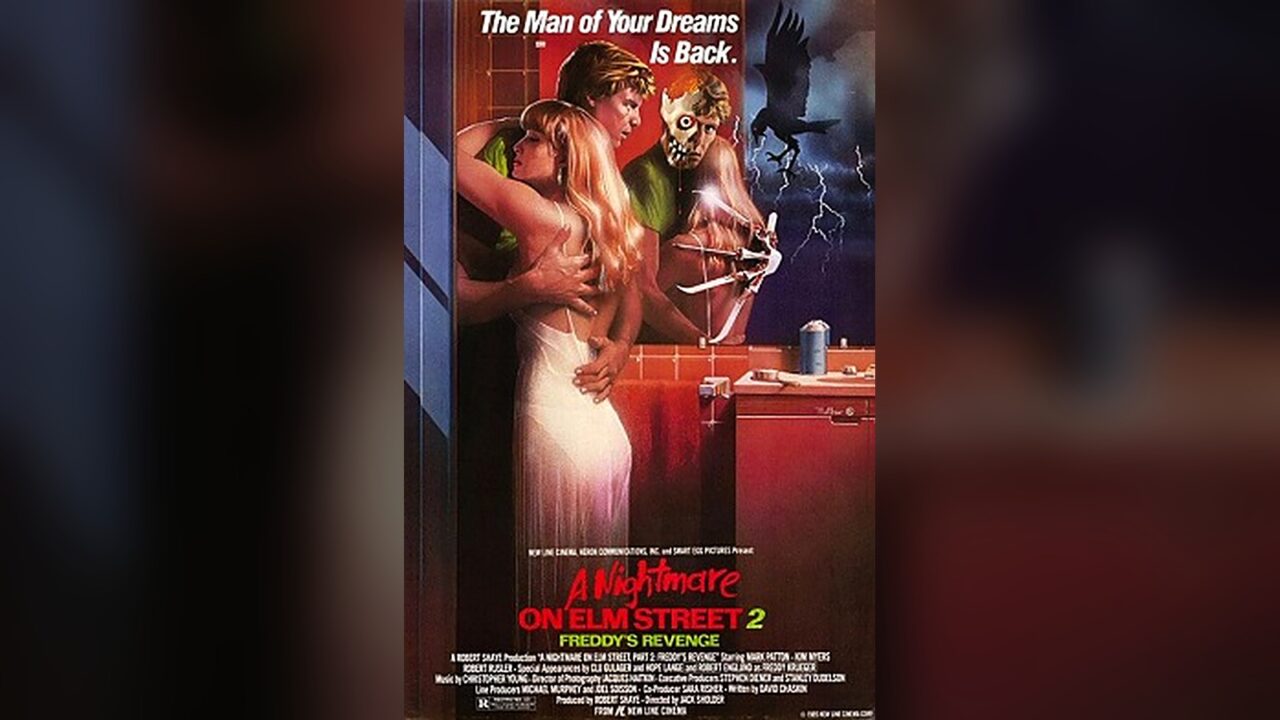
A Nightmare on Elm Street 2: Freddy’s Revenge (1985) is the possession sequel: Freddy Krueger climbs inside Jesse Walsh to kill in the real world.

The Review
This A Nightmare on Elm Street 2: Freddy’s Revenge (1985) review has to start with the confession every Elm Street fan eventually makes: for years, this was the one we apologized for. It broke the rules. Freddy wasn’t supposed to leave the dream. He wasn’t supposed to wear a teenager like a coat. Wes Craven himself walked away from it. And yet here we are, forty years on, and Freddy’s Revenge is the sequel the series can’t stop being haunted by — the odd one, the sweaty one, the one with something inside it trying to get out. That is not a metaphor the film hides from. It’s the whole picture.
Five years after Nancy Thompson’s war, the Walsh family moves into her old house on Elm Street — the same street, the same house, the same room. One absence defines the cast list: Nancy Thompson, the first film’s heroine, does not appear. The film does not bring Heather Langenkamp back, and it does not need to. Jesse Walsh (Mark Patton) is a different kind of victim — a boy, not a final girl, and the film’s idea turns on that difference: Freddy does not chase Jesse through his dreams. He moves in.
What Works
Start with the idea, because the idea is genuinely brave. The first film made sleep itself the trap; this one makes yourself the trap. Jesse can’t run from Freddy, can’t stay awake forever, can’t even trust his own hands — every teenager who has ever felt something dangerous waking up inside them is standing in that bedroom. Mark Patton plays it like a cornered animal: drenched, twitching, screaming in a register slashers usually reserve for their final girls. The film accidentally invented the final boy, and Patton’s rawness is the reason the performance has been reclaimed rather than forgotten. He is not cool. He is terrified. It works.
Then there is Englund, and this may be his most frightening turn in the whole series. Makeup effects artist Kevin Yagher’s makeup redesign strips out the goofy sneer of later sequels and puts something animal back in: Freddy moves like a predator now, and his face looks like a wound that never stopped opening. But it’s Mark Shostrom’s transformation that makes the film: Jesse is torn open in a locked bedroom, Freddy’s hands ripping out from inside his own torso while his body folds around the killer emerging from it. It should be the film’s most famous shot, and it is also its scariest idea: the monster isn’t haunting Jesse’s house. He’s haunting Jesse’s body.
And spare a thought for Lisa. Kim Myers was cast partly because she resembled a young Meryl Streep, but what she brings is better than a resemblance: she’s the only person in Springwood who believes Jesse, and the film quietly hands her the hero’s job — researcher, driver, rescuer — while the nominal leading man is busy being the weapon. The last act belongs to her, and she earns it.
What Doesn’t Work
The rules, horror lover. The rules. Craven built a killer who was omnipotent inside a dream and helpless outside one, and this film throws that engine out of the window. Freddy in the real world turns out to be a short man in a hot sweater chasing teenagers around a swimming pool — Craven’s own objection, and watching the pool party sequence, it’s hard to argue with him. Freddy should never be out of breath. The dream sequences, mostly early, are so strong that the long middle stretches of teen drama — the diary, the dinner table, the exploding pet parakeets played as a gag — feel like the film marking time until it can possess somebody again.
The kill count is thin for an Elm Street picture, and the film keeps flinching at the wrong moments: its most charged death happens behind a wall of shower steam, and whole subplots (the coach, the bars Jesse wanders into at night) are raised like a hand and never quite brought down. And the resolution — Freddy defeated by the power of a girlfriend’s love, confessed out loud — is a fairy-tale engine bolted into a slasher. It is sincere, it is even moving, but it lands like the film changed its mind about what it was in the last ten minutes. Which, behind the scenes, is more or less what kept happening.
Spoiler Section
Everything past this point gives away the ending — stop here if you have not seen the film.
Freddy’s plan, stated plainly: he is too weak to kill in the waking world, so he rides Jesse. The deaths are Jesse’s hands with Freddy behind the eyes. Coach Schneider catches Jesse wandering the night streets and drags him back to school for punishment laps; in the showers, Freddy comes out — towels whip Schneider naked against the tiles and the glove opens his back, while Jesse watches from inside his own skin. Jesse runs to Grady’s room and begs his friend to watch him sleep; Grady nods off, and wakes to Freddy bursting out of Jesse’s torso in the film’s signature effect — Jesse’s body splitting like a cocoon — before the glove takes Grady in his own bed.
At Lisa’s pool party, mid-kiss, Jesse feels the change coming and flees; when he returns as Freddy, the party becomes the series’ strangest setpiece: Freddy loose in the real world, boiling the pool, firing the grill, slashing through a crowd of panicking teenagers in a backyard in suburban Ohio. He can’t touch Lisa — Jesse’s love for her is literally in his way — so he takes the crowd instead. Lisa follows him to the old boiler-room power plant, confesses her love to the monster’s face and kisses him; Jesse fights from inside, and Freddy burns, collapsing into ash, Jesse crawling out of the cinders alive.
And then the film takes it all back with a grin: the morning bus, Jesse relaxing at last, Kerry mid-sentence about how it’s all over — and Freddy’s arm punches through her chest as the bus veers off into the desert, Jesse’s first nightmare starting over. It’s a cheat. It’s also the most honest ending the film could have picked: what Jesse is carrying doesn’t burn off in one night, and everybody on that bus knows it now.
Trivia
- Wes Craven was offered the sequel and refused it. He was not impressed by the Freddy-possesses-a-teenager idea — a different take on it was his one suggestion. His one accepted suggestion: make Lisa the hero. Writer David Chaskin rebalanced the film toward her, until she stood nearly level with Jesse.
- The possession idea nearly arrived by a stranger route: Screenwriter Leslie Bohem pitched Freddy possessing an unborn child, Rosemary’s Baby-style. New Line passed — executive Sara Risher was pregnant, and the pitch upset her. The pregnancy concept survived anyway and became A Nightmare on Elm Street 5: The Dream Child, which Bohem wrote.
- New Line almost replaced Robert Englund with an unnamed extra in a rubber mask to save money. The extra’s gait read as a bargain-basement monster, and the only footage of him that survives is in the shower kill, hidden by steam. Englund was rehired and kept the glove for the rest of the series.
- Brad Pitt was a contender to play Jesse and lost the part for being, in the producers’ judgment, too nice. Producer Robert Shaye appears uncredited as the bartender in the leather bar Jesse wanders into — Shaye later recalled the outfit came from The Pleasure Chest in Los Angeles.
- The opening bus nightmare is recycled from Craven himself: he fought to keep Freddy from driving the car in the first film’s epilogue, and the compromise was to save the idea for the sequel — with none of Craven’s characters aboard.
- The subtext is not an accident of history. For years Chaskin denied writing Jesse’s story as a gay allegory and blamed Patton’s performance; in 2010 he admitted the subtext was intentional. Director Jack Sholder has maintained he never saw it. Patton, closeted during filming, watched the film’s reception damage his career and eventually left acting; he tells his side in the 2019 documentary Scream, Queen! My Nightmare on Elm Street.
- The speed of the thing: pre-production began in April 1985 and the film was in theaters on November 1, 1985 — a sequel conceived, shot and released inside a single year, on a reported budget somewhere between $2.2 and $3 million, and it still came home with $30 million.
- Bing Crosby sings “Have You Ever Seen a Dream Walking” over the end credits — the sweetest needle-drop in the series, playing over a bus full of doomed teenagers. Jesse’s bedroom dance, glove-adjacent and unforgettable, is set to Fonda Rae’s “Touch Me (All Night Long)”.
Where to Watch
As of November 15, 2026, in the US: Freddy’s Revenge streams with a subscription on AMC+. Rent it for $3.99 on Prime Video, Apple TV Store, Fandango at Home and YouTube. Buy it for $6.99 on Prime Video, or $9.99 on Apple TV Store and Fandango at Home. No free streaming option is listed.
Quick Specs
- Director: Jack Sholder
- Screenplay: David Chaskin
- Starring: Mark Patton (Jesse Walsh), Kim Myers (Lisa Webber), Robert Rusler (Ron Grady), Clu Gulager (Ken Walsh), Hope Lange (Cheryl Walsh), Robert Englund (Freddy Krueger)
- Music: Christopher Young
- Cinematography: Jacques Haitkin and Christopher Tufty
- Editor: Bob Brady and Arline Garson
- Producers: Robert Shaye
- Production Company: New Line Cinema, Heron Communications and Smart Egg Pictures
- Distributor: New Line Cinema
- Premiered: November 1, 1985 (US theatrical release)
- Runtime: 87 minutes
- Rating: 3 out of 5 ravens
- Budget: Reported figures range from $2.2 million to $3 million
- Box Office: $30 million in the US and Canada
- On This Site: A Nightmare on Elm Street (1984) · Freddy Krueger · Robert Englund · Wes Craven
Harper’s Extras
- A Nightmare on Elm Street (1984) — Harper’s review: where the rules were written. Watch Nancy’s war first, then come back and watch this one break every rule in the book.
- Freddy Krueger — the wiki file: the burnt man himself, from the boiler room to his long afterlife in sequels.
- The shot to watch for: a locked bedroom, a boy on the floor, and Freddy’s hands tearing out of him the wrong way. Mark Shostrom’s transformation is the film’s scariest idea made flesh — the monster isn’t haunting Jesse’s house. He’s haunting Jesse’s body.
- Look closer at the face. Kevin Yagher’s makeup redesign strips away the sneer the later sequels would lean on and leaves a wound that never stopped opening. This may be the most frightening Freddy Robert Englund ever wore.
Frequently Asked Questions
Why does Freddy possess Jesse instead of haunting his dreams?
Because out in the waking world, Freddy is weak — too weak to kill on his own. So he rides Jesse into it, working through the boy’s own hands while Jesse watches from inside his own skin. It breaks the first film’s rules completely, and that break is the whole picture.
Do I need to watch the first Nightmare on Elm Street first?
It helps, but it isn’t required. Freddy’s Revenge stands on a new family and a new victim — but it moves them into Nancy Thompson’s old house, five years after her war, and Nancy herself never appears. Know what happened in that house, and every creak in this one has a history.
Why is Freddy’s Revenge considered the odd one out?
It changes the monster’s method — possession instead of dream-stalking — swaps the final girl for a final boy, and lost Wes Craven along the way: he walked away from it. Fans apologised for it for years. Forty years on, it is the sequel the series can’t stop being haunted by.
How scary is Freddy’s Revenge?
In bursts, very. Englund is at his most feral here, and the possession sequences are genuinely frightening. But the kill count is thin for an Elm Street picture, and Freddy let loose at a suburban pool party is Freddy out of his element. Come for the dread, not the body count.
Who is the real hero — Jesse or Lisa?
Officially Jesse; actually Lisa. Kim Myers’ Lisa is the only person in Springwood who believes him, and the film quietly hands her the hero’s job — researcher, driver, rescuer — while Jesse is busy being the weapon. The last act belongs to her, and she earns it.
The Verdict
Freddy’s Revenge is the Elm Street sequel that swings at a different film entirely — a possession picture about a boy at war with what’s inside him — and connects often enough that its misses have become part of its legend. It breaks Freddy’s rules, shrinks him at the pool party, and solves itself with a kiss; it also gives you Englund at his most feral, a transformation scene for the ages, and the rawest lead performance in the series. Not the best Nightmare. Possibly the most interesting one.
Rating: 3 ravens out of 5.
The weekly roundup
One letter a week, from the crypt.
- New reviews, with the ravens
- New wiki entries and news
- Cool stuff worth your night
Weekly. No spam, unsubscribe in one click.