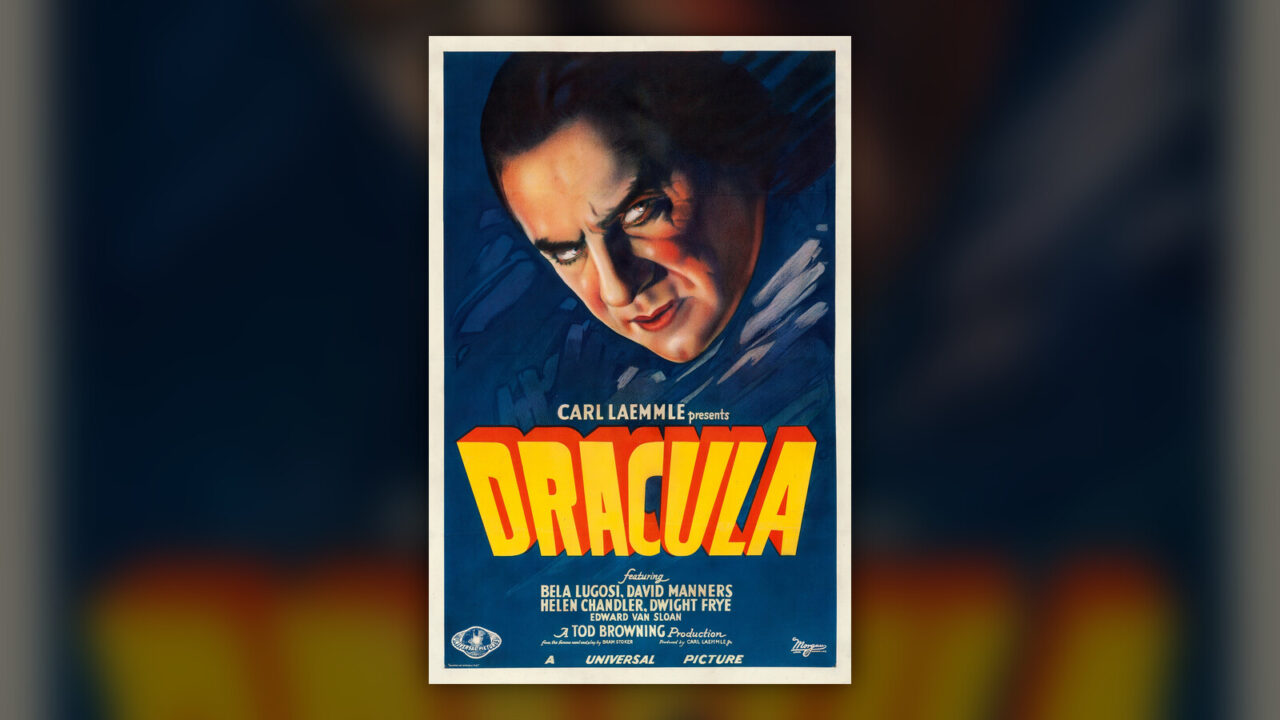
Dracula (1931) is Tod Browning’s Universal vampire film, starring Bela Lugosi as the Transylvanian count who sails to England hungry for new blood.
A coach climbs toward the Borgo Pass at dusk. The passenger leans out to ask the driver to slow down, and there is no driver. There is only a bat, flying ahead of the horses and leading them up the mountain. Ninety-five years later, that is still one of the best openings in horror. Welcome back to the crypt. Tonight we’re visiting the count who taught the movies what a vampire looks like.
The Review
Renfield (Dwight Frye) is an English solicitor with a property deal to close. His client is Count Dracula (Bela Lugosi), who wants to lease Carfax Abbey in England. The villagers beg Renfield not to go up to the castle. He goes anyway, and by the time the ship reaches England, its crew is dead and Renfield is a raving servant who eats flies. Dracula settles into the abbey next door to Dr. Seward’s sanatorium (a private asylum), charms Seward’s daughter Mina (Helen Chandler) and her fiancé, John Harker (David Manners), and starts feeding. Only one man stands in his way: Professor Van Helsing (Edward Van Sloan), a scientist who believes in what he cannot explain.
It’s a simple story, and the film tells it simply. What makes it last is one performance and about 20 minutes of pure nightmare.
What Works
- Bela Lugosi is the Count, and he still is. Bela Lugosi had already played Dracula on Broadway, starting in 1927, and he fought hard for the film. He took $500 a week, $3,500 in all, to get it. Every cent shows on screen. The slow, deliberate voice, the stare held a beat too long, the way he stands perfectly still in a doorway: none of it should work, and all of it does. When he hears wolves howling outside the castle and says, “Listen to them. Children of the night. What music they make,” he isn’t playing a monster. He’s playing a nobleman who finds us a little sad. Every cape-and-widow’s-peak vampire since owes him rent.
- The Transylvania opening is the real masterpiece. The castle is enormous, ruined and drifting with fog. Karl Freund, the cinematographer, keeps the camera gliding through it like it belongs to the house. There is almost no music and very little talk. You hear coffin lids creak. Three brides drift toward Renfield and the Count waves them away, because this one is his. It plays like a silent film, which is exactly why it’s so frightening. Nobody tells you how to feel.
- Dwight Frye steals every scene the Count isn’t in. Renfield starts as a fussy little businessman and ends as a cackling wreck who begs for spiders. Frye’s mad laugh is one of the great sounds in early horror. Nobody in the film is having a worse time, and nobody is more fun to watch.
- Van Sloan gives it a spine. Edward Van Sloan came over from the stage play too, and his Van Helsing is dry, stubborn and completely unimpressed. The scene where the Count tries to bend the professor’s will, and fails, is the best face-off in the film. Two stage veterans, one living room, and the temperature drops.
- It changed everything. Dracula was a gamble: a full-length, serious supernatural story with no comic relief and no last-minute joke explaining the ghost away. It became a hit, and Universal followed it the same year with Frankenstein. The American horror film starts here.
What Doesn’t
- Once it reaches England, it turns into a play. The film was adapted from the stage version, not straight from Bram Stoker’s novel, and the second half shows it. Long scenes sit in one drawing room. People stand, talk and exit. The camera that floated through the castle starts staying put. The energy of the first act drains away, and the climax happens almost entirely offscreen.
- The silence cuts both ways. There is no score beyond some classical music, Tchaikovsky’s Swan Lake over the opening credits and a bit of Wagner and Schubert at the theater. That works wonders in Transylvania. In London, the quiet often just feels empty.
- The supporting cast is wax. David Manners plays John Harker as a worried coat rack, and he admitted later he barely knew who was directing. He said, “the only directing I saw was done by Karl Freund, the cinematographer.” Helen Chandler has a few good moments once Mina falls under the spell, but the young lovers are there mainly so the Count has someone to stand behind.
- The scares are suggested, sometimes too politely. Dracula never transforms on camera. The bats are big, floppy props, and the Count’s final death happens off screen with a groan. In 1931 the restraint was a choice. Today, some of it plays as the film not knowing how to stage its own climax.
The Verdict: Dracula earns 4.5 ravens. The first 20 minutes are as eerie as anything Universal ever made, and Bela Lugosi built the image of the vampire that every film since has had to answer. The London half is stiff, stagey and too quiet, and the ending fizzles off camera. But you don’t come back to this one for the plot. You come back for that coach with no driver, that castle staircase, and the man waiting on it. He’s still the one they measure the others against.
Watch the Trailer

Quick Specs
- Director: Tod Browning
- Producers: Carl Laemmle Jr., Tod Browning
- Screenplay: Garrett Fort, from the stage play by Hamilton Deane and John L. Balderston, based on Bram Stoker’s 1897 novel
- Starring: Bela Lugosi, Helen Chandler, David Manners, Dwight Frye, Edward Van Sloan
- Cinematography: Karl Freund
- Editor: Milton Carruth
- Art Direction: Charles D. Hall
- Studio and Distributor: Universal Pictures
- Release Date: February 12, 1931 (Roxy Theatre, New York); February 14, 1931 (wide US release)
- Runtime: 75 minutes
- Rating: Not rated (released before the MPAA rating system)
- Budget: $341,191 (final cost, under a $355,050 estimate)
- Box Office: A major hit for Universal; no verified gross on record
- Raven Rating: 4.5 ravens
Trivia & Facts
- Lon Chaney was supposed to wear the cape. Universal planned the film around Chaney, Tod Browning’s longtime star, but Chaney died in 1930. Conrad Veidt and Paul Muni were among the other names considered before Lugosi won the part.
- The same castle, a second film, after dark. While Browning’s crew shot by day, director George Melford used the same sets at night for a Spanish-language Drácula starring Carlos Villarías.
- Harker was recast twice. Lew Ayres was first cast as John Harker, then Robert Ames, before the part went to David Manners.
- The shoot ran long. Filming started September 29, 1930, and wrapped November 15, with added scenes in December and retakes on January 2, 1931.
- A lost curtain call. On first release, Edward Van Sloan stepped out after the ending to warn the audience that there really are such things as vampires. That epilogue was cut for the 1936 reissue, along with Dracula’s dying groans.
- It got a new score in 1998. Composer Philip Glass wrote one for the Kronos Quartet, and Universal’s home releases let you choose it.
- SPOILER, plainly marked: The Count never gets a big final battle. At dawn, Van Helsing finds him in his coffin and drives a stake through his heart off camera. Mina is free the moment he dies.
Harper’s Extras
- The full record. Our Dracula (1931) wiki page has the production story, the cast and the legacy, and our Tod Browning file follows the director from Lon Chaney’s silents to this.
- The family carries on. Pick up the story right where this one ends with our Dracula’s Daughter (1936) review, the direct sequel.
- Browning’s darker turn. If you want to see what Browning did next, try Freaks (1932). It’s the strangest film he ever made, and it’s no stage play.
- What the crypt is watching. Watch the first 20 minutes with the lights off and the sound up. Then count how many vampire movies you’ve seen that open with a coach and a warning from the villagers. Lugosi got there first.
Where to Watch
As of November 21, 2026, Dracula (1931) rents for $3.99 in 4K on Prime Video and Apple TV and is available to buy digitally and on disc. Subscription streaming for the Universal classics has shifted this fall, so check your services before you rent.
FAQ
Is Dracula (1931) still scary?
The opening in Transylvania still is. It’s quiet, slow and very strange. The London half is more creepy than frightening, carried by Lugosi’s stare and Dwight Frye’s laugh.
Is Dracula (1931) based on the book?
Mostly on the stage play by Hamilton Deane and John L. Balderston, which was adapted from Bram Stoker’s 1897 novel. That’s why the second half feels like theater.
Was there a Spanish version?
Yes. Universal shot a Spanish-language Drácula at night on the same sets, directed by George Melford and starring Carlos Villarías.
That’s tonight’s file, fiends: one castle, one count, and a staircase you’ll never climb the same way again. Until next time, if a polite stranger asks to come inside tonight, let him stand on the doorstep a little longer. And if he doesn’t show up in the mirror, close the window. Sleep tight.
The weekly roundup
One letter a week, from the crypt.
- New reviews, with the ravens
- New wiki entries and news
- Cool stuff worth your night
Weekly. No spam, unsubscribe in one click.