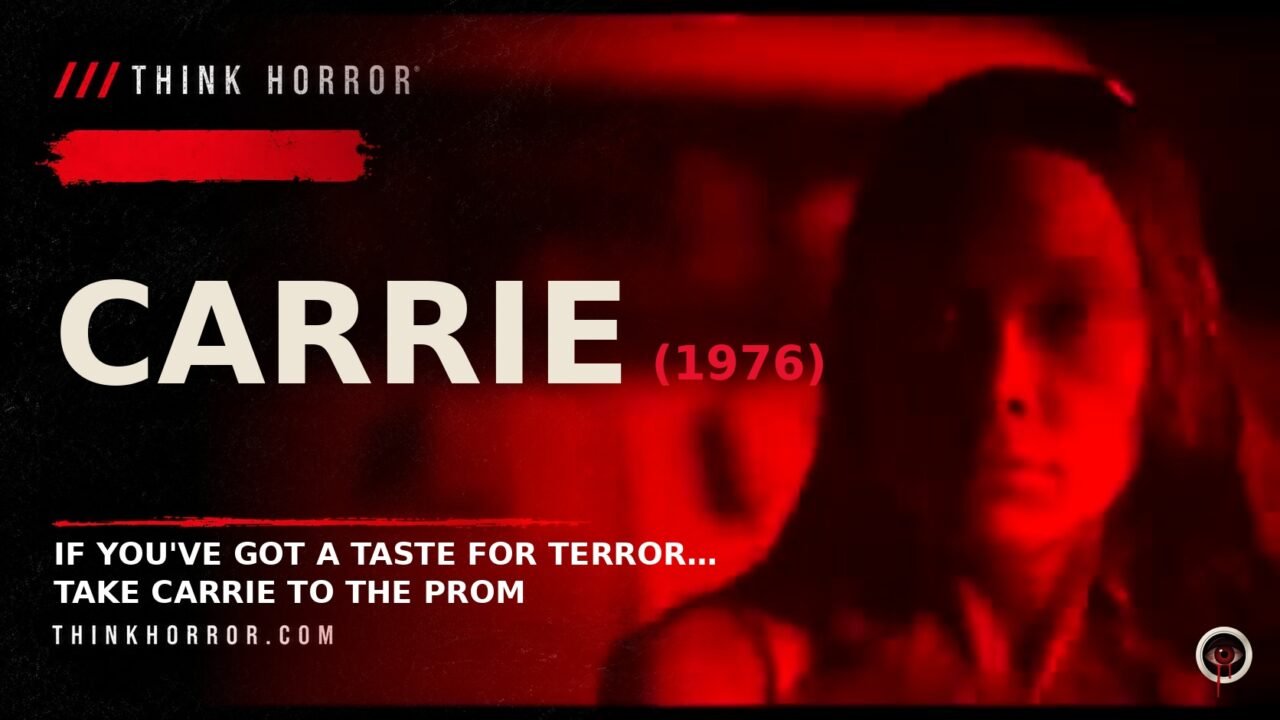
Carrie is Brian De Palma’s prom-night tragedy: a bullied girl, a fanatical mother, and a gift that answers cruelty in kind.
It starts with a shower and a scream. Carrie White gets her first period in the school locker room and does not know what it is — nobody ever told her — so she thinks she is dying, and begs for help. Her classmates answer with a chant and a rain of tampons. Above them, a light burns out and bursts. Nobody in the room notices. The audience does. In five minutes the film has shown you its whole engine: a girl with no safe room on earth — not the school, not her home, not her own skin — and something waking up inside her that will not always ask permission.
Welcome back to the crypt. Tonight’s file turns fifty this month: Carrie opened on November 3, 1976, and it has never really closed. Our full file on Carrie walks the whole case; the short version begins with a young schoolteacher’s first published novel. Stephen King’s Carrie, published in 1974, became the first of his books to reach the screen — Lawrence D. Cohen wrote the screenplay, Paul Monash produced, United Artists released it, and Brian De Palma directed it like a man building a beautiful machine to break your heart, then break everything else. Our Stephen King file traces what poured from the typewriter next. Fifty years of imitators later, nobody has built the machine better.
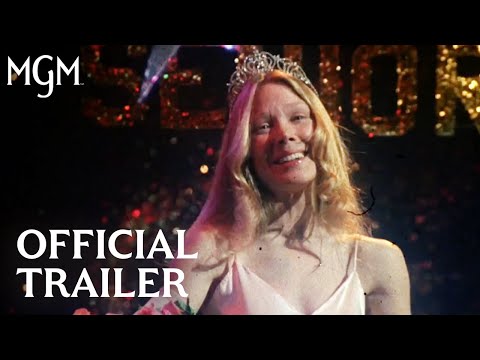
Watch the Trailer
Quick Specs
- Director: Brian De Palma
- Writer: Screenplay by Lawrence D. Cohen; based on the novel by Stephen King
- Cast: Sissy Spacek, Piper Laurie, Amy Irving, William Katt, John Travolta, Nancy Allen, Betty Buckley, P. J. Soles
- Producer: Paul Monash
- Distributor: United Artists
- Release Date: November 3, 1976 (United States)
- Runtime: 98 minutes
- Rating: R
- Budget: $1.8 million
- Box Office: $33.8 million (domestic gross)
The Review
Carrie White (Sissy Spacek) lives in the first haunted house of the picture: her own home, where her mother Margaret (Piper Laurie) keeps the candles lit and a closet-sized prayer room ready for any sin, including the sin of existing. Margaret is the film’s true believer and its first monster — a woman who has read her daughter as a curse since birth and says so in scripture. School is no refuge. After the locker-room cruelty, gym teacher Miss Collins (Betty Buckley) punishes the whole class, and one girl’s refusal to be sorry — Chris Hargensen (Nancy Allen), all teeth and spite — sets the plot’s fuse. Another girl, Sue Snell (Amy Irving), burns with a guilt the others don’t carry, and persuades her boyfriend Tommy Ross (William Katt) to ask Carrie to the prom in her place. It is the kindest thing anyone does in this film. It is also the match.
De Palma cross-cuts the prom preparations like a heist told from both ends of the gun. On one side: a girl buying lipstick, sewing a dress, glowing in a mirror for the first time in her life. On the other: Chris and her boyfriend Billy Nolan (John Travolta) in a slaughterhouse, filling a bucket with pig’s blood and rigging it above the prom thrones. The film makes you complicit in both threads — you root for the dress and you watch the rope. By the time Carrie walks into that gymnasium, the audience knows more than anyone on screen, and knowledge feels like a weight.
Then comes the prom itself, the most famous twenty minutes Stephen King ever wrote. De Palma slows everything to a waltz: the circling dance shot, the rigged ballot, the crown, the flowers — happiness held up long enough for you to memorize it. Under the stage, a cord gets pulled. The bucket tips in near-silence. And De Palma splits the screen: on one side, Carrie’s face under the falling blood, the gym’s laughter arriving in waves; on the other, the room coming apart — doors, hoses, fire — as the gift stops asking permission. She walks home to a house full of candles, where her mother waits with open arms and a knife. What follows in that kitchen is the film’s real horror: the prom only destroyed a gymnasium. This destroys the one person who ever, in her broken way, claimed to love her.
Holding all of it together is the work in front of and behind the camera. Spacek — whose own file we keep here — plays Carrie folded inward, shoulders first, a person trying to take up less world; so when the same girl straightens her spine at the prom and smiles, the transformation registers like weather changing. Mario Tosi’s photography keeps the film in soft, dreamy light that curdles, Pino Donaggio’s score sounds like a music box that has decided to grieve, and Paul Hirsch’s editing, above all in the split-screen climax, lets you see everything — and does not let you stop any of it.
What Works
- Spacek’s transformation is the special effect. No prosthetic in the picture does what her posture does. Carrie arrives at the prom as a different species from the girl in the locker room — not polished, just permitted — so the bucket doesn’t fall on a stranger. It falls on the happiest person in the building, at the happiest moment of her life. That arithmetic is why the scene still lands fifty years later.
- The prom is engineered like a trap you can see. The cross-cutting, the slow motion, the split screen: De Palma shows you every moving part — the rope, the bucket, the rigged vote, the hand on the cord — and the suspense doesn’t leak, it compounds. Hitchcock’s old lesson, relearned in blood: the audience dreads what it can see coming far more than what it can’t.
- Laurie makes Margaret a believer, not a caricature. Piper Laurie plays Margaret’s madness as devotion at full volume — tender one breath, terrifying the next, and always certain. It’s why the home scenes out-scare the gym: the prom is cruelty from strangers, but the closet, the candles and the kitchen are cruelty with a theology, administered by the only person Carrie has.
- Donaggio’s score refuses to wink. Where a lesser film would sting and stab, Carrie coos — lullaby strings and a theme pretty enough for the romance this story keeps almost becoming. The beauty is the blade: the music believes in the prom even when we can’t, so the fall is measured in the score’s own heartbreak.
What Doesn’t
- Chris and Billy are sketched broader than everyone else. Next to the film’s psychological precision, the villains play as grease-pencil teen-movie menaces — Allen commits fully, and Travolta’s Billy is genuinely funny, but the comedy thins the dread around their thread. Cutting to the slaughterhouse, the film briefly becomes a lesser, louder picture.
- The last shot trades ache for a gasp. Sue’s dream coda — the flowers, the grave plot, the hand — is one of horror’s most imitated jolts, and it earns its scream. But for one beat the film sets down the tragedy’s weight for a carnival trick; some of us wish it had trusted the quiet ending it already built. Half the desk will fight me. The seam still shows.
Critics and crowds have been split on this one since opening night — too arty for some, too brutal for others — and that argument has followed the film its whole life. Harper isn’t split.
Harper’s verdict: 4.5 ravens — one razor blade short of perfection.
Trivia & Facts
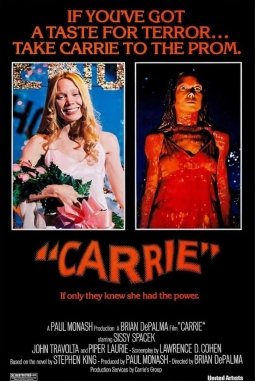
- The poster spoiled its own ending. The original campaign showed both Carries side by side — the smiling prom queen and the same girl drenched in blood — under the line “If you’ve got a taste for terror… take Carrie to the prom,” with a second tease beneath the title: “If only they knew she had the power.” United Artists sold you the catastrophe outright. Audiences came anyway. They’ve never stopped.
- King’s first nightmare, first time on screen. Carrie was Stephen King’s first published novel, in 1974, written while he was teaching school — from pages he threw in the trash and his wife Tabitha famously fished back out. De Palma’s film was the first of his books ever adapted for the screen. The empire of King adaptations that now fills whole shelves of this crypt starts here.
- The Academy knocked twice. At the 49th Academy Awards, Spacek was nominated for Best Actress and Laurie for Best Supporting Actress — the Academy almost never knocks on horror’s door, and for this film it knocked twice. Neither took the statue home. The performances did something better: they stayed.
Harper’s Extras
- Carrie — the full wiki file: the complete case file — production, release and legacy in crown-jewel depth.
- Sissy Spacek — the wiki file: the quiet Texan who carried a genre on her shoulders.
- Stephen King — the wiki file: the teacher whose first novel opened the floodgates.
- The Shining — the wiki file: King at the Overlook, through Kubrick’s colder eyes.
- It (1990) — the wiki file: the other King childhood nightmare, the one with the clown.
- Crank it: Pino Donaggio’s score — the main theme played soft, in a dark room, with something tall and candlelit standing in the corner. Mind the closet door.
Where to Watch
As of November 7, 2026, it’s streaming on Amazon Prime Video and HBO Max in the US; rent or buy it on Amazon Video, Apple TV Store or Fandango At Home.
Frequently Asked Questions
Is Carrie (1976) based on a true story?
No. It’s fiction with its feet in real cruelty: Stephen King’s 1974 novel — his first published — adapted by Lawrence D. Cohen. The locker rooms and the religious terror are invented, but out of things King had plainly seen, which is why the first hour hurts more than the last.
Is Carrie a slasher film?
This desk says no. A slasher hunts its cast for sport; Carrie spends most of its length building one person’s hope so it can be murdered in public. The body count, when it comes, is a tragedy’s, not a game’s — closer to a Greek myth lost in an American high school than to the masked-killer pictures that followed it.
Why is the prom sequence still famous fifty years on?
Because it’s a complete suspense machine in miniature: cross-cutting between the dream and the plot against it, slow motion that stretches one second of happiness until it aches, and a split-screen climax that shows the humiliation and the revenge in the same breath. Directors have been quoting it since 1976. The bucket, the blood and the silence underneath are now part of the language of film itself.
One labelled note before we go: Mike Flanagan’s Carrie series premiered on Prime Video on October 7, 2026 — a different animal wearing the same name; the news desk keeps that file, and it isn’t this one. This Carrie 1976 review belongs to 1976.
Until next time, fiends — be kind to the quiet girl in the corner, mind what’s rigged above the thrones, and if they ever offer you a crown, enjoy it with your whole heart anyway. Harper will keep a candle lit for you.
The weekly roundup
One letter a week, from the crypt.
- New reviews, with the ravens
- New wiki entries and news
- Cool stuff worth your night
Weekly. No spam, unsubscribe in one click.