You are eight years old, and your whole job at this school is carrying parcels for the big boys. The new cadet’s package is heavy and it shifts when you shake it — toys do not shift like that. The armory is empty. Nobody is watching. Your penknife is already out, fiend, and whatever is inside that box has been waiting eight years to be the first secret you ever keep.
Child’s Play 3 (1991) sends a sixteen-year-old Andy Barclay to military school, where a resurrected Chucky picks a new target: eight-year-old cadet Ronald Tyler.
Eight years on from the toy factory, the Play Pals company does the stupidest thing a haunted corporation can do: it reopens the Good Guys line, melts down the old stock, and never asks what the red stuff dripping into the plastic vat is. It is blood, fiends. It is always blood. Out of the fresh mould comes a brand-new Chucky in a brand-new body — and that detail, the new body, turns out to be the whole plot, because the voodoo rules have reset with the plastic.
The speed of this film is its biography. Don Mancini started writing it before Child’s Play 2 had even opened; when the second film hit, Universal greenlit the third with a release date nine months away, and Mancini — by his own account, out of ideas and openly calling this his least favourite entry ever since — had to fill those nine months with something. What he filled them with was a change of scenery and a change of target: Andy shipped off to Kent Military School, and Chucky, for the first time in the series, not really hunting Andy at all. He is hunting the little boy who unwraps him.

Quick Specs
- Director: Jack Bender
- Screenplay: Don Mancini
- Starring: Justin Whalin (Andy Barclay), Perrey Reeves (Kristin De Silva), Jeremy Sylvers (Ronald Tyler), Travis Fine (Brett C. Shelton), Dakin Matthews (Colonel Cochrane), Andrew Robinson (Sergeant Botnick), Peter Haskell (Mr. Sullivan), Brad Dourif (voice of Chucky)
- Music: Cory Lerios, John D’Andrea
- Cinematography: John R. Leonetti
- Editor: Scott Wallace, Edward A. Warschilka Jr.
- Producers: Robert Latham Brown; executive producer David Kirschner
- Production Company: Universal Pictures
- Distributor: Universal Pictures
- Premiered: August 30, 1991
- Runtime: 90 minutes
- Rating: R
- Budget: $13 million (reported)
- Box Office: $14,960,255 domestic / $20,560,255 worldwide (Box Office Mojo); $14,250,380 / $19,850,380 (The Numbers); $13,526,840 domestic (Headhunter’s)
- On This Site: Child’s Play 3 in the wiki · Child’s Play (1988)
The Review
Give the film its one smart move first. Andy Barclay at sixteen is a good idea on paper: mother Karen back in a psychiatric hospital, a trail of failed foster homes behind him, and the state finally parking him somewhere built to beat the imagination out of a boy — Kent Military School, all buzz cuts and barked orders, where Colonel Cochrane’s prescription for a teenager who insists a doll tried to steal his body is to forget his “fantasies.” Justin Whalin, taking over a role Alex Vincent could not play across an eight-year story jump — Vincent was about ten; it was arithmetic, not a firing — plays Andy as the series’ forgotten casualty: not a hero, a ward. The tragedy the film almost notices is that the institution is so busy breaking him that nobody watches the mail. The Good Guy doll meant for Andy’s room gets opened instead by Ronald Tyler, an eight-year-old cadet who carries parcels for the older boys, and Chucky — bursting out furious at the wrong child — does the coldest maths in the franchise. New body, new curse: he can now transfer his soul into the first person who learns his true identity. Tyler just learned it. The possession plot of Child’s Play 3 is not Andy at all. It never was.
What follows is a film of two energies fighting in the same uniform. In one, Brad Dourif remains the best special effect Universal ever bought: the doll’s mouth now moved by computer, by the effects team’s account, in sync with his pre-recorded snarl, and Chucky’s charm offensive on Tyler — the invented game of “hide the soul,” played with a killer’s patience — is genuinely queasy stuff, a groomer in primary colours. The kills keep their invention, too: Play Pals’ own CEO Sullivan, played by Peter Haskell, menaced with his company’s own toys in his own office; a garbage-truck driver lured toward his own compactor; the barber Sergeant Botnick, Andrew Robinson, opening his straight razor on the wrong customer — the outcomes, as ever, wait below. And in the other energy, the squeeze shows. The military school never becomes more than a backdrop with marching; the war-games climax — Chucky swapping one team’s paint rounds for live ammunition — is a strong set piece the film has to lean on twice as hard because the middle sags. And when the deaths come, they land unevenly: one is less a death scene than a shrug the film hopes you will mistake for irony, and the film kills its kindest character for pathos it hasn’t built and its cruelest for plot it hasn’t earned. Names and outcomes are waiting in the spoilers.
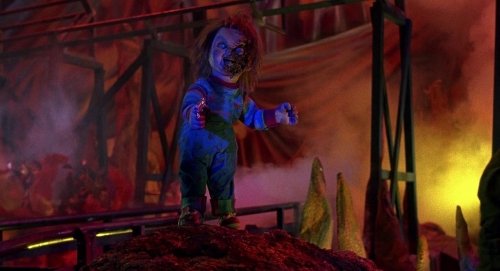
Then the carnival saves it. Tyler flees to the fairground next door, and the last act relocates into the Devil’s Lair, a horror dark ride of swinging reapers — one of whose scythes does something to Chucky’s face that the series never forgot: Bride of Chucky opens with Tiffany stitching that same ruined face back together. The finale that follows is the most purely enjoyable stretch of the picture — Andy, armed with Tyler’s pocket knife and a borrowed gun, fighting a one-armed doll through the ride’s machinery to an ending with wit and finality that the film surrounding it manages neither of often enough. What exactly the ride does to him waits below the gate. The contemporary ledger was cold: Variety called it a noisy, mindless sequel; Caryn James in The New York Times allowed that the doll was an impressive technological achievement and found little else. Audiences were nearly as cool — $20,560,255 worldwide on Box Office Mojo’s current tally, against a reported $13 million budget, made it the lowest-grossing theatrical film in the series, though its $5,718,940 four-day opening was the top-grossing Labor Day opening of its time, beating the record Bolero had held since 1984. Seven years of silence followed, and the franchise only came back by learning to laugh.
Spoiler Section
Spoilers settle here, fiends — outcomes are named plainly.
The outcomes, named plainly. Sullivan is tortured to death with his own company’s toys. The garbage-truck driver is crushed in his own compactor. Sergeant Botnick’s throat is cut with his own straight razor. Colonel Cochrane, confronted by a knife-wielding doll, dies of a heart attack. In the war games, Shelton is shot dead by the live rounds Chucky swapped in, and Whitehurst throws himself on a grenade to save the others. At the carnival, Chucky kills a security guard and takes Tyler into the Devil’s Lair, where a reaper’s scythe slices half his face away; Andy shoots him, wounds him, and finally throws him into the ride’s giant fan, which shreds him.
Tyler is saved from the transfer; the film does not show him afterward. De Silva is wounded and rushed to the hospital. Andy is taken away by the police for questioning — a reputation that will follow him for three more decades of sequels.
Trivia
- The script predates the sequel’s opening. Mancini began writing Child’s Play 3 before Child’s Play 2 was released; once the second film succeeded, Universal set a release date nine months out. He has called it his least favourite entry in the series and said plainly that he had run out of ideas — the army of multiple Chuckys he wanted was cut for budget, then finally used twenty-six years later in Cult of Chucky.
- Andy was recast by arithmetic. The story jumps eight years, to 1998; Alex Vincent was about ten years old and could not play sixteen. Jonathan Brandis was considered before Justin Whalin was cast. Vincent was not fired — he returned as Andy in Curse of Chucky (2013) and has played the role ever since.
- The director Mancini wanted was Peter Jackson. The job went to Jack Bender, a television director who would later become a lead director and executive producer on Lost. Asked about the film in a 2017 interview, Bender dismissed it in two words: “kinda silly.”
- The school is real. The Kent Military School scenes were shot at the Kemper Military School in Boonville, Missouri, from February 1991; the carnival finale was filmed in Valencia, California. The carnival climax was recreated in 2009 as a Halloween Horror Nights maze, “Chucky’s Fun House,” at Universal Studios.
- The ruined face starts here. The scythe that takes half of Chucky’s face in the Devil’s Lair leaves the wound he is still carrying when Bride of Chucky opens — Tiffany stitches that same face back together, and the scars stay for the rest of the series. This film also froze the series for seven years — it is the last Child’s Play played straight, and the last to use the Child’s Play title until the 2019 remake.
- The record must be stated plainly. In 1993, British tabloids linked this film to two child murders — the killing of James Bulger in Liverpool and of Suzanne Capper in Manchester. The link was speculation, amplified by a judge’s sentencing-stage remarks in the Bulger trial. The officers who actually investigated both cases said the opposite, on the record: the Bulger investigation specifically looked for a video link and concluded there was none, and the Capper investigation found no suggestion the film had anything to do with the crime — the Chucky element there was the 150 Volts track, taped off Piccadilly Radio and played by the killers — not a screening of the film. The film inspired neither murder. What it did do is help trigger a genuine panic: UK rental shops voluntarily pulled the trilogy, Sky Television refused to broadcast it, and Britain tightened its video-classification law. The doll was blamed; the record acquits it.
Where to Watch
As of November 9, 2026, in the US: Child’s Play 3 streams by subscription on AMC (JustWatch lists no other subscription service; Reelgood currently lists no US streaming for it at all). You can rent or buy it digitally on Amazon Video, Apple TV Store, Fandango At Home or Google Play. Streaming availability can change.
The Verdict
Rating: 2.5 ravens out of 5.
Two and a half ravens. Child’s Play 3 is the rushed one, and there is no use pretending otherwise — its own writer disowns it, its director called it “kinda silly” in a 2017 interview, and the nine-month turnaround is visible in every thin scene. But it is not worthless: Dourif never slacks, the hide-the-soul business is properly nasty, and the Devil’s Lair gives the series one of its defining images. Watch it as the end of something — the last straight-faced Child’s Play, the last one called Child’s Play for twenty-eight years — and it plays better than its reputation.
The weekly roundup
One letter a week, from the crypt.
- New reviews, with the ravens
- New wiki entries and news
- Cool stuff worth your night
Weekly. No spam, unsubscribe in one click.