Los Angeles, after midnight — and in Constantine’s city, the things walking past you are not all people. You can see the wings under the coats and the rot under the faces; you have seen them since you were a child, and it has cost you everything, including, once, your life. Two minutes dead bought you the only fact that matters: where you are going when the cancer finishes. Now something is breaking the rules of the truce, and you are the only exorcist in town who reads the fine print. Light another cigarette, fiend. The meter is running.
Constantine (2005) is a supernatural noir in which Keanu Reeves plays a damned, chain-smoking exorcist racing his own lung cancer to save his soul.
The rules of his world are a gangster’s treaty: Heaven and Hell have a wager running on humanity, their agents may whisper but never cross over, and the only soldiers allowed on Earth are half-breeds — half angel, half demon, all of them visible to a man who was born seeing them and tried to die to stop. He failed. He was dead for two minutes, and two minutes were enough to show him exactly where suicides go. Now the balance is breaking, something is trying to be born into the world through a dead psychic’s twin sister, and the only man who understands the machinery is coughing blood into a Los Angeles sink. Fiends, this is the good stuff: theology with a body count.
It was not received that way in 2005. The comic-book faithful arrived with torches lit, and some of their complaints were fair: John Constantine of Hellblazer is a blond, working-class Liverpudlian con man modelled on Sting, and here he was a black-haired American in Los Angeles. The critics mostly shrugged, and Roger Ebert actively hated it. But audiences adopted the orphan — the critic/audience split on this film is one of the widest of its decade — and twenty years on it stands restored in 4K, its star campaigning to play the part again. Judge the film on the screen, not the one in the fans’ heads, and this is a noir mass for the damned — and it sings.

Quick Specs
- Director: Francis Lawrence
- Screenplay: Kevin Brodbin and Frank Cappello
- Starring: Keanu Reeves (John Constantine), Rachel Weisz (Angela Dodson / Isabel Dodson), Shia LaBeouf (Chas Kramer), Tilda Swinton (Gabriel), Peter Stormare (Lucifer), Djimon Hounsou (Papa Midnite), Gavin Rossdale (Balthazar), Pruitt Taylor Vince (Father Hennessy), Max Baker (Beeman)
- Music: Brian Tyler and Klaus Badelt
- Cinematography: Philippe Rousselot
- Editor: Wayne Wahrman
- Producers: Lauren Shuler Donner, Benjamin Melniker, Michael E. Uslan, Erwin Stoff, Lorenzo di Bonaventura, Akiva Goldsman
- Production Company: Warner Bros. Pictures, Village Roadshow Pictures, Batfilm Productions, The Donners’ Company, Di Bonaventura Pictures, Weed Road Pictures, 3 Arts Entertainment
- Distributor: Warner Bros. Pictures
- Premiered: February 7, 2005 (Paris)
- Released: February 18, 2005 (US)
- Runtime: 120 minutes
- Rating: R
- Budget: $100 million (reported; references run $70-100 million)
- Box Office: $230.9 million
- On This Site: Constantine in the wiki – Keanu Reeves
The Review
Start with the premise, because the premise is the film’s soul and its screenplay’s best idea: damnation as paperwork. Constantine isn’t fighting evil in the abstract. He is a man with a terminal diagnosis and a confirmed reservation downstairs, performing exorcisms the way a convict performs community service — hoping the hours count. Gabriel tells him to his face that they don’t: his work is selfish, done to buy a pardon, and Heaven doesn’t sell those. It is a genuinely bleak piece of theology to hang a hundred million dollars on, and the film never flinches from it. Every cigarette — and there is always a cigarette — is a small suicide committed by a man who knows precisely what suicide costs. When Ebert sneered that he keeps on smoking, he meant it as a joke about Keanu Reeves’s energy level. It is accidentally the whole film in five words.
Reeves first, then, since the casting wars start there. No, he is not the comic’s Constantine, and the film knows better than to ask him to fake a Liverpool smirk. What he plays instead is a penitent conserving breath: flat, courteous, exhausted, a man doing arithmetic on his own soul in every scene. It suits a character whose great trick is not magic but nerve — this Constantine wins his fights with preparation, leverage and brass, from the mirror he has waiting for a soldier demon (deportation, he calls it) to the final bargain, which he wins by lying down and dying on purpose. Richard Corliss in Time called the film a one-of-a-kind hybrid: a theological noir action film, and that is exactly the register Reeves is keyed to: Bogart with a rosary, Marlowe with a death sentence, the detective who already knows whodunit because he’s been there.
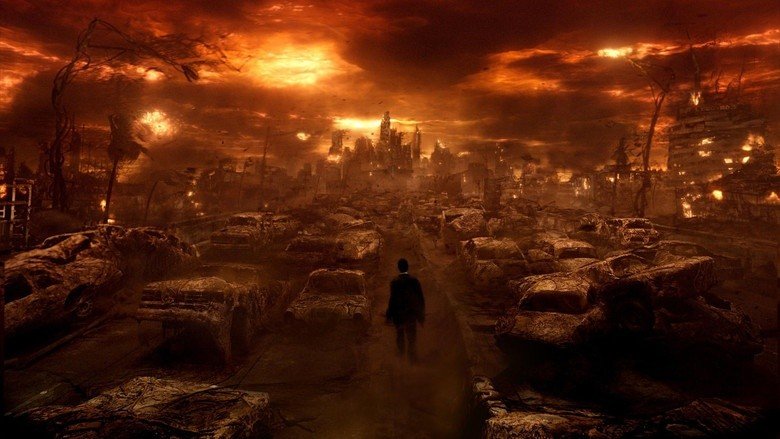
And the world he moves through is the real star. Francis Lawrence came from a decade of music videos and shot Los Angeles like a city under occupation: rain-slick downtown streets, a bowling alley that fronts for an armoury, a nightclub where angels and demons drink under a flag of truce. Then there is Hell itself, built from 1940s nuclear test footage — the same Los Angeles, frozen at the instant of the blast, winds tearing at a landscape of wrecked freeways and ash. It remains the most fully imagined Hell of its decade, and the crossings into it (a cat, a tray of water, a held breath) are staged as drownings, which is what they are. The mirror exorcism that opens Constantine’s casework — a demon too big for the girl it’s wearing, dragged out and trapped in glass — announces the whole method: horror played as procedure, procedure played as noir.
Two supporting performances walk off with the film, and they are the twin poles of its theology. Tilda Swinton’s Gabriel is an archangel played as impeccable middle management — androgynous, couture, quietly contemptuous of the species she administers. Corliss called her immaculately decadent, and the performance’s chill idea is that resentment of humanity isn’t a demonic position in this world; it’s a heavenly one. Gabriel doesn’t fall through lust or pride but through something colder: disgust at how cheaply forgiveness is handed out. Opposite her, in barely five minutes of screen time, stands Peter Stormare’s Lucifer — arriving in a white suit like a landlord come to collect in person, amused, punctilious, and the only power in the film who keeps his bargains to the letter. His entrance, with time stopped around a pair of slit wrists, is the best Devil scene of the modern era, and the negotiation that follows — a dying man selling the Devil information about his own son’s coup — is the film’s peak: damnation as a poker game where the pot is a soul and both players know the odds.
Between those poles, the machinery creaks, and honesty demands the creaks be logged. The Spear of Destiny plot — invented for the film, owing nothing to the comics — is a courier service for a macguffin: a spear tip crosses the map so that the climax can have a knife. Mammon, the would-be Antichrist, never becomes a character; he speaks through Angela and is dragged home before he can want anything on screen. Papa Midnite, gloriously tailored by Djimon Hounsou, exists to explain the rules and then guard a door. Chas — Kramer here, comics readers, not Chandler — is given appetite and loyalty but no arc before the film spends him for weight in the third act. And the middle hour leans hard on inventory: Max Baker’s Beeman, the armourer in the bowling alley, hands over bullet shavings from the assassination attempt on the Pope, holy water from the river of Jordan, and, you’ll love this, screech beetles — a charming scene, and unmistakably a shopping trip where a detective story should be.
What holds the middle up is Rachel Weisz, doing double duty as the Dodson twins: Isabel, the devout psychic who killed herself to deny Mammon his vessel, and Angela, the LAPD detective who refuses to let her sister be damned for it. Angela’s investigation is the film’s engine and its conscience — she is the only character whose motives are clean — and her reawakening, held under bathwater until the gift she suppressed comes back up screaming, is the ugliest and most tender thing in the picture: a blessing administered like a drowning, by a man who learned his own gift the same way. The film’s Catholicism is set dressing in places, but in the twins’ story it has a pulse — one sister who saw too much and broke, one who refused to see and is breaking.
The reputation’s story needs no shorthand. The film made $230.9 million worldwide on a reported $100 million — respectable, not coronation-sized, with two-thirds of it earned overseas — and then simply refused to die: cult status through the 2010s, a 4K restoration overseen by Lawrence released on the film’s twentieth anniversary in February 2025, and Reeves saying at every opportunity, for over a decade, that he wants to play Constantine again. As for the sequel — print the truth and only the truth: a Reeves-Lawrence sequel, announced in 2022, remains officially in development but ungreenlit; the principals’ accounts of its script have never quite lined up, James Gunn said in October 2025 that he hadn’t read one, and in November 2026 the trades reported DC Studios had hired a different writer, Francis Galluppi, to write a new Constantine film, with Reeves not mentioned and the studio declining to comment. Neither it’s coming nor it’s cancelled is a sentence the record currently supports.
Spoiler Section
Spoilers settle here, fiends — the ending and the Devil’s bargain are discussed plainly.
The climax earns its theology. Gabriel, revealed as Mammon’s divine assistance all along — Heaven’s own officer, opening the gate so that suffering can make humanity worthy — is undone not by Constantine’s arsenal but by his suicide: the one move that summons Lucifer personally. And the redemption that follows is the rare film grace that plays fair: Constantine spends his boon not on his life but on Isabel’s soul, and the sacrifice — witnessed, unbargained — is what lifts him. Lucifer’s response is the character in one gesture: furious at being cheated by the rules, he heals the cancer with his own hands and gives the man back his life, purely so time can damn him again properly. Even the post-credits grace note lands: Chas at his grave, wings out, ascending — the apprentice the film spent carelessly, remembered kindly. It doesn’t excuse the spending. It does complete the film’s argument that in this economy, nobody’s ledger is simple.
Trivia
- The man from the comics. John Constantine was created by Alan Moore with artists Stephen Bissette and John Totleben, first appearing in The Saga of the Swamp Thing #37 (June 1985); the artists, fans of The Police, deliberately drew him to look like Sting. Moore, burned by earlier adaptations of his work, refused any credit or association with this film and asked that his royalties be split among the character’s other creators.
- It was nearly called Hellblazer. The film carried the comic’s title through development before being renamed Constantine to avoid confusion with the Hellraiser films — the same confusion that had nearly renamed the comic itself in 1988.
- The version that never happened. Producer Lauren Shuler Donner began developing the film in 1997. Director Tarsem Singh was attached in 2001 with Nicolas Cage set to star — producer Akiva Goldsman recalled on the film’s reunion panel: We put it together with Nic Cage and Tarsem directing, we started prepping the movie, and then we stopped prepping the movie. Lawsuits followed; Francis Lawrence, a music-video director, got the job and made it his feature debut.
- Los Angeles plays itself. Reeves put it in his deal that the film shoot in Los Angeles rather than cheating the city in Toronto or Vancouver — Koreatown, Echo Park and downtown stand in the frame. Lawrence designed Hell from 1940s nuclear test films: the same city, held at the moment of the blast.
- An accidental R. The film was intended to be PG-13; the MPAA rated it R anyway, which Lawrence has attributed to its religious overtones — a verdict the director was still discussing, cheerfully enough, at the film’s fifteenth-anniversary reunion.
- The score that was too dark. Brian Tyler wrote and recorded some 110 minutes of score, which executives judged too sombre for the film’s wisecracks. With weeks left, Klaus Badelt was brought in to write new, lighter electronic material, which Tyler then conducted alongside his own — hence the shared credit, which is a rescue credit, not a collaboration from scratch.
- The girlfriend who vanished. Michelle Monaghan filmed several scenes as Ellie, a half-breed demon who is Constantine’s sometime lover and informant. Lawrence cut the role down to two brief shots and a single line — Holy water? — deciding the film worked better with Constantine lonelier.
- Mind the names. Chas is Kramer in this film and Chandler in the comics; the witch doctor is Papa Midnite, spelled without the gh, in both. And Angela’s LAPD partner, played by Jose Zuniga, is Detective Weiss — a homophone landmine in any cast list that also stars Rachel Weisz.
- Twenty years to the day. Warner Bros. released the 20th-anniversary 4K Ultra HD edition — a restoration overseen by Lawrence, with a new Reeves/Lawrence featurette, Two Decades of Damnation — on February 18, 2025, exactly twenty years after the film’s US opening.
Where to Watch
As of November 9, 2026, in the US: Constantine streams on HBO Max. Rent or buy it on Amazon Video, Apple TV Store and Fandango At Home. Collectors: the 20th-anniversary 4K Ultra HD is the edition to own. Listings rotate — check before you settle in.
The Verdict
Rating: 3.5 ravens out of 5.
So the verdict, fiends. Constantine is not the Hellblazer film the faithful wanted, and judged as an adaptation it will always carry that asterisk. Judged as what it is — a big, sombre, beautifully dressed studio noir about a dying man haggling with Heaven — it is one of the most distinctive horror films of its decade: a Hell built from test footage, an angel played as management, a Devil who keeps his word, and a hero whose superpower is that he has read the fine print of his own damnation. The plot machinery creaks, the villain never quite arrives, and none of it matters as much as it should, because the atmosphere is total and the bargain at its centre is perfect. Twenty years on, the critics’ shrug has not aged as well as the film has. He keeps on smoking — and twenty years later, the film is still burning too.
The weekly roundup
One letter a week, from the crypt.
- New reviews, with the ravens
- New wiki entries and news
- Cool stuff worth your night
Weekly. No spam, unsubscribe in one click.