Every horror fan keeps a short list of remakes they defend at parties, and mine has a werewolf on it. The Wolfman arrived in 2010 trailing two years of bad headlines — a director who walked away weeks before filming, a budget that ballooned, a release date that kept sliding — and it left theatres branded a flop, with the president of its own studio eventually calling it one of the worst movies Universal ever made. And yet. Underneath the wreckage of that production sits the most handsomely mounted Gothic horror film of its decade, a picture whose monster was built by hand, by the greatest makeup artist the genre has ever produced, and which carried an Academy Award home while the industry was still laughing at it. Both of those descriptions are the same film. That tension is exactly what makes The Wolfman worth your time — and what makes it so maddening.
The Wolfman (2010) is Universal’s lavish Gothic remake of its own 1941 classic: Lawrence Talbot comes home to Blackmoor and inherits his father’s curse.
Quick Specs
- Title: The Wolfman (one word)
- Year: 2010
- Director: Joe Johnston
- Screenplay: Andrew Kevin Walker and David Self, from Curt Siodmak’s original story and characters
- Cast: Benicio del Toro (Lawrence Talbot), Anthony Hopkins (Sir John Talbot), Emily Blunt (Gwen Conliffe), Hugo Weaving (Inspector Francis Aberline), Geraldine Chaplin (Maleva), Art Malik (Singh)
- Runtime: 103 minutes (theatrical cut; an extended cut adds roughly 17 minutes)
- Rating: R
- Not to be confused with: The Wolf Man (1941), the Lon Chaney Jr. original this film remakes, or Wolf Man (2025), the later, separate reboot.
The Premise
Blackmoor, England, 1891. Ben Talbot is dead, torn apart in the woods by something that walks like a man and kills like an animal, and his brother Lawrence — a stage actor long estranged from the family — comes home to Talbot Hall at the urging of Ben’s fiancée, Gwen Conliffe. The reunion with his father, Sir John, is cold enough to frost the windows. The locals blame a wild beast, or the Romani camped outside the village. Lawrence, being a Talbot and therefore constitutionally incapable of leaving a curse alone, visits the Romani camp on the night of a full moon — and walks away with a bite, a set of stitches from the Romani elder Maleva, and her warning, which becomes the film’s moral spine: only a loved one can release him now.
From there the machinery of the original story turns with grim pleasure. Lawrence heals too fast, hears too much, feels the moon pulling at him. Inspector Francis Aberline arrives from London, takes one look at Lawrence’s history — a childhood trauma, a year in an asylum — and decides the prodigal son is his most interesting suspect. And underneath it all sits the Talbot family secret, which the film holds back until it can do the most damage: the curse did not come to Blackmoor with Lawrence. It was already living in the house.
What Works
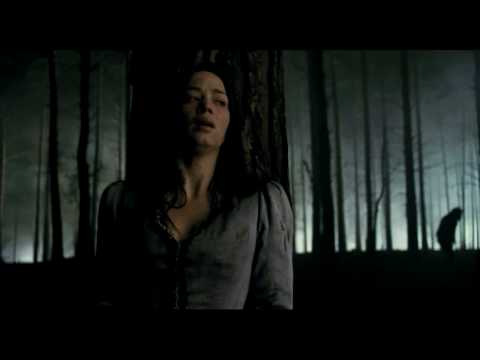
The craft, first and always. This is a film you can practically smell — woodsmoke, wet moorland, candlelit stone. Production designer Rick Heinrichs dressed Chatsworth House down for Talbot Hall, swamping a great stately home in weeds, dead grass and ivy, and Roger Ebert, in a review that was nobody’s idea of a rave, still singled out the atmospheric locations and the film’s melodramatic scope for praise. Cinematographer Shelly Johnson shoots the nights the way Gothic horror begs to be shot, all moonlight and fog, and Danny Elfman‘s score — dark, melodic and mournful — wraps the whole thing in exactly the right gloom. That score has its own survival story: it was set aside during the film’s troubled post-production in favour of a contemporary electronic replacement, the replacement was judged wrong for a period Gothic piece, and the released film uses Elfman’s music, adapted to the final cut. The film sounds like itself again. It matters.
The cast earns their keep, too. Del Toro was no hired gun — he is a lifelong fan of the 1941 film and a collector of Wolf Man memorabilia who championed this remake and produced it, and his Lawrence is all bruised stillness, a man carrying a childhood horror he cannot name. Entertainment Weekly‘s Owen Gleiberman praised the performance by comparing it favourably to Lon Chaney Jr.’s in the original, which is about the tallest compliment this role can be paid. Hopkins, meanwhile, plays Sir John with a silky, amused menace that keeps curdling into something worse, and Hugo Weaving’s Aberline gives the film a dry, dogged intelligence to push against.

The Makeup: Rick Baker’s Love Letter
If The Wolfman has a soul, it is sitting in Rick Baker’s makeup chair. Baker has said that the 1941 Wolf Man and Frankenstein are the films that made him want to become a makeup artist as a boy, and he pursued this job like a debt coming due. His governing decision, backed hard by del Toro, was fidelity: stay as close as possible to Jack Pierce’s 1941 design rather than reinventing the creature. Romanek, the original director, had gone through thousands of concept renderings; when Johnston took over, Baker went back to one of his earliest designs, and that is the face on screen — yak-hair wildness and all, updated with sharper claws and bigger teeth but unmistakably Pierce’s grandson.
The application took three hours each day, with an hour to remove, fresh prosthetics and loose hair laid on daily. Baker joked to Entertainment Weekly that the transformation was less extreme than it looked — that going from Benicio del Toro to Benicio del Toro as the Wolf Man mostly meant more hair and bigger teeth. The one honest friction: the transformation scenes themselves lean on CGI, which disappointed Baker, who doubted animators could match design knowledge earned over a lifetime; Johnston, arriving weeks before the cameras rolled, felt digital work gave him flexibility he did not otherwise have. Both men had a point, and the film shows it — the finished makeup is magnificent, the morphing between man and beast less so.
The Academy noticed the right half of that bargain. At the 83rd Academy Awards, Rick Baker and makeup effects supervisor Dave Elsey won Best Makeup — the category’s name as it then stood — for this film, and it also took the Best Make-Up honour at the 37th Saturn Awards. A supposed turkey, walking off with the industry’s top craft prize. That is not nothing. That is the film’s defenders’ whole argument in one statuette.
What Doesn’t Work
Now the other film, the one inside the first. The Wolfman was announced in March 2006; Mark Romanek was attached to direct in 2007 and left in January 2008, weeks before filming — “creative differences” is the official bucket, and into it go disputes about budget, tone, script and schedule that different accounts weight differently. Joe Johnston was hired on 3 February 2008 and had, by his own account, three weeks of prep before principal photography began on 3 March. The film shot that spring in Britain for a starting budget of $85 million, then went back for extensive reshoots in May 2009 — among other things, to put one of its werewolves down on all fours after the upright version played awkward, and to restore a London rampage and a clearer ending that had been cut for money. The editor was replaced in post, with Walter Murch brought in alongside Dennis Virkler. The release date moved five times, from November 2008 to 12 February 2010. By most trackers the budget finished at $150 million; The Numbers puts the worldwide gross at $142.6 million, Box Office Mojo at $139.8 million — short of that reported budget on either count, before marketing, which is why the word “flop” follows this film around.
You can feel some of that surgery on screen. The middle sags where material was lifted out and other material welded in; suspense, the one ingredient a werewolf film cannot fake, keeps leaking away between the set pieces — the recurring critical complaint, even in sympathetic notices, was a handsome film whose script could not generate genuine chills. Hopkins’s performance shifts temperature in ways that smell of scenes shot a year apart, because some of them were. And the father-son revelation at the film’s core, though faithful in outline to the material, lands with less devastation than it should: the film tells us about Lawrence’s childhood wound more often than it makes us feel it. When Universal president Ron Meyer, speaking at a festival panel in 2011, called it “one of the worst movies we ever made,” he was being cruel and quotable — but he was not inventing the disappointment out of nothing. He was just wrong about where it lived. The failure here is not effort or craft. It is nerve, lost somewhere between three directors’ worth of intentions. (Romanek counts; so does the studio that hired a replacement a month out and then reshot the result.)
Standing Next to 1941
The 1941 The Wolf Man is not merely a classic; it is the film that wrote the modern werewolf rulebook — the silver, the full moon’s curse, Maleva’s poem, the tragic gentleman monster. A remake was never going to outrun it, and this one is smart enough not to try. Where Curt Siodmak’s original is a lean, sad fable, Johnston’s film is a baroque family tragedy wearing the same fur: it keeps Lawrence, Gwen, Sir John and Maleva, keeps the bite and the silver and the loved one’s terrible duty at the end, and finds its own bleak grace note in making the curse hereditary in the worst way — a father handing ruin to his sons. It is a remake, not a sequel, and nothing in it pretends otherwise; no sequel followed, the 2012 Werewolf: The Beast Among Us is no continuation despite early plans, and the 2025 Wolf Man is a fresh reboot that owes this film nothing. What the 2010 film adds to the lineage is scale and sorrow and that face — Pierce’s design, rebuilt by the artist Pierce inspired. Later reassessments, from Awards Radar to JoBlo’s production retrospective, have been noticeably kinder than the first wave of reviews, and I think time is on their side.
Where to Watch
Checked November 9, 2026. Streaming with a subscription on HBO Max, and free with ads on YouTube. Rent or buy on Amazon Video, Apple TV and Fandango At Home. Streaming rights shift, so check your service before you settle in.
The Verdict
The Wolfman is a gorgeous, wounded animal of a movie: a masterpiece of Gothic craft and practical makeup wrapped around a script that keeps losing its nerve. See it for Baker’s monster, for the fog and the moonlight and del Toro’s haunted quiet, and forgive it the seams. It is too good to dismiss and too uneven to canonise — which, for a remake of a film that invented its monster outright, may be the most honourable outcome available.
Rating: 3.5 ravens out of 5 — superb Gothic craft and an Oscar-winning monster, held back from a 4 by a script that keeps trading suspense for spectacle.
The weekly roundup
One letter a week, from the crypt.
- New reviews, with the ravens
- New wiki entries and news
- Cool stuff worth your night
Weekly. No spam, unsubscribe in one click.