
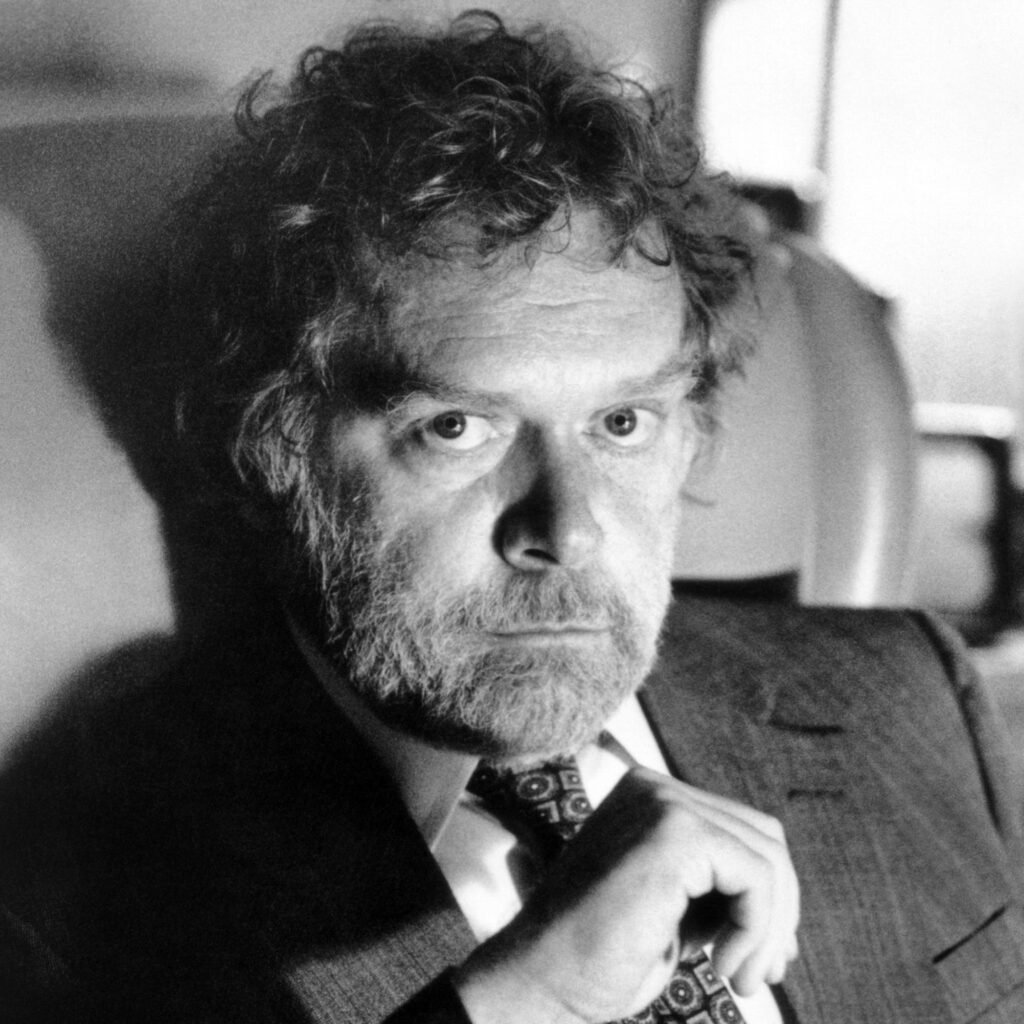
Ted Tally is the American screenwriter who adapted The Silence of the Lambs, won its Oscar, and refused to write Hannibal.
He is a playwright first — Yale-trained, Obie-winning — who came to film late and then wrote the screenplay that broke horror’s prestige ceiling. His method, stated in one line at an Austin Film Festival session, is the whole craft of adaptation: “Make the choice of whose story it is.” Everything else in his record follows from that discipline, including the refusal at its centre: offered the sequel everyone wanted, he read the novel, was horrified, and walked away. Tally is genuinely press-shy — no memoir, no official site, almost no personal publicity — so this page sticks to the documented record, which turns out to need no filling in.
Quick Specs
- Born: 9 April 1952, Winston-Salem, North Carolina
- Full name: William Theodore Tally
- Education: Yale University — B.A. 1974; Yale School of Drama — M.F.A. in playwriting, 1977
- Known for: The Silence of the Lambs (1991), Red Dragon (2002), Terra Nova (play, 1977)
- Honour: Academy Award for Best Adapted Screenplay, The Silence of the Lambs
The Playwright
Tally was born in Winston-Salem and started writing at thirteen — his own account is that the first plays came during his high school years. At Yale he took a B.A. in 1974 and an M.F.A. in playwriting from the School of Drama in 1977, and later taught playwriting seminars there himself. The Yale of his formation was, in his later description, a “holy temple of theater” in which writing for movies “was not desirable, and television was out of the question.” The fellowships came early: a CBS Foundation playwriting fellowship in 1977, a National Endowment for the Arts grant for 1983–84, a Guggenheim fellowship for 1985–86.
His signature play arrived while he was still a student. Terra Nova grew from Antarctic photographs that haunted him into researching Captain Robert Falcon Scott’s doomed 1911–12 South Pole expedition. After a staged reading at the Eugene O’Neill Theater Center, it was staged at the Yale Repertory Theatre in 1977. Discipline is needed on its honours, because they belong to different productions: the Obie Award came with the later New York production — the reference record dates it 1984 — and the Drama-Logue Award is dated 1979. A full production had followed at Chichester Festival Theatre in 1980, and Tally adapted the play for television in 1984. Coming Attractions, a satire in which a nobody criminal is manufactured into a television-celebrity killer by his agent, won the Outer Critics Circle’s John Gassner Award in 1981. The rest of the stage work — Hooters (1978), Little Footsteps, Silver Linings — is named here without narration, because beyond their publisher listings the reliable production record is thin, and this page does not pad. His early television work included scripts for The Comedy Zone and The Father Clements Story (1987), which won him the Christopher Award. The bridge to film was personal: in 1979 the British director Lindsay Anderson mentored him through developing Empire, a proposed film about the Indian Mutiny of 1857 that was never made. Tally’s own moral from it, repeated decades later: “No day spent writing is ever wasted.”
White Palace, and the Choice
His first feature credit is shared, and the sharing order matters. White Palace (1990), directed by Luis Mandoki from Glenn Savan’s novel, is credited to Ted Tally and Alvin Sargent: Tally wrote the original drafts, and Sargent — the veteran of Ordinary People — was brought in for the rewrite, a sequence on record from Syd Field, the consultant called in on the film. Tally has said he is drawn to strong female characters, naming White Palace‘s Nora Baker himself — the direct ancestor, in his work, of Clarice Starling.
The Silence of the Lambs (1991) was directed by Jonathan Demme from Thomas Harris‘s 1988 novel, and Tally is its sole credited screenwriter. The project had begun with Gene Hackman, who first recognised the novel’s potential and was set to direct before the Demme version took shape. What Tally did is documented in his own account of the adaptation. “I knew this had to be Clarice Starling‘s story,” he said. “Even though the book goes inside Hannibal Lecter’s mind, inside Crawford’s mind, inside Jame Gumb’s mind, the book basically follows the character of Clarice… Anything she’s not in… had to be cut, if possible.” The costs he names himself: Jack Crawford’s dying wife, which he “bitterly tried to hang on to” through the early drafts before cutting it by the third, and nearly all of Jame Gumb‘s background, so the audience learns about Buffalo Bill only as Clarice does. He had never been on a movie set before; visiting the Pittsburgh shoot, he found the multi-storey Lecter prison set built inside a jet-turbine factory and producer Ed Saxon laughing, “What hath Ted wrought?” — and judged, in his later recollection, that no subsequent script of his “came out so much like the movie in my head,” because he and Demme were “on a wavelength.”
The film’s economy is the famous part. Hannibal Lecter is on screen, by Tally’s own estimate, some fifteen to twenty minutes — published counts vary, because they count differently — yet dominates because, as he put it, “so many scenes are about him and he’s not there… the whole movie revolves around him, because he’s the key to the plot.” His verdict on the character he inherited: “the Sherlock Holmes of evil.” And his doctrine of the thing: “The better the villain, the better the hero. The better the villain, the better the plot, because the villain is the one who’s usually driving the plot” — followed immediately by the credit: “I was very, very, very lucky to inherit that character. I could not invent him to save my life.” One line of his is constantly misquoted in the culture, so the record: Lecter, played by Anthony Hopkins opposite Jodie Foster‘s Clarice, never says “Hello, Clarice” in this film. Tally wrote “Good evening, Clarice.” The misquote arrived with the sequel he refused to write.
The Oscar, and the Ledger Around It
Tally personally won one Academy Award: Best Adapted Screenplay, at the 64th Academy Awards on 30 March 1992, for The Silence of the Lambs — alongside, for the same film, the Writers Guild of America Award and the Edgar Award for Best Motion Picture Screenplay. The film’s Big Five sweep — Picture, Director, Actor, Actress and Adapted Screenplay — belongs to the film: it made Lambs only the third film ever to take all five, after It Happened One Night (1934) and One Flew Over the Cuckoo’s Nest (1975), and four of those statuettes belong to other people. The Writers Guild later placed the Lambs screenplay on its own greatest-screenplays list, at No. 61 in its 2006 ranking, and Syd Field built a quarter of his study of adaptation around the script as the model of the form. Austin’s moderator, the director Robert Rodriguez, praised Tally’s style of “creating long second acts and allowing a scene and the characters to ‘breathe'” — the long Starling-and-Lecter interview spine of Lambs being the architecture in question.
The rest of the credited filmography, kept unmerged: The Juror (1996), directed by Brian Gibson and starring Demi Moore and Alec Baldwin, Tally’s solo adaptation of George Dawes Green’s novel; and the same year, Before and After (1996), directed by Barbet Schroeder and starring Meryl Streep and Liam Neeson, his adaptation of Rosellen Brown’s novel — two 1996 adaptations, two different directors and novelists. Outbreak (1995) is not a Tally screenplay credit: the film is credited to Laurence Dworet and Robert Roy Pool, and Tally’s work on it was an uncredited rewrite — script-doctor work, documented as such. All the Pretty Horses (2000), directed by Billy Bob Thornton from Cormac McCarthy’s novel, carries his solo adaptation credit. He is credited as associate producer on Mission to Mars (2000), and in consultancy roles — story consultant on Shrek 2 (2004), creative consultant on Madagascar (2005) and Shrek the Third (2007) — real credits, stated at their real weight, not inflated into authorship of those films. 12 Strong (2018) is sequenced, not flat: the project was Tally’s script, from Doug Stanton’s non-fiction book Horse Soldiers, rewritten by Peter Craig; both men are credited.
The Refusal, and the Return
He did not write Hannibal (2001) — he turned it down, on the record, and the refusal is one of the best-documented facts of his career. The film was written by David Mamet and Steven Zaillian and directed by Ridley Scott, with Julianne Moore taking over Starling. Tally’s account: he and Demme “read it and were horrified… We didn’t see how we could make a movie from it that we could be proud of and not feel sleazy about it.” He has also named the size of what was being declined — a payday, as he put it, “putting us up there in Spielberg territory.”
Then he came back — to the beginning. Red Dragon (2002), directed by Brett Ratner, is Tally’s adaptation of Harris’s 1981 novel, the first Lecter book, eleven years after he adapted its sequel: Will Graham, played by Edward Norton, against Hopkins’s Lecter and Ralph Fiennes‘s Francis Dolarhyde. Production reporting notes that Tally added and expanded Lecter material beyond the novel’s proportions — the same economy problem as Lambs, solved the same way: scenes about Lecter even where Harris keeps him caged at the margins. It is a new adaptation of the novel, not a remake of anything, and the distinction has its own page-worthy history: the same novel was filmed sixteen years earlier as Manhunter (1986), written and directed by Michael Mann, with William Petersen as Graham and Brian Cox as Hannibal “Lecktor” — a film Tally had nothing to do with, as Mann had nothing to do with his.
The Working Method
What little of his process is on record is consistent across thirty years. At Austin he stressed that lessons learned on one script often “don’t carry over to the next writing project” — the humility of a man whose one indisputable masterpiece was made by a single ruthless choice, repeated nowhere else in quite the same form. The Washington Post‘s 1992 profile of him was titled “Writer Ted Tally and the Sacrifices of ‘Lambs'” — the sacrifices being his own word for the method: Crawford’s wife, Gumb’s history, everything that was not Clarice. The theatre training shows in the result. His scripts let scenes run long in the second act and let characters breathe inside them, rather than cutting away — the interview scenes in Lambs play like stage duets, two people in a room, because a playwright wrote them. And the reticence is part of the record too: where his peers built public personas, Tally let the credits speak, which is why the credits on this page are stated so exactly.
Why He Matters
Tally wrote the screenplay that broke horror’s prestige ceiling: a serial-killer horror film crowned by the Academy with the Big Five, after which the psychological horror-thriller could be prestige material rather than exploitation. The mechanism was his — horror organised as a heroine’s journey, the monster rationed to a fraction of the running time and made more frightening by the rationing — and every elevated serial-killer film since works in the space that structure opened. The double adaptation has no real parallel: the same novelist’s Lecter books, adapted a decade apart and out of order, with Tally the connective screenwriter of the Hopkins era at both ends — and the middle film publicly refused on craft grounds in between. He remains the adapter-as-author case study: one script, taught as the model of its form. The playwright who thought film barely a profession ended up defining what a horror screenplay could be — by choosing whose story it was, and cutting everything else.
Keep it locked on Think Horror — a census taker once tried to test us.