
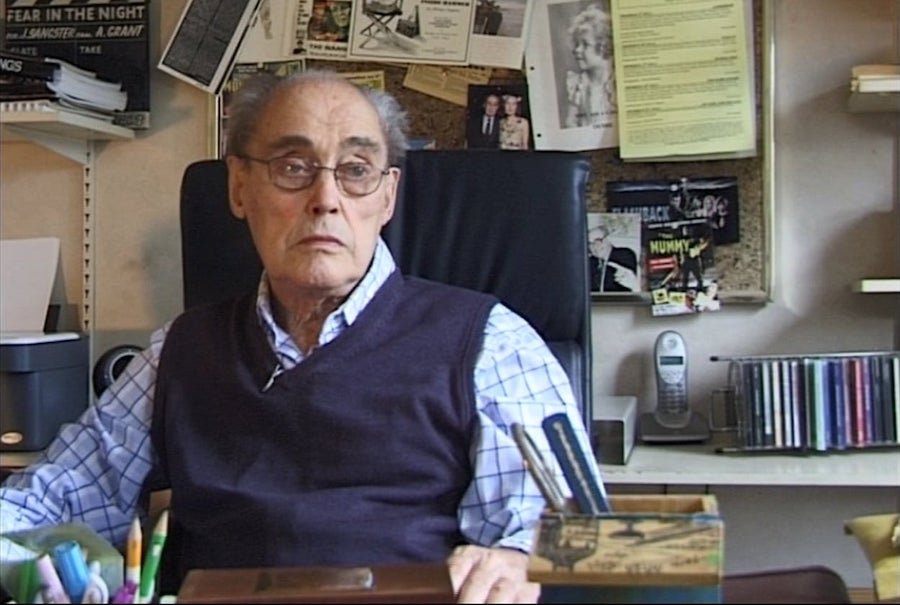
Jimmy Sangster (1927 to 2011) was the Welsh screenwriter who wrote Hammer’s The Curse of Frankenstein and Dracula, inventing its Gothic house style.
Quick Specs
| Born | December 2, 1927, Kinmel Bay, Denbighshire, north Wales (as James Henry Kinmel Sangster) |
| Died | August 19, 2011, at home in Kensington, London, aged 83 |
| Jobs | Screenwriter, producer, director, novelist |
| First script | A Man on the Beach (1955, a short) |
| First feature script | X the Unknown (1956) |
| Hammer Gothic screenplays | The Curse of Frankenstein (1957), Dracula (1958, US title Horror of Dracula), The Revenge of Frankenstein (1958), The Mummy (1959) |
| Pseudonym | John Sansom |
| Directed | The Horror of Frankenstein (1970), Lust for a Vampire (1971), Fear in the Night (1972) |
| American TV | Kolchak: The Night Stalker, Wonder Woman, Banacek, Ironside, McCloud, The Six Million Dollar Man |
| Memoirs | Do You Want It Good or Tuesday? (1997); Inside Hammer (2001) |
| Marriages | Monica Hustler (1950 to 1968); Sandra Nadeau (from 1972, later divorced); Mary Peach (1995 until his death) |
Who He Was
James Henry Kinmel Sangster was born on December 2, 1927, in Kinmel Bay, Denbighshire, in north Wales, the son of an estate agent. His middle name comes from the town, and the spelling matters: Kinmel, not Kimmel. He went to Ewell Castle School in Surrey.
He went into the British film industry at 16, around 1944, in junior floor jobs. The accounts differ on the first title, which is given as clapper boy, production assistant, or production assistant and projectionist, and later film loader and clapper operator. What is not in doubt is the shape: he started at the bottom of the floor crew.
After those first jobs he served in the Royal Air Force, stationed in India. Back in civilian life he worked as a third assistant director on Ealing Studios productions, among them The Captive Heart and Pink String and Sealing Wax. In 1949 he joined Exclusive, the company that became Hammer Film Productions.
At Hammer he climbed a ladder that had nothing to do with writing. He worked as a production assistant, then as an assistant director, including second-unit work, then as production manager on the studio’s B-pictures. Writing came out of that job, not the other way round. Hammer producers Anthony Hinds and Michael Carreras urged him to try a script. In his own retelling, his answer was: “I’m not a writer. I’m a production manager.”
He married three times. His first wife was Monica Hustler, a hairdresser on the early Hammer films, from 1950 until their divorce in 1968, and they had one son. He married Sandra Nadeau in 1972, and they later divorced. In 1995 he married the actor Mary Peach, who survived him.
From the late 1960s and into the 1970s he spent roughly a decade and a half working in Los Angeles, mostly in American television, before returning to London. He retired in the late 1980s, but he kept turning up at conventions, in interviews and on DVD commentaries, and a shelved script of his was filmed in Germany as Flashback in 2000. He died at his home in Kensington, London, on August 19, 2011. Born in December 1927, he died that August, before his birthday, so he was 83. No cause was announced.
The Work, and What He Did in It
A Man on the Beach (1955) was his first script of any kind, and it was a short film, not a feature.
X the Unknown (1956) was his first feature script, and his breakthrough. A radioactive, mud-like entity terrorises Scotland. The project was planned as a Quatermass film until Nigel Kneale refused permission to use his character, which is why the hero is a new scientist. Hammer sold the “X” in the title off the X certificate, as it had with The Quatermass Xperiment. Leslie Norman is the credited director.
The Curse of Frankenstein (1957) is the founding text of Hammer horror. Sangster wrote it; Terence Fisher directed, with Peter Cushing as Baron Frankenstein and Christopher Lee as the Creature. What Sangster did was supply a new story that owed little to Mary Shelley’s novel or to James Whale’s Universal film, and move the centre of gravity from the Creature to the creator.
His Frankenstein is a determined, charming, corrupt and sexually amoral dandy. He uses the Creature to murder the maid he has made pregnant, then sits prissily refined at the breakfast table, asking for the marmalade. Producer Anthony Hinds had commissioned Sangster to rewrite an earlier script, associated with Milton Subotsky and Max J. Rosenberg, that raised fears of looking too much like the Universal films, and the Hammer history record credits Sangster’s treatment with lifting the project from a black-and-white quickie to a colour production. It became Hammer’s first colour Gothic horror, and the film that made Cushing and Lee horror stars.
The censors noticed. In the Hammer history record, the British Board of Film Censors examiner Audrey Field reported on the script on October 10, 1956: “We are concerned about the flavour of this script,” which “goes far beyond what we are accustomed to allow even for the ’X’ category.”
Dracula (1958), released in the US as Horror of Dracula, was the even bigger hit. Sangster wrote it; Fisher directed, with Cushing as Van Helsing and Lee as Dracula. Sangster reused the Curse template with the polarity reversed. Cushing’s visionary is now the hero, a man thwarted by small-minded ineptitude while he tries to destroy Lee. Lee’s Count is active and virile, not a mesmerist in a cape.
The Revenge of Frankenstein (1958) was written the same year. Fisher directed again, and Cushing returned as the Baron, who has survived and is practising under an alias. Dracula and the Revenge both came out in 1958, alongside his scripts for other producers, and that speed is part of the record, not a dating error.
The Mummy (1959) completed the run: another Sangster script, another Fisher film, with Cushing and with Lee as Kharis. That is Hammer’s founding Gothic cycle, The Curse of Frankenstein, Dracula, The Revenge of Frankenstein and The Mummy, all written by Sangster and all directed by Fisher. Sangster directed none of them.
The Brides of Dracula (1960) is a shared credit. The screenplay is credited to Sangster, Peter Bryan and Edward Percy, with Anthony Hinds uncredited, and Fisher directed. Sangster wrote the original script, Disciple of Dracula. Bryan rewrote it, removing Dracula and adding Cushing’s Van Helsing, and Percy revised it further. Christopher Lee declined to return, the Count does not appear at all, and David Peel plays the vampire, Baron Meinster.
He was never Hammer’s alone. Because he was not under exclusive contract, he also wrote for the studio’s imitators:
- Blood of the Vampire (1958).
- The Trollenberg Terror (1958), released in the US as The Crawling Eye.
- Jack the Ripper (1959).
- The Siege of Sidney Street (1960), in which he turns up in a non-speaking cameo as Winston Churchill.
The thrillers were his own preference. By his own account he had little interest in the Gothic and liked twist-driven plots best. After Intent to Kill (1958) came Taste of Fear (1961), released in the US as Scream of Fear, a spec script he handed over only on condition that he could produce it. That made him a writer-producer, and he stayed one through a run of psychological crime pictures: Paranoiac (1963), and the two Bette Davis films The Nanny (1965) and The Anniversary (1968), both written and produced by Sangster. The Nanny was his personal favourite of his films, in the critic Tim Lucas’s account.
Dracula: Prince of Darkness (1966) is a split credit, and both halves have to be stated. The screenplay is by Sangster, writing as John Sansom, from a story by Anthony Hinds. Fisher directed, and Lee returned as Dracula, famously without a single line of dialogue. Why he is silent depends on who is telling it: Lee’s version is that he disliked the lines, while Sangster said he wrote none, and on another occasion, “Sorry, I have no idea.” The silence is the fact. The reason is not settled.
He directed exactly three features, all in the 1970s, and none of them is a classic-era Gothic. All three feature Ralph Bates.
- The Horror of Frankenstein (1970): his directing debut, which he also produced and co-wrote with Jeremy Burnham. It is a black-comedy semi-remake of The Curse of Frankenstein, with Bates as the Baron and no Cushing, and Sangster agreed to the remake on condition that he could direct it. It was double-billed with Scars of Dracula.
- Lust for a Vampire (1971): director only. The screenplay is by Tudor Gates. Sangster took over at short notice, about two weeks before shooting, when Fisher was sidelined by a road accident, and inherited a cast, a finished script and built sets. He clashed with the producers, including over the inserted pop song “Strange Love.” The film was produced in 1970 and released in January 1971.
- Fear in the Night (1972): director, producer and co-writer with Michael Syson, with Judy Geeson, Joan Collins, Peter Cushing and Bates. It is a woman-in-peril thriller in his Taste of Fear line, developed from Brainstorm, an unmade script he wrote for Universal in 1963. Kim Newman’s verdict in The Guardian is that it “is his best work as director.” It was also his last.
His later feature writing included Whoever Slew Auntie Roo? (1971), The Legacy (1978) and Phobia (1980), directed by John Huston. By then his main employment was American television.
In Los Angeles he wrote for Kolchak: The Night Stalker, Wonder Woman, The Six Million Dollar Man, Ironside, McCloud, The Magician, Banacek and the anthology Ghost Story, also known as Circle of Fear. He was not only a writer for hire on episodes: he also worked as story editor or scriptwriter on Banacek and Wonder Woman. His single Kolchak episode, “Horror in the Heights,” the rakshasa episode with Phil Silvers, is repeatedly singled out as one of the series’ best.
He wrote novels too. The first was Private I (1967), also published as The Spy Killer and filmed as a US television movie of that name in 1969. The Katy Touchfeather espionage books, Touchfeather and Touchfeather, Too, followed, along with Foreign Exchange (filmed for television in 1970), Snowball, Hardball, Blackball and Your Friendly Neighborhood Death Peddler, a backlist later republished by Brash Books. A previously unpublished Sangster novel, Fireball, was announced as discovered in 2019 and released in 2020.
He also wrote about himself and his trade. His memoir Do You Want It Good or Tuesday? was first published in 1997, with a US publication in 2009. Inside Hammer (2001) is his inside account of the studio, with script extracts, and Screenwriting: Techniques for Success (2003) is a working manual.
Cool Verified Facts
- He was a production manager, not a writer, when Hammer asked him to write.
- He wrote The Curse of Frankenstein and Dracula, but Terence Fisher directed both.
- John Sansom was his pseudonym. John Elder was a different man, Anthony Hinds.
- He did not write Hammer’s The Phantom of the Opera, which is Hinds as John Elder, or The Devil Rides Out, which is Richard Matheson.
- He plays Winston Churchill, without a word, in The Siege of Sidney Street.
- He took over Lust for a Vampire about two weeks before shooting.
- Every film he directed features Ralph Bates.
- His only Kolchak episode, “Horror in the Heights,” is one of the series’ most praised.
Signatures, Habits and Behind the Scenes
The creator, not the creature, is his defining move, and he made it twice in two years. In Curse, Frankenstein the man, brilliant, charming and ruthless, is the monster, and the Creature is his instrument and his victim. In Dracula the same template flips, so that Van Helsing is the driven visionary and Dracula an active, physical predator. It is the most consequential writing decision in Hammer’s history, and it is documented, not legend.
He wrote to the X certificate, not around it. His Hammer scripts were built for Britain’s adults-only X market, which Hammer had learned to work with The Quatermass Xperiment, and scripts went to the censors for advance comment so the finished film could be as strong as the certificate allowed without costly cuts. Colour only raised the stakes, as the Curse report shows.
Speed and economy were the house style, because he was a production manager who wrote. The scripts fit Hammer’s constraints: small casts, standing sets at Bray, and a producer’s sense of what could actually be shot on the money. The filmography shows the pace: in 1958 alone, Dracula and The Revenge of Frankenstein, plus scripts for other producers.
Under the Gothic is a thriller writer. The man who wrote the vampire films also wrote Taste of Fear, Paranoiac, The Nanny and Fear in the Night, and the Gothic scripts are engineered like thrillers: exposition held back, reversals planted, and the visionary-thwarted-by-fools engine reused because it worked. Kim Newman’s dry alternative explanation: “Sensing a formula which worked, or in a hurry.”
He talked his own work down, consistently, and that is his account of himself, not a verdict. To hear him tell it, he got the Frankenstein job because no one else would do it, and “simply typed it out and turned it in.” On DVD commentaries he affected surprise that anyone cared. The screenwriter Peter Atkins called him “a very self-effacing writer who was better than he thought he was.”
The pseudonym was a quality signal. He chose John Sansom because it kept his initials, he said, and because “I didn’t much like the finished shooting scripts.” The Sansom credit marks scripts he felt had been taken away from him.
Why He Matters
He wrote Hammer horror into existence as a house style. Before Sangster, Hammer was a B-picture studio. The 1957 to 1959 run, four Sangster scripts directed by Terence Fisher, created the colour Gothic formula: period settings, blood and sexuality inside the X certificate, and Cushing and Lee as its twin poles. The studio and its many imitators lived on it for fifteen years. Tim Lucas called him the Stan Lee of Silver Age horror.
He modernised the monsters by psychologising them. Moving the horror from the creature to the creator, the amoral, class-bound, breakfast-table Frankenstein, and making Dracula physical and erotic gave post-war horror its adult register. Every screen Frankenstein who is more interesting than his monster is working in Sangster’s structure.
He is the bridge figure of the whole Hammer system. Production assistant, assistant director, production manager, screenwriter, writer-producer and director, all inside one small studio, and then the author of its two house memoirs. That is why his testimony, properly attributed, sits under so much Hammer history.
And the second career is real. More than a decade as a working American television writer and story editor, on Kolchak, Wonder Woman and Banacek among others, plus a shelf of espionage novels, makes him one of very few British Gothic screenwriters who moved successfully into 1970s US network television.