
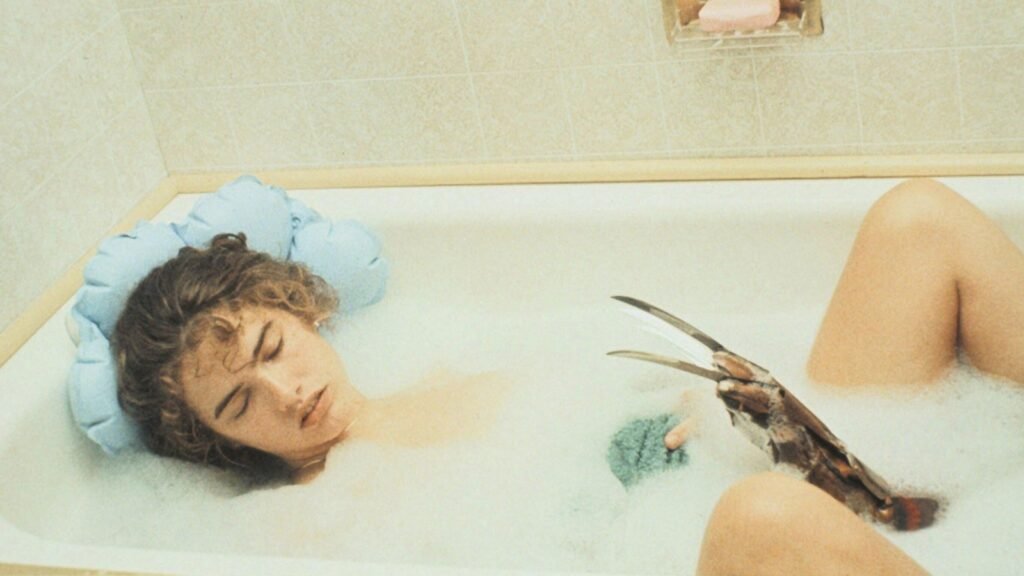
Nancy Thompson is the heroine who beat Freddy Krueger first — the original Elm Street final girl, played by Heather Langenkamp in 1984 and 1987.
Quick Specs
- Portrayed by: Heather Langenkamp
- Created by: Wes Craven
- Appears in: A Nightmare on Elm Street (1984) and A Nightmare on Elm Street 3: Dream Warriors (1987)
- Home: 1428 Elm Street, Springwood, Ohio
- Parents: Lt. Donald Thompson (John Saxon) and Marge Thompson (Ronee Blakley)
- Status: Deceased — killed by Freddy Krueger in Dream Warriors (1987)
- Series: Nightmare on Elm Street franchise
1428 Elm Street, 1984
Nancy Thompson is a middle-class teenager with divorced parents and a boyfriend across the street when she and her friends start dreaming about the same man — burned, gloved, patient. What separates her from every teenager in every slasher film before her is what she does about it: she investigates. Tina dies at a sleepover Nancy arranged to keep her safe. Rod hangs in a jail cell for a murder Freddy committed. Glen, who researched dream lore for her, is pulled into his own bed. Nancy, mainlining coffee and booby-trap manuals, drags the truth out of her mother instead: the dream man is Fred Krueger, a child murderer the neighborhood parents burned alive after a legal technicality set him free — and Marge has kept his glove in the furnace all these years, the way you keep evidence against yourself. The bars Marge installs to lock Nancy in tell you everything about how this family handles the truth.
At a sleep clinic, Nancy makes the discovery the whole series runs on: asleep, she grabs Freddy’s fedora — his name written inside it — and wakes holding it, with cuts on her arm and a streak of gray burned into her hair. What crosses over can be fought. So she builds the fight: a house full of traps, a father stationed to break in on a twenty-minute timer, and herself as bait. She pulls Freddy Krueger bodily into the waking world, runs him through every trap she built, sets him on fire and locks him in the basement — and he still gets upstairs to her mother. What the audience sees in 1984 is a burning Freddy smothering Marge in her bed before both of them vanish into the mattress; the line Nancy later uses in Dream Warriors, that her mother “died in her sleep,” is her summary of it, not the mechanism, and this page keeps the two separate. Alone with Freddy risen again, Nancy uses the last weapon Glen’s research gave her: she turns her back. “I take back every bit of energy I gave you,” she tells him. “You’re nothing. You’re shit.” Starved of her fear, he lunges — and evaporates. It is the cleanest kill in the franchise. It is also not the ending.
The ending that argues with itself
What follows is a coda at war with the film it concludes: a foggy morning, everyone alive, Glen’s convertible — whose roof snaps down striped in Freddy’s red and green, locking the laughing teenagers in as it speeds away, while across the street Freddy’s arm bursts through the Thompson front door and pulls Marge through its little window. The compromise is documented, not rumored. Craven wanted the film to end on the turn of the back: “I felt that the film should end when Nancy turns her back on Freddy and his violence — that’s the one thing that kills him. Bob wanted to have Freddy pick up the kids in a car and drive off, which reversed everything I was trying to say.” Producer Robert Shaye wanted a sequel-shaped sting; the striped convertible roof was the treaty. The readings have never settled — the coda exposes the whole film as one long dream; or, as one careful reading has it, both of them won: Nancy took Freddy’s power by refusing fear, and Freddy won anyway, because everyone she loved was dead. Craven himself called the change his regret: “it’s the one part of the film that isn’t me.” Print the fight and the coda together, the way audiences have had to hold them for forty years. She won. The car drove off anyway.
The diary, and the grave
Nancy does not appear in Freddy’s Revenge (1985) — this page lists it because every filmography that includes her gets it wrong. What survives is her diary, found by the new teenager in her old room at 1428 Elm Street, recounting the first film like a field manual left by a previous occupant of a haunted house. What became of Nancy between films, the sequel never says. She is absent as a character from The Dream Master (1988) — fandom accounts note her headstone glimpsed in one scene, which this page carries as a fandom report, not a verified appearance — and from The Dream Child and Freddy’s Dead entirely. Her story in the films is two chapters. The second one ends her.
Dream Warriors: the mentor
Three years on, Nancy Thompson is a young adult in graduate school for psychology, hired as a student intern — an intern therapist, in the phrase the coverage agrees on; the “psychiatrist” label that follows her around comes from one film summary and is wrong — at Westin Hills, where the last of the Elm Street children are warehoused as suicides-in-waiting. She recognizes them because she is them: her “groundbreaking research on pattern nightmares” is a survivor’s testimony with a bibliography. When a patient named Kristen Parker pulls Nancy into her dream — Kristen’s own gift, present since childhood, for pulling other sleepers into her dreams, the mirror image of Nancy’s gift for pulling things out — Nancy finally has colleagues. She teaches the group to fight inside the dream, champions the experimental dream-suppressant Hypnocil she has been taking herself, and gets suspended for it when a patient falls into a coma. The powers distinction matters and the retellings blur it: Kristen’s power was never Nancy’s, and when Kristen later passes a power on, in The Dream Master, it is her own she gives to Alice. Nancy’s gift ends with Nancy.
It ends in the dream, doing the job. While Dr. Neil Gordon and her father go to bury Freddy’s bones in consecrated ground, Nancy rejoins the patients — and Freddy comes to her wearing her father’s face, claiming to have crossed over and wanting to say goodbye. She embraces him, and he stabs her with his own glove; the accounts vary on the wound’s location, and this page prints the mechanism rather than pretend otherwise. Dying, she rises once more and drives the glove into Freddy herself before he can reach Kristen, as the bones are buried and burned miles away. She dies in Kristen’s arms, and Kristen makes the promise the series never improved on: she will dream Nancy into a beautiful dream. Langenkamp, looking back, was unsparing about her own work in the film: Nancy had become “a facilitator… a kind of a reassuring presence in the movie rather than this fighting, battle warrior that she was in the first movie” — and she decided the relationship with the kids carried it anyway. She was right, and so was her unease: the Nancy of 1987 is a guardian, and guardians in this series are spent like ammunition.
Two things that are not Nancy appearances
Wes Craven’s New Nightmare (1994) is listed on Nancy’s filmography everywhere, and it does not belong there as an appearance. In that film Langenkamp plays a fictionalized Heather Langenkamp who, as the entity closes in, embodies Nancy — takes up the streak, the pajamas, the role — one last time. The character Nancy Thompson does not exist inside that film’s story; the actress does. This page counts it as the role’s afterlife, not its third chapter. And the 2010 remake’s heroine is Nancy Holbrook, Rooney Mara’s character — a different young woman with a different surname, family and wound, whose connection to Thompson is a first name and an homage. Wikipedia, asked why the surname changed, can only record that the reasoning is unknown. So can this page.
The look
Two details carry Nancy visually, and both were decisions. The gray streak was meant to be her whole head: Craven had a full gray wig made, disliked it, and settled for the single streak that appears after the clinic dream and stays — through Dream Warriors, and again when Langenkamp embodies the role in 1994 — a piece of the dream she could never take off. (One reading of it, carried here as its author’s framing: trauma made visible, a lock of hair the nightmare bleached and time never restored.) And the white pajamas with the blue trim and roses, designed by costume designer Dana Lyman, who has described the outfit as “her armor as she went into battle.” Horror’s most famous final girl goes to war in sleepwear, and the sleepwear is the point: Nancy’s battlefield is the one place everyone else is unarmed.
Casting Heather Langenkamp
Langenkamp came from Tulsa, from extra work in Francis Ford Coppola’s Tulsa-shot films (her scenes were cut, though a surviving speaking bit earned her union card), from a small independent drama and a place at Stanford. She auditioned in the winter of 1983, nineteen years old, for a heroine written as fifteen — print both numbers, because the “fifteen-year-old star” version is a durable error — and by the account preserved in Hutson’s history of the franchise, she improvised a clawing motion and a screech in the room that helped end the search. Craven wanted, in his words, someone very “non-Hollywood,” an “all-American, girl-next-door,” and believed she embodied it. The reported figure is that she beat out more than 200 other actresses; treat that as the record’s reported figure, not an audition ledger. The famous near-misses should be printed only with their correction attached: Courteney Cox and Demi Moore were long rumored to have auditioned, and casting director Annette Benson has ruled both out — unsure on Tracey Gold and Jennifer Grey, silent on Claudia Wells. Langenkamp was reported to have won a Best Actress award at Avoriaz for the role; Craven, for his part, came back in 1986 and asked her permission to write Nancy into Dream Warriors — his draft kept her closer to the first film’s fighter, and though the characterization softened in production, her death, he had already decided, stayed.
Why she lasts
The scholarship started with Carol J. Clover, whose 1992 Men, Women, and Chainsaws built the “final girl” theory and called Nancy “the grittiest of the Final Girls” — watchful to the point of paranoia, competent with tools and traps, the survivor who meets the killer and takes him on. The argument since is whether Nancy fits the theory or breaks it: Shannon Keating reads her as Freddy’s equal in the audience’s affection, surpassing the trope’s stereotypes; Don Sumner goes further and calls her its antithesis — a heroine whose proactivity means the victimhood the theory presumes never applies. Craven had given his own verdict years earlier, in 1988, and it remains the strongest sentence written about her: “She refused to accept her parents’ lies… She stayed awake, she took responsibility for being a conscious human being, and it’s the one thing that saved her life while everybody else slept and died.” The list-makers have spent decades agreeing without converging — ranked the number one final girl of the 1980s in one accounting and by resourcefulness in another, third on a 2026 list of the twenty-five best — and the franchise’s own peers voted with their pens: Stranger Things’ heroine is Nancy Wheeler, a namesake the connection of which is attributed to a 2016 account of the show’s influences. Her afterlife beyond the films is real but fenced: in the comics continuations of the early 1990s — comics continuity, not film canon — Nancy’s soul becomes the Beautiful Dream’s agent against Freddy, and she returned decades later in a crossover finale; in the 1989 computer game she is playable, her dream power freezing enemies in place. The films gave her two appearances, one diary, one headstone and one promise. It was enough. Start where she starts, at the 1984 original, then watch her finish it in Dream Warriors — or browse the whole war on the franchise hub, beside the man she beat on the Freddy Krueger page and the actor who outfought him across eight films on Robert Englund’s.