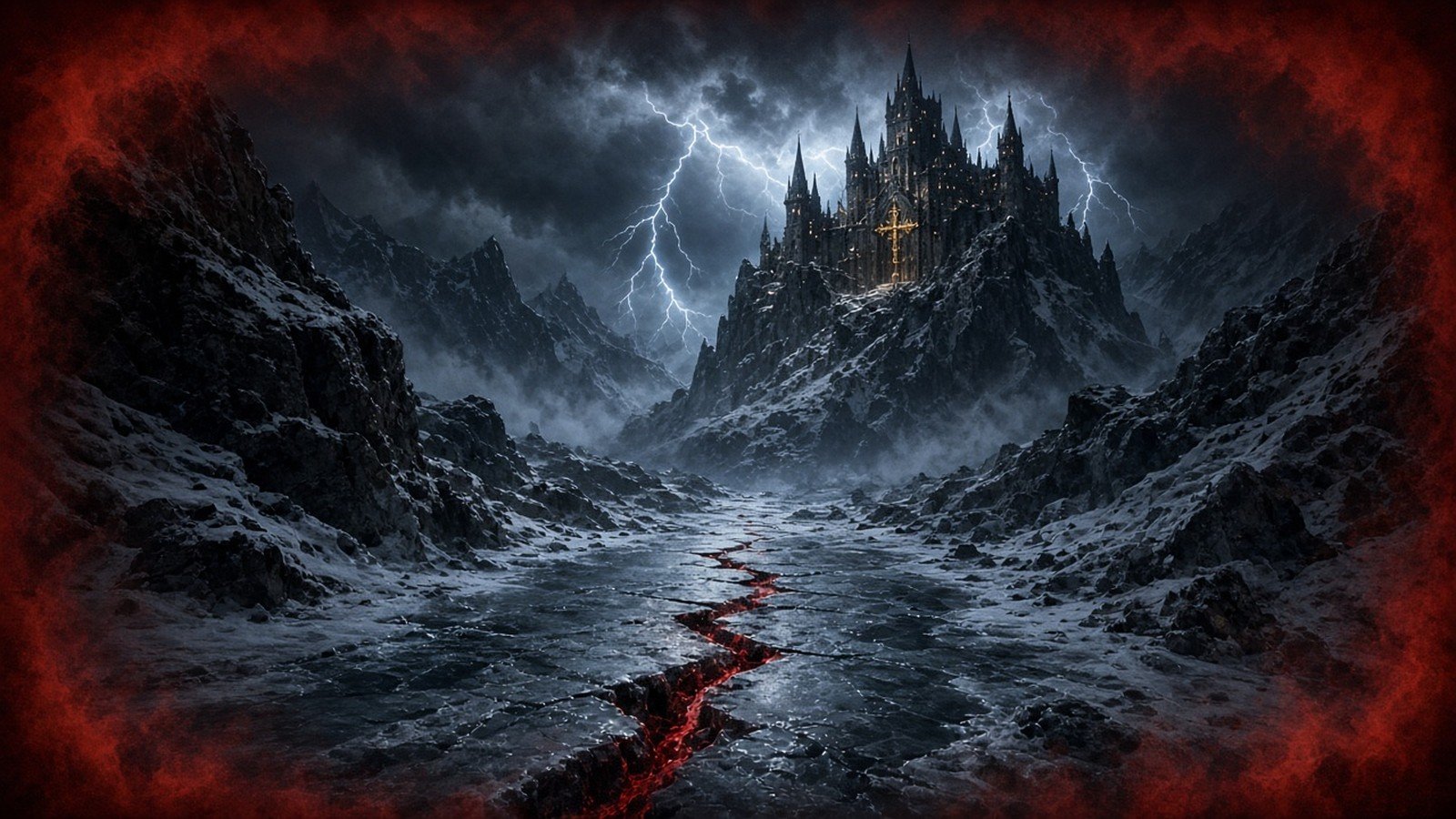
The bell is ringing, and you are standing in the churchyard when you realise something is wrong with the sound of it. It is not the clean toll of a Sunday morning. It is muffled, and wet, and wrong — as if something soft is caught up inside the bell itself, deadening the bronze. The altar boy is pulling the rope with both hands, his face white, and he will not speak again for a year. Not a word. Whatever he found up in the belfry took his voice with it.
Look up. The castle is on the mountain above the village, black against the sky, and its shadow is falling across the church — across the whole church, roof to door — and the villagers will not go inside while that shadow touches the stones. They have not been to Mass in a year. The priest drinks in the tavern now instead of saying the liturgy, and nobody blames him, because the shadow is still there every evening, and the bell is still ringing wrong, and everyone in the village knows whose castle that is.
A man in black is climbing the mountain path toward it, carrying a cross big enough to bar a castle gate. He means to end this. He is about to make it worse.
Welcome to the village below Castle Dracula, horror lover. Pull up a chair in the tavern. This is the one where the priest’s blood brings the Count back by accident — and the cross that was meant to keep him out becomes the thing that kills him.
Dracula Has Risen from the Grave (1968): Christopher Lee returns as a Count revived by accident, barred from his own castle.

Quick Specs
- Director: Freddie Francis (taking over from Terence Fisher, who broke his leg in a car accident in pre-production)
- Screenplay: John Elder (Anthony Hinds)
- Starring: Christopher Lee (Count Dracula), Rupert Davies (Monsignor Mueller), Veronica Carlson (Maria Mueller), Barry Andrews (Paul), Barbara Ewing (Zena), Ewan Hooper (the Priest), Marion Mathie (Anna), Michael Ripper (Max), George A. Cooper (the Landlord)
- Music: James Bernard
- Cinematography: Arthur Grant
- Editor: Spencer Reeve
- Producers: Aida Young
- Production Company: Hammer Film Productions
- Distributor: Warner-Pathé Distributors (UK), Warner Bros.-Seven Arts (US)
- Premiered: November 1968 (UK — 7 vs. 24 November, sources differ); February 6, 1969 (US)
- Runtime: 92 minutes
- Rating: G (US)
- Budget: £175,000 (per Wikipedia, citing Wayne Kinsey’ Hammer Films: The Elstree Studio Years)
- Box Office: No gross figure exists — reported as Hammer’s biggest hit to that point (Wikipedia calls it Hammer’s highest-grossing film; MeTV the most commercially successful Hammer film to date)
- On This Site: Dracula Has Risen from the Grave (1968) film page
The Review
First, the director — because this film is not a Terence Fisher film, and everything about it follows from that.
Terence Fisher directed the first two Lee Draculas, Horror of Dracula (1958) and Dracula: Prince of Darkness (1966), and he was meant to direct this one too. Then he broke his leg in a car accident in pre-production, and Hammer turned to Freddie Francis — an Oscar-winning cinematographer before he was a director, a man who had shot The Innocents (1961) and knew exactly what a camera could do to a face in the dark. It was the first Hammer Dracula without Fisher at the helm, and Francis did not try to be Fisher. He made something else: a lush nightmare, in Midnight Only’s words, a film that looks like a fever dream and plays like a sermon.
The look is the first thing you notice, and it is the reason the film is still discussed. Arthur Grant photographed it using coloured filters belonging to Francis — the same filters he had used on The Innocents — and whenever Dracula or his castle is in a scene, the edges of the frame are tinged crimson, amber and yellow, pulling your eye to the centre of the screen and making the whole world feel lit from inside by something unholy. Slant calls them “yellow-brown gels around the frames’ edges”; Spooky Isles says the effect frames the outer sides of the image in reds and yellows “at some critical points… pulling your focus to the centre part of the screen.” The rooftops of the Monsignor’s home city — a spectacular set built at Pinewood, all skewed angles and painted backdrops — are the closest Hammer ever came to full expressionism, in Spooky Isles’ words, calling to mind The Cabinet of Dr. Caligari (1920) and Faust (1926). The film is in colour throughout, and the colour is doing the storytelling. This is not a film you watch for the plot. It is a film you watch for the way the red creeps in at the edges of the frame whenever he is near.
And the plot, horror lover, is a trap — a trap the film sets for Dracula himself, and the trap is the whole story.
A year after the events of Dracula: Prince of Darkness, in which Dracula was destroyed in icy water, the village below his castle is still living in his shadow — literally. The shadow of the castle falls across the church, the villagers refuse to attend Mass, the local priest has lost his faith and drinks at the tavern, and the altar boy who found a girl’s corpse crammed inside the church bell has been mute ever since. Monsignor Mueller comes on a routine visit, finds an empty church and a broken priest, and decides to end it: he climbs the mountain to the castle and performs an exorcism, fixing a large metal cross to the castle gate. The priest follows only partway up. Mueller finishes the rite alone.
Here is the thing nobody in the film understands until it is too late: the exorcism works — and working is the disaster. The cross bars Dracula from his own castle. He cannot go home. And while the priest is fleeing down the mountain in a thunderstorm, he stumbles, strikes his head on a rock, and is knocked unconscious — and his blood trickles through a crack in the ice of a frozen stream, down onto Dracula’s lips where the Count lies frozen beneath the ice, and Dracula wakes up.
Get this right, because every bad summary gets it wrong: nobody revives Dracula on purpose. There is no ritual, no servant, no ceremony. In Prince of Darkness, the servant Klove revived him deliberately; here Klove is nowhere, and the revival is an accident — a frightened priest’s head wound, a crack in the ice, a few drops of blood. The film’s horror is not that someone called the Count back. It is that the world did it by mistake, while trying to be rid of him.
And the Count who wakes up is furious, and he has a plan. He enslaves the priest — the same priest whose blood woke him, now his creature, his eyes and hands — and forces him to reveal the name of the exorcist. Then he makes the priest desecrate a coffin to give him a sleeping place, and follows Mueller home to his city, where he means to take revenge on the Monsignor’s beautiful niece, Maria. The castle is barred to him, so he installs himself in the café cellar below the tavern — the Café Johann — and goes to work the way Dracula always goes to work: through the people around his target. First the barmaid, Zena, whom he bites and enslaves and sets to luring Maria to him. Then Maria herself, bitten in her own bedroom while the rooftops watch.
Zena is worth a pause, because she is the film’s most interesting victim and the one most summaries get wrong. She is not a bride. She is not a vampire. She is a tavern girl Dracula bites and enslaves, who nearly succeeds in bringing Maria under his power — and when she fails, Dracula kills her himself and orders the priest to burn her body in the bakery ovens before she can turn. She dies a servant, not a consort, and the film is colder for it: Dracula does not love his instruments. He uses them up and has them burned. Barbara Ewing plays her with a desperate, hungry energy that the Monthly Film Bulletin singled out at the time, praising her death scene — she “dies with an expression of triumphant and satisfied lust frozen on her face,” in the Bulletin’s words — and Ewing takes the acting honours in a film where most of the cast is there to be handsome or holy. She is neither. She is hungry, and the film lets her be.
The hero, meanwhile, is the film’s great gamble, and the gamble is the reason the film is a parable rather than just another Dracula picture. Paul — Maria’s boyfriend, a bakery worker under Max, who runs the café — is an atheist. He says so at dinner with Maria’s family, to the Monsignor’s open displeasure, and the film does not treat it as a quirk. It treats it as the load-bearing fact of the whole story. Because when Paul and the priest finally find Dracula’s coffin in the café cellar and drive a stake through his heart, the rite fails — the faithless priest and the atheist Paul cannot say the required prayer, and Dracula rises and pulls the stake out of his own chest himself. Christopher Lee objected to the scene when he read it, and later conceded that “the audience at the time thought it was stunning.” He was right to object and right to concede: it is the film’s thesis in one image. A stake is just wood. Without faith, it is nothing. The film is the most religiously themed Dracula Hammer ever made, in TV Guide’s words, and it means it — the whole plot is a proof that the weapons only work if you believe in them.
That is also why the ending works, and why it is one of the great images in all of Hammer. Dracula kidnaps Maria and flees to the castle, pursued by Paul and the priest. At the castle he orders Maria to remove the cross from the door — the same cross Mueller fixed there, the cross that barred him from his own home — and she throws it over the parapet into the ravine below, where it lands upright, wedged between the rocks. Paul fights Dracula on the parapet, and during the struggle Dracula falls over the side — and lands on his back, impaled on the cross. The priest, freed at last from the vampire’s influence, recites the Lord’s Prayer in Latin, and Dracula perishes, dissolving into dust. Paul, reunited with Maria and having apparently regained his Christian faith, crosses himself while looking at the remains. The cross that locked Dracula out becomes the stake that kills him. The prayer Paul could not say in the cellar is the prayer the priest says on the mountain. The film closes its own circle, and it closes it with a crucifixion — Dracula impaled like a butterfly on a large gilt cross, in the Monthly Film Bulletin‘s phrase, weeping tears of blood in some accounts of the scene. It is the most iconic death in the Hammer Dracula cycle, and it is the image the film was built to reach.
The man at the centre of it is Christopher Lee, in his third outing as the Count, after Horror of Dracula and Prince of Darkness — and this time, he speaks. In Prince of Darkness Lee had no lines at all (his own account: “I didn’t speak, because I said I couldn’t say the lines”), and the silence became famous. Here he gets his voice back, briefly — a handful of lines, delivered, as one reviewer puts it, “with heaping amounts of hate in his voice,” most memorably ordering the cross got out of his sight. It is not a large speaking role, and the film does not pretend otherwise. But after the mute Count of 1966, hearing Lee snarl again is the film’s small gift to the audience, and his eyes do the rest of the talking: bloodshot and red whenever his hunger rises, in Slant’s Eric Henderson’s words, “frequently and unnervingly bloodshot whenever his sexual drive begins to rev into gear.” Lee is barely in the film — the complaint every review makes, then and now — but when he is on screen, the frame tilts toward him, and the coloured filters do the rest.
The production around him was a scramble with a happy ending. Fisher’s broken leg handed the film to Francis; Hammer had moved out of its old home at Bray Studios and was working on hired stages — Pinewood, in this film’s case, not Bray and not Elstree, whatever the fandom pages say. The move is visible on screen: the film lacks the approach road, coach path and moat of the Bray-shot predecessors, and Bernard Robinson’s new castle exterior had to be built to match the old standing set. The cast came with its own stories: Rupert Davies, the Monsignor, was the stern moral centre the film needed; Veronica Carlson, Maria, was a Hammer discovery — Classic Monsters carries the story that she was spotted bikini-clad in a newspaper — and she went on to two more Hammer films, Frankenstein Must Be Destroyed (1969) and The Horror of Frankenstein (1970). Ewan Hooper, the priest, had all of his dialogue dubbed in release prints, for reasons nobody has ever quite explained — his own voice was perfectly acceptable, and the dubbing leaves lip-sync slips in the final scene. And behind it all, the film was sold before it was made: James Carreras sold the package to the American distributors, Warner-Seven Arts, on the strength of Lee appearing in the title role, without ever asking Lee — who was appalled at the prospect of another Dracula and only conceded when a pay hike was offered. Lee’s own account of the pressure is blunter: Carreras told him he had already sold it with Lee in the part, and to think of all the people he would put out of work. That is the story as Lee told it, and it is printed here as his account, not as a contract fact.
The critics of 1968 were not kind, and the split is the story. Variety called it “a tired episode,” adding, “The story’s slight, the horror and the bloodcurdling essential to these pix is minimal and even Dracula himself appears bored at being resurrected yet again.” Howard Thompson of the New York Times was blunter still: “Dracula Has Risen From The Grave. Yes, again. And judging by this junky British film in color — a splatter with catchup or paint or whatever, to simulate the Count’s favorite color — he can descend again.” The Monthly Film Bulletin was the kindest of the three, finding the film “rather short on shock sequences” but praising Francis’s “pleasing colour compositions,” Lee as “his customary suave self,” and Ewing’s Zena. The Hammer Story (Hearn & Barnes, 2007) splits the difference in a phrase that has stuck: “a minor triumph of style over content,” the film “succeeds by virtue of Francis’ adventurous direction.”
Later opinion has been kinder, and the kindness has a reason: the style is the content, once you stop expecting a Fisher film. Classic Monsters calls it “one of the most profitable and successful films in the entire series” and “a masterpiece of style,” saying Francis “brought a style to the film which sets it apart, certainly from its successors.” Midnight Only calls Francis “an inspired substitute” for Fisher and the film “a lush nightmare.” Spooky Isles says that “if not the absolute pinnacle of Hammer’s output, the passing years have been quite kind to Dracula Has Risen from the Grave.” The audience voices on the page say the same thing the retrospectives say, that the film is a minor triumph, a dreamlike painting of a picture, held back only by how little Lee is in it. Slant’s Eric Henderson gave it 3 out of 4, and the modern consensus is that the film’s reputation has only grown since 1968.
One more thing worth knowing before you watch: the film travelled well. In Australia it was the first Hammer Dracula to be passed by the censors — the previous two had been banned outright — and it ran a three-week season at Sydney’s Capitol Theatre in January 1970, slightly censored. And commercially, whatever the critics said, it worked: no gross figure survives, but the film is reported as Hammer’s biggest hit to that point, and Classic Monsters counts it among the most profitable and successful films in the entire series. The audience that stayed away from the church in the film kept turning up at the cinema in real life.
And a word on the names, because the film’s paperwork is a mess and the review should not pretend otherwise. The Monsignor is Mueller in the cast list and Muller in some accounts, Ernest in some and Ernst in others — this review uses Monsignor Mueller, the cast-list form, and calls him the Monsignor after that. His home city is spelled three different ways across the sources, so it is not named here at all. The story is set a year after Prince of Darkness, and no calendar year is printed, because the sources cannot agree whether that means 1896 or 1905. Anna is the Monsignor’s widowed sister-in-law and Maria is his niece; whether Anna is also Maria’s mother is claimed by one source only, so it is not printed. Paul has no surname in any reliable source — the “Paxton” you will see in one mirror site is not used. And Peter Cushing does not appear in this film at all: there is no Van Helsing here, and the Monsignor is the moral authority. If a summary tells you Cushing plays a bishop in this one, it is inventing him.
Spoiler Section
Stop here if you have never seen it. The Count keeps his secrets for first-timers.
It opens with the bell. A young altar boy discovers the corpse of a young woman crammed inside a church bell — another victim of Count Dracula — and the shock leaves him mute. A year later, Monsignor Mueller arrives in the village, finds the church empty because the castle’s shadow falls across it, finds the priest drinking in the tavern having lost his faith, and decides to exorcise the castle. He climbs the mountain with the reluctant priest, who follows only partway; Mueller fixes a large metal cross to the castle gate and performs the rite alone. The cross bars Dracula from his own castle — no action in the film ever takes place inside its walls again.
During a thunderstorm, the fleeing priest stumbles, strikes his head on a rock, and is knocked unconscious. Blood from the wound trickles through a crack in the ice of a frozen stream and onto Dracula’s lips below, where he lies frozen beneath the ice from his destruction in the previous film. Dracula wakes. He enslaves the priest, forces him to reveal the exorcist’s name, has him desecrate a coffin for a sleeping place, and follows Mueller to his home city to take revenge on Maria, the Monsignor’s niece.
In the city, Dracula installs himself in the cellar of the café where Paul works — Max runs the café and bakery, and the Landlord is a separate man entirely, so do not mix them up — and sets Zena, the barmaid, to luring Maria to him. Zena carries the drunken Paul to bed after his disastrous dinner with Maria’s family, where he admits he is an atheist; Maria finds Zena there. Zena nearly succeeds in bringing Maria to Dracula, covering her head with a bag and leading her to him, but Paul comes looking for her and Maria escapes. Dracula kills Zena for her failure and orders the priest to burn her body in the bakery ovens before she can turn.
Dracula bites Maria in her bedroom, climbing over the rooftops to reach her. He returns the next night, and Mueller enters Maria’s room just before Dracula bites her again; Dracula flees, Mueller pursues him across the rooftops, and the priest knocks Mueller down. Mueller makes his way home, is cared for by Anna, summons Paul, passes on the book of rites of protection against vampires and the ways to defeat them — and then succumbs to his wounds.
Paul enlists the priest, not knowing he is under Dracula’s spell. The priest attacks Paul as they watch over Maria; Paul defeats him and forces him to lead the way to Dracula’s lair in the café cellar. They drive a stake through Dracula’s heart — but the faithless priest and the atheist Paul cannot say the required prayer, so Dracula rises and removes the stake himself.
Dracula kidnaps Maria and flees to the castle, pursued by Paul and the priest. At the castle, Dracula orders Maria to remove the cross from the door. She throws it over the parapet into the ravine below, where it lands upright, wedged between the rocks. Paul fights Dracula on the parapet, and during the struggle Dracula falls over the side — onto the cross. The priest, freed from the vampire’s influence, recites the Lord’s Prayer in Latin before collapsing, and Dracula perishes, dissolving into dust. Reunited with Maria, and having apparently regained his Christian faith, Paul crosses himself while viewing Dracula’s remains.
Trivia
- The revival is an accident. No ritual, no servant, no ceremony — a priest’s head wound, a crack in the ice, a few drops of blood on Dracula’s lips. In Prince of Darkness Klove revived him deliberately; here nobody means to.
- The cross is the whole plot. Mueller’s exorcism bars Dracula from his own castle, so no scene in the film takes place inside its walls — and the same cross becomes the weapon that kills him.
- Fisher broke his leg. Terence Fisher was meant to direct, but a car accident in pre-production put Freddie Francis in the chair — the first Hammer Dracula without Fisher.
- Lee speaks again. After the silent Count of Prince of Darkness, Lee gets a handful of lines here — and his bloodshot eyes do most of the talking.
- The priest’s voice is not his own. All of Ewan Hooper’s dialogue was dubbed in release prints, for reasons never explained — and the dubbing leaves lip-sync slips in the final scene.
- The rooftops are expressionism. The Pinewood rooftop set, all skewed angles and painted backdrops, is the closest Hammer ever came to The Cabinet of Dr. Caligari.
- Not Bray. The film was shot at Pinewood Studios, after Hammer moved out of its old Bray home — not at Bray, and not at Elstree, whatever the fandom pages say.
- Zena is not a bride. She is bitten, enslaved, and killed and burned before she can turn. Barbara Ewing’s death scene was the performance the Monthly Film Bulletin singled out for praise.
- The film was sold before Lee agreed to it. James Carreras sold the package to Warner-Seven Arts on the strength of Lee playing Dracula, without asking him — Lee only conceded when a pay hike was offered, by his own account after Carreras warned him of the crew he would put out of work.
- Australia finally let one through. The first Hammer Dracula the Australian censors passed — the previous two were banned — running three weeks at Sydney’s Capitol Theatre in January 1970.
- The home-media afterlife. DVD four-pack on November 6, 2007 (with Dracula, Taste the Blood of Dracula and Dracula A.D. 1972); Blu-ray on October 6, 2015, in a Hammer collection pack.
- The discovery story. Veronica Carlson, who plays Maria, was spotted bikini-clad in a newspaper, per Classic Monsters — and went on to two more Hammer films, Frankenstein Must Be Destroyed (1969) and The Horror of Frankenstein (1970).
- The title is a promise the film keeps. Dracula Has Risen from the Grave — and the rising is the first thing the plot does, by accident, in a thunderstorm, on a frozen stream.
Where to Watch
Checked November 9, 2026. Streaming rights shift — check your service before you settle in.
- Rent or buy: Amazon Video, Google Play, Fandango At Home
No subscription streaming is listed: the only subscription lead found (Reelgood’s Philo list page) could not be confirmed against a second source, and Philo’s own site search returns nothing for the title — so nothing is printed rather than something guessed.
The Verdict
Dracula Has Risen from the Grave is Hammer’s most beautiful Dracula film and its most devout — a picture that believes, really believes, in crosses and prayers and the shadow a castle throws across a church, and builds its whole story out of that belief. Freddie Francis gives it the coloured filters, the expressionist rooftops, and the single most iconic death in the Hammer cycle: Dracula impaled on the very cross that locked him out of his own home, dissolving into dust while a freed priest says the Lord’s Prayer in Latin. Lee is magnificent in the little he is given, Ewing’s Zena is the film’s human heart, and the failed staking — a stake that is only wood without faith — is the most honest scene Hammer ever shot about what its monsters actually are. Against that, the film is thin where it should be thick: Lee is barely in it, the middle sags around the atheist dinner and the café machinations, Paul is a pallid hero next to the Monsignor, and the plot is a straight line from revival to revenge with no surprises in it. The 1968 critics were not wrong that the story is slight. They were wrong that it does not matter. The style is the story here, and the style has only grown more beautiful with age — a dreamlike painting of a Dracula film, lit red at the edges, with a crucifixion for a finale.
Go to the village. The bell is ringing wrong, the shadow is on the church, and the man on the mountain is carrying a cross big enough to bar a castle gate. It will not keep him out. It will kill him instead.
3.5 out of 5 ravens.
The weekly roundup
One letter a week, from the crypt.
- New reviews, with the ravens
- New wiki entries and news
- Cool stuff worth your night
Weekly. No spam, unsubscribe in one click.