The Mummy (1959) Review
The Mummy (1959) is Hammer’s Technicolor tragedy: Christopher Lee’s Kharis rises to avenge Princess Ananka, and Peter Cushing’s John Banning stands in his way.
You’re in your study, late, with the lamp turned low and the French windows shut against the fog. The local police inspector has gone home, satisfied that mummies belong in museums. Then the glass explodes inward, and something wrapped in mud-black linen is across the room before you can stand, hands closing on your throat, eyes fixed on yours above the bandages. It doesn’t speak. It doesn’t need to. Your father read the scroll, fiends. You are simply next on the list.
Welcome back to the crypt. Tonight’s file is the film that proved Hammer could take Universal’s toys and make them bleed in colour: the first picture made under the studio’s 1958 deal for Universal’s classic monsters, Hammer’s third pairing of Cushing and Lee, and the one where the monster gets the saddest eyes in the house. Terence Fisher’s The Mummy. Mind the swamp. It keeps what it takes.
Watch the Trailer

Quick Specs
- Director: Terence Fisher
- Screenplay: Jimmy Sangster
- Producers: Michael Carreras, Anthony Nelson Keys
- Starring: Peter Cushing, Christopher Lee, Yvonne Furneaux, Eddie Byrne, Felix Aylmer, Raymond Huntley, George Pastell, Michael Ripper
- Production company: Hammer Film Productions
- Distributor: Rank Film Distributors (UK); Universal-International (US)
- Cinematography: Jack Asher
- Music: Franz Reizenstein
- Released: September 25, 1959 (UK); December 1959 (US)
- Runtime: 88 minutes
- Budget: Reported between £100,000 and £125,000.
The Review
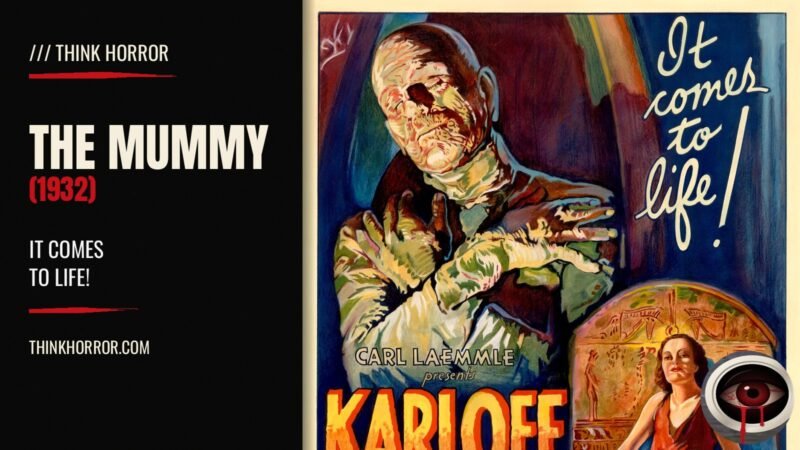
By 1958 Hammer had done the impossible twice. The Curse of Frankenstein and Dracula had turned a small British studio into the most talked-about horror house in the world, and Universal, which had owned movie monsters for a generation, chose to deal rather than fight. The agreement handed Hammer access to Universal’s classic horror stable, and this was one of the first pictures to come out of it. The title says remake of the 1932 Karloff film. The plot says otherwise: Jimmy Sangster’s script borrows its mummy, its revenge and its swamp from Universal’s 1940s sequels, The Mummy’s Hand, The Mummy’s Tomb and The Mummy’s Ghost, and keeps from 1932 little more than the name Joseph Whemple and a scroll that wakes the dead. Sangster later said he couldn’t remember watching the earlier films. The resemblance, either way, is a family one.
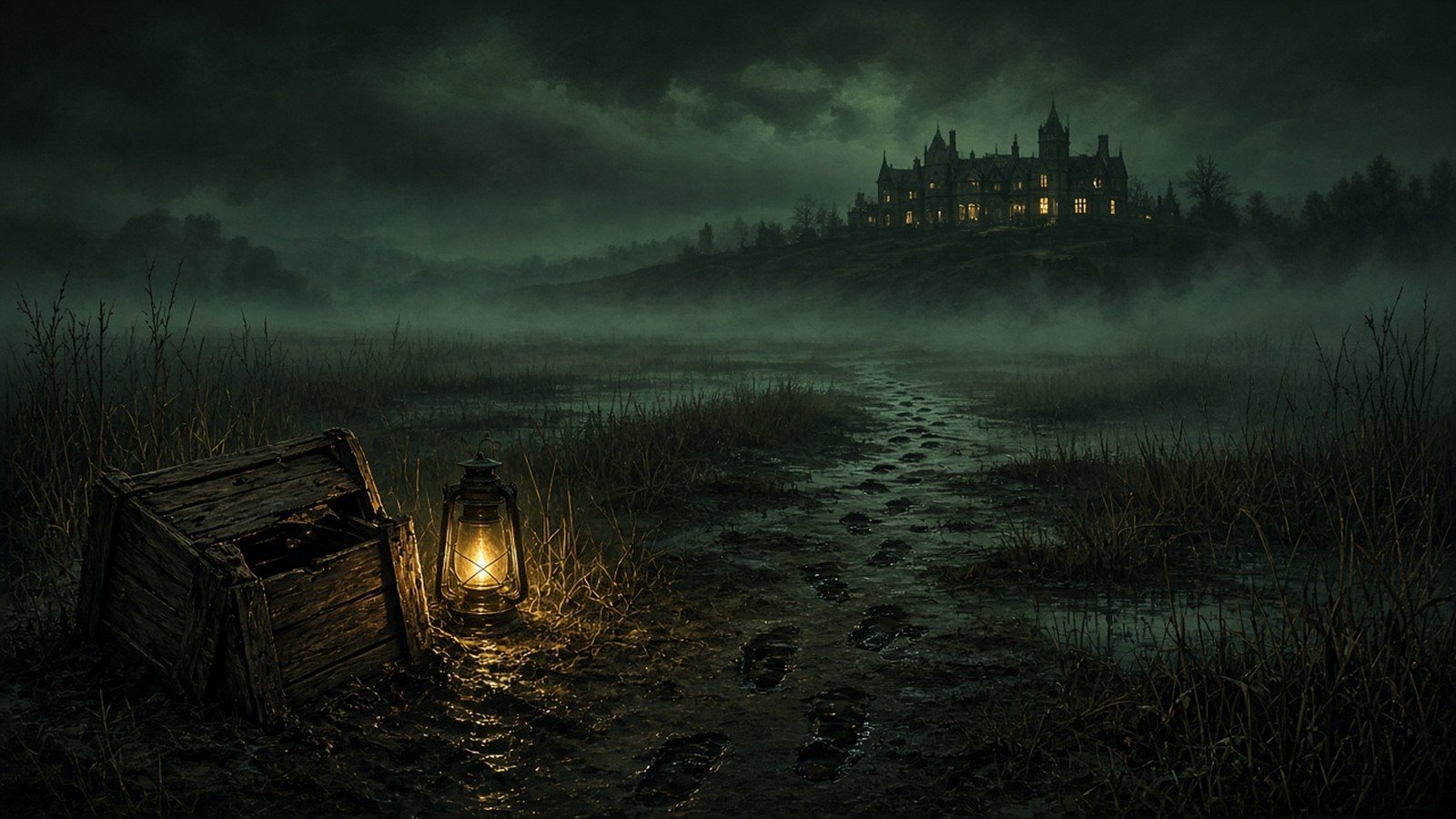
Egypt, 1895. Archaeologist Stephen Banning (Felix Aylmer) and Joseph Whemple (Raymond Huntley), the father and uncle of young John Banning, break into the tomb of Princess Ananka, high priestess of the god Karnak, ignoring the warning of a devout local, Mehemet Bey (George Pastell). John (Peter Cushing) waits outside with a broken leg. Alone in the tomb, Stephen reads aloud from the Scroll of Life, and his colleagues find him screaming, then silent, then catatonic. Three years later in England, he wakes in a nursing home long enough to tell John what he raised that night: Kharis (Christopher Lee), the high priest who loved Ananka, tried to bring her back from death, and was buried alive as the guardian of her tomb for his sin. Mehemet has followed the family home with Kharis in a crate. One drunken cart ride later, the crate is in a bog, and the bog is where Kharis waits for his orders.
What follows is a revenge picture with a clockwork plan: Stephen first, then Joseph, then John. The police, in the shape of Eddie Byrne’s sceptical Inspector Mulrooney, deal only in cold, hard facts, and a towering bandaged shape walking through French windows does not count as one until it is far too late. The film’s real turn comes at the Banning house, when John’s wife Isobel (Yvonne Furneaux) rushes to his aid and Kharis stops dead. She bears an uncanny resemblance to Ananka. The killing machine has a heart, and the heart is the weak point.
What Works
- Christopher Lee makes a monster out of two eyes. Under Roy Ashton’s makeup, Lee has almost nothing to work with: his face is bound, his voice is gone, and the role is all lurch and grip. He plays it anyway, with his whole frame and the only exposed part of his face. When Kharis sees Isobel, the eyes do everything a monologue would do, and they do it faster. This is the mummy as a grieving man, not a shambling prop, and it is the reason the film outlives its plot.
- The violence has weight. Kharis does not shuffle. He crashes through windows and doors and comes at his victims in a straight line, at a pace the Universal mummies never managed, and when bullets go into him at close range they simply go in. John’s revolver does nothing. Cushing’s spear, driven clean through the creature, does nothing. Fisher stages each failure as a fresh small horror: the rules of how to stop a monster keep running out.
- Cushing plays a hero who has to think instead of run. The broken leg keeps John Banning at a desk, and Cushing makes a virtue of it, playing the archaeologist as a man who reads his way out of danger. His visit to Mehemet, prodding at the man’s faith across a drawing room while both of them know exactly what is waiting outside, is the best dialogue scene in the picture, and it plays like a duel without a single weapon drawn.
- Jack Asher’s colour sells the whole fantasy. The swamp at night is a mist-thick, blue-green dreamscape that never pretends to be a real field, and it doesn’t need to. The Egyptian interiors and Asher’s lighting give a modest budget the look of a far richer picture. Hammer’s Technicolor was the point of the exercise, and here it is used like a paintbrush.
- The ending earns its sadness. The finale does not end with a hero’s shot. Kharis carries the unconscious Isobel into the swamp, sets her down when she asks him to, and only then does the police gunfire drive him under the black water, the Scroll of Life sinking with him. The film knows exactly whose tragedy this is.
What Doesn’t
- The flashback stops the clock. The Egyptian backstory, with its burial processions, rituals and Kharis’s punishment, is staged with real care, but it arrives in the middle of a revenge thriller and runs long. The momentum built by the first murders drains away while the film explains what the audience has already guessed.
- The detective work is padding. Mulrooney’s slow conversion from scoffer to believer is played for gentle comedy, and his rounds of interviews with locals add colour without adding dread. The cast is game, but these scenes are the film marking time between Kharis’s visits.
- Mehemet is a function, not a villain. George Pastell does what he can with a role that is mostly glowering and giving instructions, and the script never gives his faith the dignity it gives Kharis’s love. The result is a film whose human antagonist is far less interesting than the creature he commands.
The ledger was mixed from the start. In 1959 the Monthly Film Bulletin praised the glamorous photography but found the picture weighed down by wordy exposition and the Egyptian flashbacks, and the New York Times called it woodenly directed; Variety, more generously, found it excellently executed in every technical department. Time has been kinder to the melancholy than the mechanics. Hammer’s own authorised history calls it little more than a string of handsomely lit killings, then admits its romantic undertow lifts the bandaged brute far beyond his predecessors. That is the film exactly: a routine revenge plot carried, on the back of one great silent performance, somewhere sad and beautiful.
Harper’s verdict: 3.5 ravens — the best-dressed corpse in the swamp.
Trivia and Facts
- Cushing suggested his own best moment. Peter Cushing said he proposed the scene in which Banning drives a spear through the mummy — he had been inspired by the pre-release poster, which showed Kharis with a shaft of light passing through his body.
- The censor got the cruellest cuts. The flashback scene in which Kharis’s tongue is cut out, and a shotgun demise, were originally more graphic and were trimmed for the British censor. What survives is suggestion, and it is plenty.
- The makeup was built for a man who had to move. Makeup artist Roy Ashton researched mummies at the British Museum before designing Kharis, and the costume was made with a hidden zip down the back beneath the wrappings because the bandages alone were so difficult to work in.
- The Doctor met it later. The film was a particular influence on the 1975 Doctor Who serial Pyramids of Mars, in which robot mummies stalk an English country house.
Harper’s Extras
- The Mummy (1959) — the full wiki file: the complete case file on Hammer’s first Mummy, from the Universal deal to the sequels.
- The Mummy (1932) — the wiki file: Karloff’s Imhotep, the original, and a very different monster from Kharis.
- Christopher Lee — the wiki file: from Kharis and Dracula to the long, towering career that followed.
- Peter Cushing — the wiki file: Hammer’s great gentleman hero, spear in hand.
- Terence Fisher — the wiki file: the director who built Hammer’s Gothic house.
- The Mummy (2026) — Harper’s review: Lee Cronin’s take on the legend, sixty-seven years later.
- Crank it: Franz Reizenstein’s score. Big, brassy and unapologetically romantic, it plays Kharis as a lover first and a killer second, which is exactly how the film sees him.
Where to Watch
Checked November 9, 2026. Streaming with a subscription on fuboTV and HBO Max, and to rent or buy on Amazon Video, Apple TV and Fandango at Home.
Frequently Asked Questions
Is The Mummy (1959) a remake of the 1932 Boris Karloff film?
Only in name. Hammer’s film shares the title and a life-giving scroll with the 1932 original, but Kharis, Ananka and the revenge plot come from Universal’s 1940s sequels, The Mummy’s Hand and The Mummy’s Tomb. Think of it as a cousin, not a child.
Does Christopher Lee speak in The Mummy?
Barely. As the mummy, Kharis is silent and the performance is almost entirely physical, carried by Lee’s eyes and bearing. He speaks only briefly, as the living high priest in the Egyptian flashback.
Is Christopher Lee in the Hammer Mummy sequels?
No. Hammer made three more Mummy films, The Curse of the Mummy’s Tomb (1964), The Mummy’s Shroud (1967) and Blood from the Mummy’s Tomb (1971), and Lee appears in none of them. Each sequel tells a separate story; none continues Kharis’s.
How does The Mummy (1959) end?
Kharis carries the unconscious Isobel into the swamp, but he sets her down when she tells him to. Once she is clear of him, the police open fire and he sinks into the quagmire, taking the Scroll of Life with him. Isobel survives.
Until next time, fiends — keep the lights low, keep the scrolls unread, and if your wife looks a little too much like an Egyptian princess, keep her hair pinned up. Harper will leave a lamp burning for you.
The weekly roundup
One letter a week, from the crypt.
- New reviews, with the ravens
- New wiki entries and news
- Cool stuff worth your night
Weekly. No spam, unsubscribe in one click.