Frankenstein Created Woman (1967) is Hammer’s most melancholy Frankenstein film, where Cushing’s Baron transplants an executed man’s soul into the drowned body of his lover. The beautiful avenger he makes sets out to visit his killers, one by one.
You’re walking home from the vicar’s house, in a blonde wig and a new face. Behind you three men are closing in, stones in their hands, and you know what they want. You are not afraid of them. You remember their faces the way a dentist remembers a broken tooth, as a problem to be solved with a sharp instrument, at close range, in the dark. One trips you, and his hands go for your throat, and almost calmly you see exactly how it will be done. You were a maid once, fiends. You died for being kind. You came back for this.
Welcome back to the crypt. Tonight’s file is the one whose poster promised a film Hammer never actually shot: the studio’s fourth Frankenstein film and its quietest, a picture about gender, class, justice and a very dry martini. Terence Fisher’s Frankenstein Created Woman. Keep the lab door locked. Keep your soul where the Baron can’t use it.
Watch the Trailer

Quick Specs
- Director: Terence Fisher
- Screenplay: Anthony Hinds (as John Elder)
- Starring: Peter Cushing (Baron Victor Frankenstein), Susan Denberg (Christina Kleve), Thorley Walters (Dr Hertz), Robert Morris (Hans Werner), Peter Blythe (Anton), Derek Fowlds (Johann), Barry Warren (Karl), Alan MacNaughtan (Kleve), Duncan Lamont (Werner), Peter Madden (Chief of Police)
- Music: James Bernard
- Cinematography: Arthur Grant
- Editor: Spencer Reeve
- Producers: Anthony Nelson Keys
- Production Company: Hammer Film Productions
- Distributor: Warner-Pathé (UK) · 20th Century-Fox (US)
- Premiered: March 15, 1967 (US)
- Runtime: 86 minutes (UK) / 92 minutes (US)
- Verdict: 3.5 ravens — a melancholy oddity in a white blouse and a bloodstain.
- Budget: £140,000
- On This Site: Frankenstein Created Woman in the wiki
The Review
Frankenstein Created Woman was Hammer’s fourth Frankenstein film, and it had been waiting a long time to exist. Hammer first mooted it in 1958, while The Revenge of Frankenstein was in production — the title a cheeky riff on Roger Vadim’s And God Created Woman, with “And Then” still attached. It finally went before the cameras at Bray Studios on July 4, 1966, among the last productions Hammer ever shot there, reuniting the original brain trust: Fisher directing, Anthony Hinds writing as John Elder, James Bernard scoring, and Cushing’s Baron at the centre. Christina was cast from the centrefold: Susan Denberg, an Austrian model who had been Playboy’s Miss August 1966, with almost no acting experience — a gamble the picture is still arguing about.
In the film, the Baron (Peter Cushing) is still obsessed with his greatest problem: what is a soul, and can it be put back into a body? Working with Dr. Hertz (Thorley Walters), a slow, kindly colleague, he has built a trap for the soul of the newly dead — and means to pour what he catches into another fresh body. The first soul to hand is Hans (Robert Morris), the Baron’s young assistant, who loves Christina Kleve, the innkeeper’s daughter, whose whole left side is disfigured and partly paralysed. When the three dandies who torment her at the inn — Anton, Johann and Karl — beat her father to death stealing his wine, it is Hans who hangs for it: he had threatened Kleve in front of the police that same night, his coat is found by the body, and the one alibi that could save him — the night he spent with Christina — he refuses to speak, to protect her name. Christina, returning from a specialist her father had paid for, arrives in time to witness the execution, and throws herself in the river. Frankenstein takes Hans’s trapped soul and places it in Christina’s resurrected frame; over months of treatment her deformities are cured entirely: a new woman, beautiful where Christina was disfigured, with no memory of either life — and something in her manner that is not Christina at all. The film’s own language is clear about the premise: a soul is transferred from one body to another.
The Baron’s intention is a pure experiment in science. The body’s new tenant, meanwhile, had a purpose of his own. Christina is soon walking the dark roads around the village, pursuing the three young men whose crime Hans hanged for — luring each of them somewhere private, seducing them, and killing them, one by one, at the insistence of the voice she carries. The Baron, who has watched his labours come to life, becomes very aware of the gap between what he wanted and what he made.
The closing stretch is the film’s most quietly horrific passage. Christina is discovered over the last of the three, the severed head of Hans held close — the voice in her satisfied at last, the debt pronounced paid. The Baron pleads with her to let him tell her who she is. She knows only that she has no one and nothing left to live for, and she runs to the river and drowns herself, as she did before he remade her. Victor, disappointed, and having apparently learned a lesson, walks away in silence.
What Works
- Cushing holds the film like a conductor. He plays the Baron as a serious scientist who thinks he can continue a life by giving a body a soul, and when the film turns cruel he plays the same man as a bewildered, guilt-stricken witness to his own creation. The performance is muted and tender, and that is exactly what the picture needs.
- Susan Denberg commits to the role. Denberg was cast for her looks, and Hammer knew it, but she gives the part more than a pin-up: her movement, her pauses, her quiet spells between murders give Christina a life that the script only half-writes. Her own voice is not among her instruments — her Austrian accent was judged too strong and her dialogue was dubbed — so the performance is carried in stillness. And forget the old fan-press story that she died young, by her own hand or by accident: it was never true. She left the business, returned to Austria, and lives. The film’s sadness is quite heavy enough without inventing hers.
- The film is Hammer at its most philosophical. It is the Hammer film that most seriously asks what a human being is, and when the question is asked in terms of a soul and a body, the answer is not a shriek but a long pause followed by a violent act. It is a rare Gothic picture that turns its horrors on its makers instead of its monster.
- James Bernard’s score does the thing early Hammer scores did: it forces the film’s ridiculous moments to play with a straight face. Bernard, who scored The Curse of Frankenstein, brought something of that same gothic urgency to a film that would otherwise lean towards camp.
- The Baron’s dilemma has a real poignancy. Frankenstein is not punished here by a mob. He is punished by his own creation, who asks the question, by her face, the question that undoes him: how does a scientist who has succeeded in giving life to the dead remain a man? The film gives him no easy answer.
What Doesn’t
- It fumbles its own mythology. A soul that can be bottled, carried across the laboratory and poured into a new body risks becoming a machine part rather than a mystery, and the film never quite reconciles the plumbing with the poetry it is reaching for. The other transformation is handled just as glibly: months of treatment erase Christina’s deformities entirely — a miracle performed off-screen and explained in a line, so the woman Hans loved is gone in every sense the film declines to examine.
- The script is too talky for its own good. The film leans on exposition: the Baron’s science, the police investigation, the village gossip. The story wants a tight, gothic pace, but it spends long stretches explaining itself. And the script’s speeches suggest a film that wants to be about class, but ends up being about a rich man’s vandalism.
- The picture is handsomely made but its violence can feel languid. The murders arrive as set-pieces with a slow, almost ritualised pace and a lot of drifting through corridors, which means the film’s tension often sags in between.
The ledger was mixed from the start, and harsher than memory paints it. Variety praised “the excellent technical aspects which have come to be expected of the Hammer Film people,” but found the script “often seems overly influenced by other and better-written screen efforts.” The Monthly Film Bulletin was colder still, judging that the film “in no respect matches James Whale’s Bride of Frankenstein” — and Leonard Maltin summed up the critical shrug in six words: “Everything goes wrong, including script.” The reappraisal came from the faithful and one very famous admirer. The Radio Times Guide to Films, awarding three stars, noted the film “is considered by Hammer aficionados to be the best Frankenstein made by the House of Horror,” and in 1987 Martin Scorsese programmed it in a season of his favourite films at the National Film Theatre: “If I single this one out it’s because here they actually isolate the soul… The implied metaphysics are close to something sublime.” Time has sided with Scorsese: the range of opinion since has moved from the routine and camp to the elegant and melancholy, with the film now routinely called the most poignant of Hammer’s Frankensteins. (Rotten Tomatoes, checked November 2026: 62% from 13 critics’ reviews.)
Harper’s verdict: 3.5 ravens — a melancholy oddity in a white blouse and a bloodstain.
Trivia and Facts
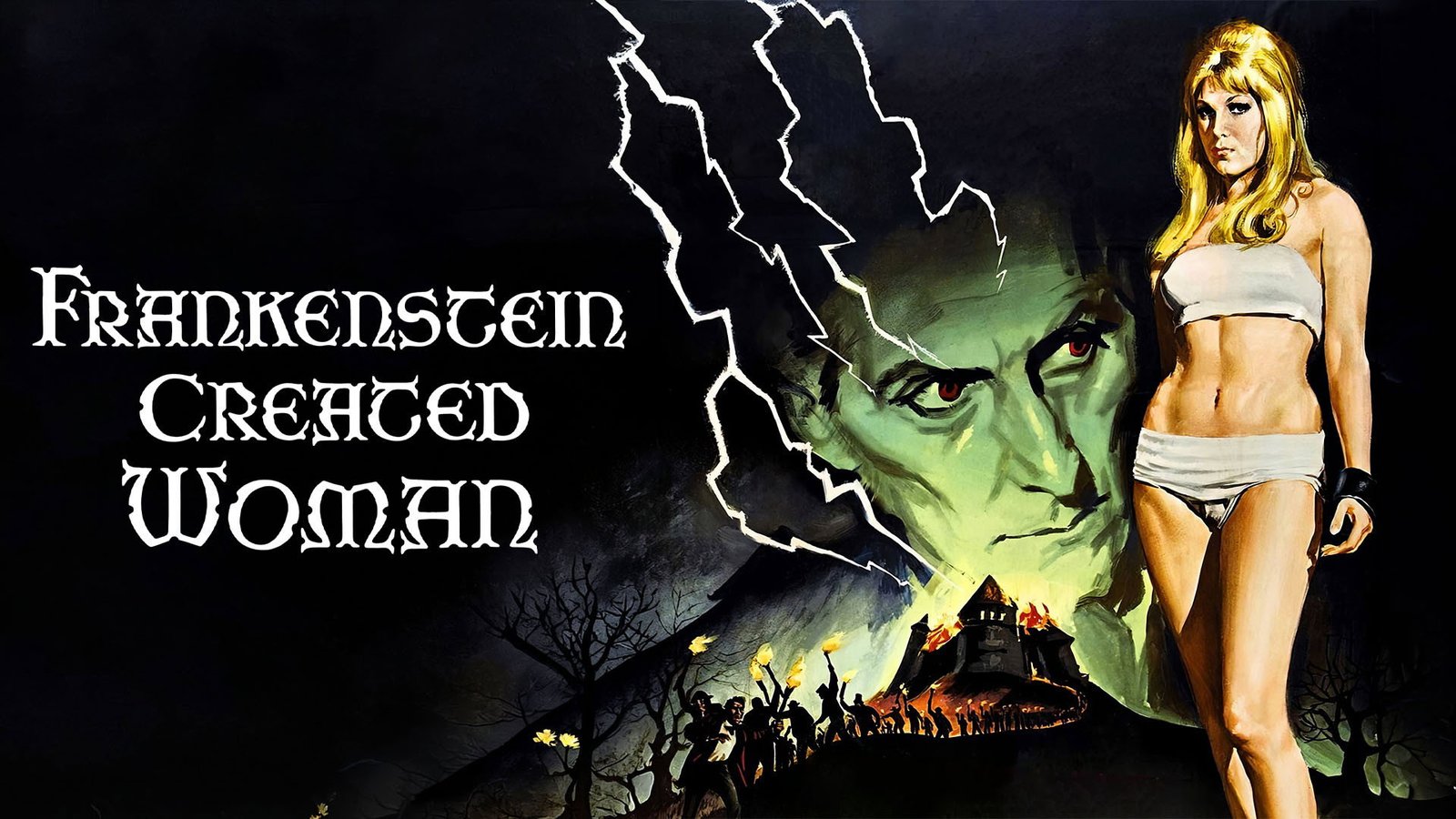
- The poster promised a different film. The publicity made famous by the artwork — Denberg in bandages and little else, the creation as pin-up — depicts a “creation” the film never shows: the actual transfer happens in machinery and dialogue, and at no point does anyone wear the poster’s outfit on screen. Hammer sold the centrefold; Fisher delivered a ghost story.
- America got her first. The film opened in the United States on March 15, 1967 — three months before its British release on June 18 — on a double bill with The Mummy’s Shroud. Fox’s studio records show the pairing took $1,590,000 in rentals against the $1,625,000 it needed to break even: a near miss, and a loss.
- Christina was a Playmate. Susan Denberg, born Dietlinde Zechner in 1944, was an Austrian model who became Playboy’s Miss August 1966; Hammer cast her months later with almost no acting experience. Her accent was judged too strong and her dialogue was dubbed by another actress — the face, the stillness and the walk are Denberg’s; the voice is not.
- It waited eight years to be made. Hammer first mooted the film in 1958, during production of The Revenge of Frankenstein, when Roger Vadim’s And God Created Woman was a sensation — the working title was And Then Frankenstein Created Woman. It finally shot at Bray Studios from July 4, 1966, one of Hammer’s last productions there.
- It was a creative team old and new. James Bernard, who scored The Curse of Frankenstein, brought a familiar urgency to the score, which was written for the film’s most melancholic moments.
- The Baron made four. Frankenstein Created Woman was Hammer’s fourth Frankenstein film, following The Curse of Frankenstein (1957), The Revenge of Frankenstein (1958) and The Evil of Frankenstein (1964).
Harper’s Extras
- Frankenstein Created Woman — the full wiki file: the complete case file on the Baron’s most unsettling experiment.
- The Curse of Frankenstein (1957) — the wiki file: the film that started Hammer’s Frankenstein series.
- The Revenge of Frankenstein (1958) — the wiki file: Cushing’s Baron, back from the dead himself.
- The Evil of Frankenstein (1964) — the wiki file: the Baron’s monster, without the soul.
- Frankenstein Must Be Destroyed (1969) — the wiki file: the next entry, and the Baron’s cruelest.
- Peter Cushing — the wiki file: Hammer’s great gentleman scientist, at his most philosophical.
- Terence Fisher — the wiki file: the director who built Hammer’s Gothic house.
- Crank it: James Bernard’s score. It has the same gothic pulse as his earlier Frankenstein music, and it turns Christina’s walk into a funeral march in a blonde wig.
Where to Watch
As of November 9, 2026, Frankenstein Created Woman is not on a major US subscription streaming service, but you can rent or buy it digitally on Amazon Video, Apple TV Store or Fandango At Home. It is also available on Blu-ray, including Scream Factory’s Collector’s Edition. Streaming availability can change.
Frequently Asked Questions
Is Frankenstein Created Woman a sequel to The Evil of Frankenstein?
Yes, in the loose Hammer sense. It is the fourth film in the series, following The Curse of Frankenstein (1957), The Revenge of Frankenstein (1958) and The Evil of Frankenstein (1964). You don’t need to have seen the earlier films, but the Baron (Peter Cushing) is the same character.
Why does Christina kill the three men?
Because they killed her father and let her lover hang for it. Anton, Johann and Karl beat the innkeeper Kleve to death stealing his wine; Hans, who had threatened Kleve before witnesses that night, was convicted and guillotined, refusing the alibi that would have shamed her. With Hans’s soul carried in Christina’s body, she sets out to avenge them both, seducing and killing each of the three in turn.
Is that Susan Denberg’s own voice?
No. Denberg’s Austrian accent was considered too strong, and her dialogue was dubbed by another actress. It is one reason the performance plays so physically — the stillness, the pauses and the walk are hers; the voice is not. (And no, despite decades of fan-press repetition, she did not die young: she left acting, returned to Austria, and is alive.)
Is Frankenstein Created Woman based on a Mary Shelley story?
Only in the loosest sense. The story — a soul transferred into a drowned woman’s body — is an original by Anthony Hinds (writing as John Elder); the title plays on Roger Vadim’s And God Created Woman (1956), with the Bride of Frankenstein idea somewhere underneath it. Mary Shelley never wrote anything like it.
Until next time, fiends — keep the lights low, keep the lab door locked, and if a beautiful stranger asks you to walk her home, check whether she is asking you or avenging someone. Harper will leave a lamp burning for you.
The weekly roundup
One letter a week, from the crypt.
- New reviews, with the ravens
- New wiki entries and news
- Cool stuff worth your night
Weekly. No spam, unsubscribe in one click.