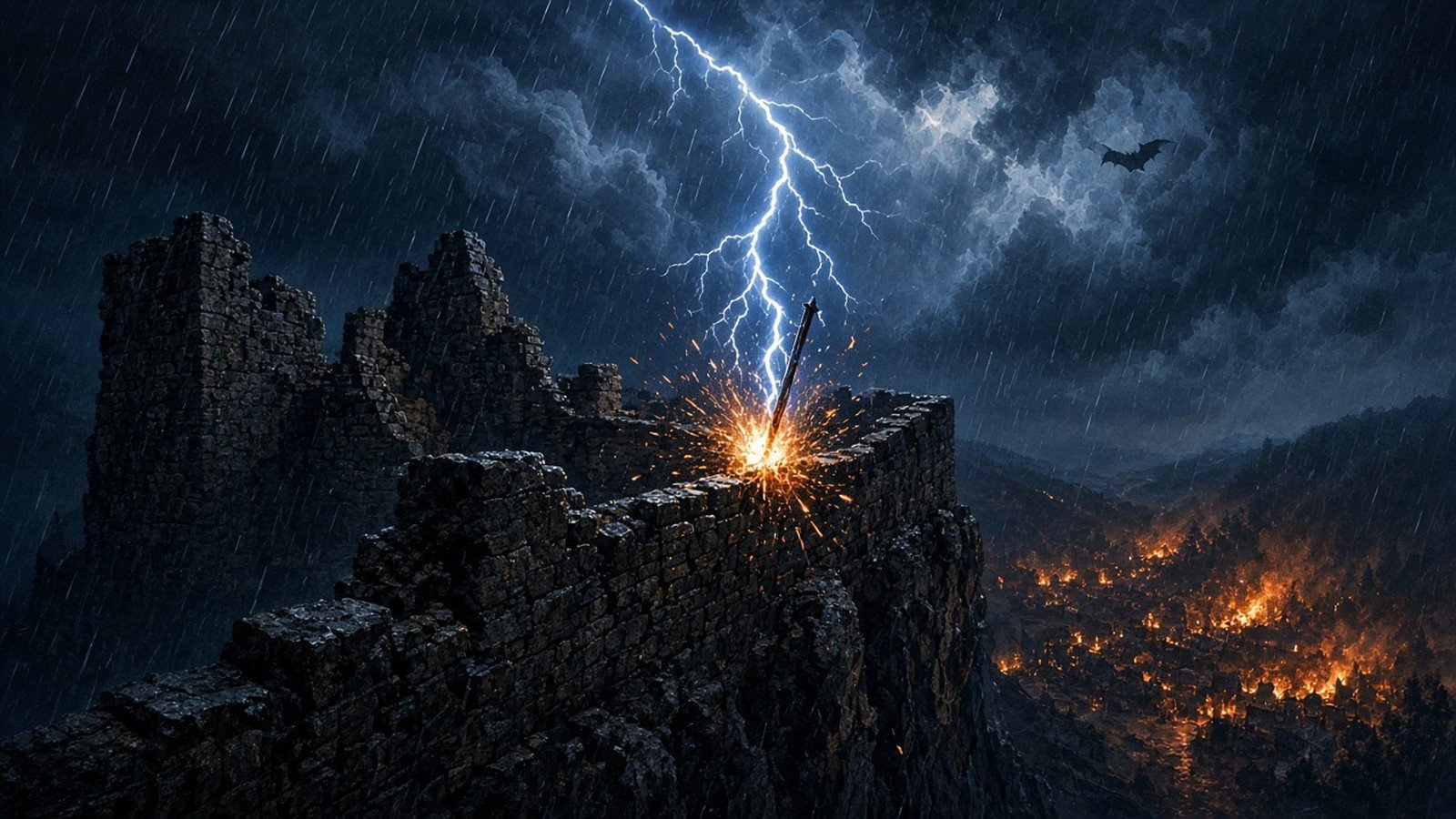
The storm is coming up the mountain, and you are standing in the village square when the first bats come over the rooftops. Not one bat. Dozens of them, black against a black sky, and they are not hunting in the fields tonight. They are going for the church.
You can hear the villagers behind you, shouting, carrying torches, and you can smell the smoke from the castle they have just set on fire — because they marched up there this evening to burn the Count out, and they came home believing they had done it. They had not. He was asleep in a stone room no fire could reach, and now his bats are in the church, and every woman in the village is inside it, and the doors are shut.
Look up. High on the castle wall, above the flames, there is a window with no door behind it — a room nobody can walk into, a room with a stone plinth and a pile of ashes on it. And something with wings is flying in through that window, carrying blood in its mouth.
Welcome to the village below Castle Dracula, horror lover. Pull up a chair in the tavern. This is the one where the Count comes back on a bat’s vomit — and dies by lightning, holding the very spike that was meant to kill him.
Scars of Dracula (1970) is Hammer’s messiest Dracula film, with Christopher Lee resurrected by a bat’s blood.

Quick Specs
- Director: Roy Ward Baker (not Terence Fisher, not Freddie Francis, not Peter Sasdy)
- Screenplay: John Elder (Anthony Hinds)
- Starring: Christopher Lee (Count Dracula), Dennis Waterman (Simon Carlson), Jenny Hanley (Sarah Framsen), Christopher Matthews (Paul Carlson), Patrick Troughton (Klove), Anouska Hempel (Tania), Michael Gwynn (The Priest), Michael Ripper (Landlord), Wendy Hamilton (Julie), Delia Lindsay (Alice), Bob Todd (Burgomaster)
- Music: James Bernard
- Cinematography: Moray Grant
- Editor: James Needs
- Producers: Aida Young
- Production Company: Hammer Film Productions
- Premiered: November 8, 1970 (UK); December 23, 1970 (US, limited)
- Runtime: 91 minutes (the 95/96-minute figures in older books are erroneous)
- Rating: R (US — the first Hammer film to get an R rating); UK: X originally, later 15
- Budget: £186,000–£200,000 (book-sourced range)
- Box Office: No gross figure exists
- On This Site: Scars of Dracula (1970) film page
The Review
First, the director — because this film is not a Terence Fisher film, and everything about it follows from that, and getting the name wrong is the easiest mistake in the whole Hammer cycle.
Roy Ward Baker directed this film — not Fisher, not Freddie Francis, not Peter Sasdy. Baker was a Hammer veteran by then — Quatermass and the Pit (1967), The Anniversary (1968), Moon Zero Two (1969), and The Vampire Lovers (1970), the film he had just finished when Hammer handed him Dracula. He studied all the previous Dracula pictures before shooting, hoping to catch the style of the series’ earlier entries, and he was given only six weeks to shoot the whole Technicolor film, in May–June of 1970, per Variety‘s report as retold by Cinema Retro. Six weeks, one castle, one Count, and a script by Anthony Hinds — credited, as always, as John Elder — that had to follow two Dracula films in the same year. It shows. It has always shown. That is the film’s great flaw and its great fascination, and an honest review says both at once.
And the first thing to get straight is what this film is not. It does not continue Taste the Blood of Dracula. Taste ends with Dracula dissolving into dust inside a disused church near London; Scars opens with his remains lying on a stone plinth in a chamber in his Transylvanian castle, with no explanation of how they got there. The film breaks continuity with its predecessor rather than continuing it — Winnert says so plainly, and Movies & Mania and Cool Ass Cinema say the same — and the film is effectively standalone. It is the fifth and last of Hammer’s period Draculas, in Winnert’s phrase: after this one, the Count would come to modern London in Dracula A.D. 1972 (1972) and The Satanic Rites of Dracula (1973), and the 19th century would close behind him. Do not let anyone tell you Hammer announced it as a reboot. It is a sequel that forgot to be a sequel, and the forgetting is part of the story.
The forgetting starts with the resurrection, and the resurrection is the most famous scene in the film — famous because it is ridiculous, and ridiculous because it is unforgettable.
Dracula’s remains lie on a stone plinth in a chamber in his castle, a chamber that can be reached only through a window set high in the castle wall. A large bat flies in and hovers over the plinth, regurgitating blood onto the Count’s remains. The remains interact and bond with the dripped blood. Within seconds, Dracula is once more resurrected. That is the scene as written, and every account of it agrees on the shape of it — Wikipedia’s plot, Cool Ass Cinema, Winnert, Horror Cult Films, HighDefWatch — while disagreeing only on how silly it looks. Winnert’s version is the one that has stuck: “A rubber bat creaks down a wire and dribbles ketchup from the corner of its mouth onto a skeleton in an open coffin, and this fades in and out on an image of Christopher Lee.” HighDefWatch calls it “a hilariously comical bat puppet.” Cool Ass Cinema says the bat “puke[s] up a thick, sanguinary substance on his ashes thereby bringing him to life.” Nobody, in fifty-five years, has called it dignified. And nobody has forgotten it, either — which is more than you can say for most resurrections in this series. How the remains got into a room with no door is never explained, and the film does not try. Cool Ass Cinema notes the gap, Winnert notes it, the on-magazine FAQ notes it. Carry it as the film’s own hole, not as a fact to resolve: the ashes are back in Transylvania without explanation, and the film simply starts from there.
What follows is the bloodiest Hammer Dracula yet, and the film knows it — it was the first Hammer film to get an R rating in the United States, and it was originally X-rated in the UK for graphic content, later reclassified 15. The villagers, enraged that yet another young woman has been murdered by the Count, rise up with a priest’s blessing and set fire to Dracula’s castle. But Dracula is safely asleep in his solid stone chamber, and when the villagers return home, they find that every woman in the village has been slaughtered in the church by vampire bats. Get that number right, because the summaries get it wrong: Wikipedia says every woman; one review adds children. The film shows the women, and only the women. The bats are Dracula’s revenge for the fire, and the film does not soften it — the church is a charnel house, and the village has no women left in it, and the film moves on as if that were a thing a village could survive.
The film’s second story starts somewhere else entirely, and it is the story that carries the picture. Elsewhere, a libertine named Paul Carlson is falsely accused of rape — his accuser is Alice, the Burgomaster’s daughter — and flees the Kleinenberg authorities by jumping into a coach which, though driverless, heads off at great speed. He is knocked off the coach, stumbles into an inn, and persuades the waitress Julie to let him in; the innkeeper throws him out. Walking in the forest, Paul finds the driverless coach again, and Klove — Dracula’s servant, returning to the castle — drives it back with him in it.
And here is where the film becomes something stranger than a sequel. Paul is welcomed at the castle by the Count and by Tania, a woman who later reveals herself to be imprisoned by Dracula as his mistress. Paul has a liaison with Tania, who concludes their lovemaking by trying to bite his neck. Dracula appears and, casually throwing off Paul’s efforts to stop him, stabs Tania through the heart with a dagger for betraying him. He then stoops over to drink the blood from the wounds of her dead body. Klove dismembers her body and dissolves it in a bath of acid. Do not call Tania his wife, and do not call her a willing consort — she is his prisoner, his mistress, and the film kills her for wanting a night of her own choosing. Anouska Hempel plays her with a wild, desperate eroticism that Winnert singles out, and her death — stabbed by the Count, carved up by the servant, dissolved in acid — is the most cold-blooded scene in the whole Hammer Dracula cycle, and the one the British Board of Film Classification trimmed for UK cinema and video, along with the priest’s bat-killing, per Winnert.
Paul’s own end comes off screen, and Simon’s search for him is the rest of the film. Paul’s more sober brother Simon, and Simon’s fiancée Sarah Framsen, come searching for him. Julie the waitress directs them to the castle, and they investigate. Dracula immediately has designs on Sarah — but Klove, who has fallen in love with the woman after seeing her photograph amongst Paul’s possessions, helps the couple escape by refusing to do Dracula’s bidding and remove Sarah’s crucifix. As punishment, the servant is burnt by Dracula with a heated blade. And here is the thing that makes Klove the most interesting character in the film, and the one most summaries flatten: he wavers. He helps the couple escape, and then he betrays Simon into the same doorless room Paul was trapped in. He lowers the rope that lets Simon climb the castle wall, and then he attacks Dracula with Tania’s dagger on the battlements. He is not loyal, and he is not redeemed. He is a servant in love with a photograph, torn between his master and a woman he has never met, and Patrick Troughton — the Second Doctor, playing Dracula’s right-hand ghoul — gives him a twitching, frightened, utterly human desperation that no other Hammer servant ever had. Do not write him as simply loyal or simply redeemed. He is both, and neither, and the film is better for it.
Get the casting traps right, because this film is a minefield of them. Simon Carlson is Dennis Waterman, not Patrick Troughton. Klove is Patrick Troughton, not Michael Gwynn. The Priest is Michael Gwynn, not Klove’s actor. Waterman was the young television star — the hero, Paul’s brother, Sarah’s fiancé — and Troughton was the servant, and Gwynn was the village priest who helps Simon and is attacked and killed by a vampire bat. And Klove here is not the same Klove as Dracula: Prince of Darkness (1966), where the servant of the same name was played by Philip Latham — it is never established that they are the same character, and Winnert says plainly that he “appears to be a different character with the same name.” Write “a servant also named Klove,” never “Klove returns.”
The opposition, meanwhile, is not Van Helsing. Peter Cushing does not appear in this film at all — there is no Cushing credit in the film — and the film is shaped by the absence. The people standing against Dracula are a young layman, his fiancée, and a village priest: Simon, Sarah, and the Priest. One critic’s verdict on that substitution is the honest one — “Waterman hardly poses the threat to Christopher Lee that a Peter Cushing Van Helsing does” — and the film knows it. Simon is brave and decent and out of his depth, and the film never pretends otherwise. When he opens the coffin in the middle of the locked room and finds the sleeping Dracula, the vampire’s power reaches through his closed eyelids and Simon collapses before he can act. When he recovers, the vampire has vanished — and investigating further, Simon finds Paul’s drained corpse, displayed on a spike. (Some accounts say a hook; the film’s imagery has been described both ways.) And looking out of the window, Simon sees the Count running up the wall outside like an insect — the Stoker trait, restored at last, the Count scaling his castle walls like a spider, straight from the novel.
That restoration of Stoker is the film’s real claim to interest, and the critics who have been kindest to it have all made the same point. David Pirie, in A Heritage of Horror (1973), noted that the film restores three traits of Stoker’s Count: the “icily charming host,” the command over nature and animals, and the scaling of the castle walls like an insect. Movies & Mania carries the same three traits, Winnert notes the wall-crawling, Burrunjor notes the spider-climb “taken straight from the novel,” and Starburst opens on the “icily charming host.” This is the Dracula who invites you in, pours the wine, and climbs the wall outside your window afterwards — and it is the first time since 1958 that the film lets him be that Count. Christopher Lee gets more to do and say here than in any other Hammer Dracula except the first, in Wikipedia’s and Movies & Mania’s words — Cool Ass Cinema says he gets “a wagon cart full of dialog,” Winnert says there is “plenty for Christopher Lee to do and say,” and the film is his most substantial Dracula since 1958. After the silent Count of Prince of Darkness and the near-cameo of Taste, Lee is finally allowed to talk, to host, to command, to enjoy himself — and he relishes every second of it, in the words of the modern reassessments. Do not carry the Taste framing over to this film. Lee is not a cameo here. He is the film.
The production around him was a scramble with a happy ending and a cheap one. Finance came from EMI Films — Warner Bros. had refused to finance or distribute the picture, and EMI took over distribution in the UK while the small American Continental Films handled it in the US. The film was shot at Elstree Studios in Borehamwood, with Hertfordshire locations, and the move is visible on screen: the sets are cheaper than Bray’s, the castle is a fraction of what it was, and Winnert calls them “cheap sets” without malice, because the cheapness is part of the film’s grubby charm. Michael Ripper is the Landlord here — the tavern landlord, not Max from Risen, not Inspector Cobb from Taste — and the film gives him exactly the role his face was made for. The cast came with its own stories: Toke Townley, the elderly waggoner, was making his final film before his death on September 28, 1984, aged 71. And behind it all, the film was the last of its kind — the last period Dracula, the last 19th-century entry, the last time the Count would haunt a Transylvanian castle before Hammer dragged him into swinging London.
The critics of 1970 were not kind, and the split is the story. Howard Thompson of the New York Times, reviewing it on June 19, 1971 alongside the other half of the double bill, The Horror of Frankenstein, told audiences to avoid Scars of Dracula “like the plague,” calling it “garish, gory junk.” Kevin Thomas of the Los Angeles Times wrote that the film “simply revs up one of the most familiar Dracula plots with sex and violence,” adding, “Given something to work with, as in The Vampire Lovers, director Roy Ward Baker can turn out an excellent film. But really all he manages to do here is keep things moving.” The Monthly Film Bulletin called it “one of the weaker films in the Hammer Dracula cycle,” explaining that “most of the film is padded out with very dull and by now routine filler material, besides some rather unnecessary sadism. Even the normally powerful resurrection sequence is dealt with hastily before the credits, so there is far too little of Christopher Lee and far too much of the various young leads.” Lyndon W. Joslin, in Count Dracula Goes to the Movies (2017), wrote that “the plummet in quality that had been threatening the Hammer Dracula series for years finally came to pass with Scars of Dracula, a garish live-action cartoon.” John Kenneth Muir, in Horror Films of the 1970s (2002), called it “a by-the-numbers sequel that amply demonstrates why the studio’s audience was shrinking as the 1960s became the 1970s.” Winnert, giving it two stars, wrote that “Roy Ward Baker directs with a clumsy fist… the pitiful special effects are truly rotten… Even diehard Dracula, Hammer or Lee fans might give up on this one, but, then again, young leads Dennis Waterman and Jenny Hanley are pleasant company, and there is plenty for Christopher Lee to do and say. It has its moments.”
Later opinion has been kinder, and the kindness has a reason: the film is a mess, but it is an entertaining mess, and the mess is the point. Starburst, in its December 2025 review, gave it 4 out of 5. Slant’s Budd Wilkins, reviewing the Kino 4K in December 2025, called it “underrated” and “a turning point in Hammer’s Dracula series.” Flickering Myth called it “an entertaining movie and as good fun as any Hammer film if taken in the right spirit” and “probably the weakest of the Christopher Lee-starring Dracula films” — both things at once, which is the honest verdict. Burrunjor, the favorable counterweight, wrote that “in spite of these faults I think this truly is a fantastic Vampire film that actually helps to rectify some of the problems of the last two entries in the series.” Collider, via HighDefWatch, ranked it next to last at No. 8 of Hammer’s Dracula films, between The Satanic Rites of Dracula and Dracula A.D. 1972, with Dracula (1958) at No. 1.
One more thing worth knowing before you watch: the money. The budget is a book-sourced range, never a single figure — £186,000 per Moody’s EMI Films and the Limits of British Cinema (2018) against £200,000 per Hearn & Barnes’s The Hammer Story (2007) — and no box-office gross exists anywhere to print. The Numbers lists no gross for the film, and this review will not invent one. What the record does give is the film’s afterlife, and it has been a long one: Anchor Bay’s DVD in 2004, Scream Factory’s US Blu-ray in 2019, StudioCanal’s restored 4K limited collector’s edition in the UK on November 24, 2025, and Kino Lorber’s US 4K on December 16, 2025 — the film that was once the cheapest-looking Hammer Dracula now has the most loving restoration in the series.
And a word on the names, because the film’s paperwork is a mess. The village and its authorities are Kleinenberg — the name appears in the plot accounts and in Hammer’s own trailer description — but do not claim it as a continuity link to Risen, whose village shares the name; the films’ continuities do not join up, and the shared name is coincidence, not connection. Tania is spelled Tania here, not Tanya — the IMDb synopsis uses Tanya. Paul has no surname beyond Carlson, and Simon is his brother, not his keeper, not his landlord, not anything else — there is no “keeper of the castle” character in this film. Klove is the servant, the Priest is the priest, and the Landlord is the landlord, and if a summary tells you otherwise, it is mixing this film up with another one.
Spoiler Section
Stop here if you have never seen it. The Count keeps his secrets for first-timers.
It opens with the bat. Dracula’s remains lie on a stone plinth in a chamber in his castle, a chamber reachable only through a high window, and a large bat flies in and regurgitates blood onto the remains, and within seconds the Count is resurrected. How the remains got into a room with no door is never explained. The film does not care, and neither should you — the bat is the whole explanation, and the bat is enough.
The villagers, enraged that yet another young woman has been murdered by the Count, rise up with the priest’s blessing and set fire to the castle. Dracula sleeps through it in his stone chamber. When the villagers return home, they find every woman in the village slaughtered in the church by vampire bats.
Elsewhere, Paul Carlson — libertine, falsely accused of rape by Alice, the Burgomaster’s daughter — flees the Kleinenberg authorities in a driverless coach, is knocked off it, and talks his way into an inn through the waitress Julie, before the innkeeper throws him out. In the forest he finds the coach again, and Klove drives it back to the castle, where Paul is welcomed by the Count and by Tania, Dracula’s imprisoned mistress. Paul has a liaison with Tania; she tries to bite his neck afterwards, and Dracula stabs her through the heart with a dagger for betraying him, drinks the blood from her wounds, and has Klove dismember her body and dissolve it in a bath of acid.
Paul is locked in a room high in the castle — a doorless room, a room with no way out except the window — and he tries to climb down on tied-together bed curtains, but the line is withdrawn by Klove, and Paul finds himself in the Count’s chamber. He is found dead, drained, his corpse displayed on a spike. Simon, his brother, comes searching with his fiancée Sarah, directed to the castle by Julie. Dracula wants Sarah for his new mistress, but Klove — who has fallen in love with her photograph — refuses to remove her crucifix, and Dracula burns him with a heated blade for it.
Simon enlists the Priest, and they go back to the castle together. The Priest is attacked and killed by a vampire bat. Simon is betrayed by Klove into the same doorless room Paul was trapped in. He opens the coffin in the middle of the room and finds the sleeping Dracula — and the vampire’s power reaches through his closed eyelids, and Simon collapses before he can act. When he recovers, the vampire has vanished, and Simon finds Paul’s corpse on the spike, and looks out of the window to see the Count running up the wall outside like an insect.
With a rope let down by Klove — the wavering servant helping again, after betraying him — Simon climbs up the outer wall to go after Sarah, who has made her way back to the castle battlements as a storm approaches. Dracula confronts her there, and this time he uses his bat familiar to remove her crucifix. Just then Klove arrives and attacks the Count with the dagger that murdered Tania, but the servant is outmatched by Dracula’s inhuman strength and is thrown over the side of the castle. Simon appears, removes a loose metal spike from the castle’s battlements, and throws it at Dracula. The spike pierces the Count’s lower torso, missing his heart. Unharmed, the Count pulls it out and raises it to impale Simon — but it is struck by lightning, and Dracula is engulfed in flames. Staggering in agony, the Count collapses and topples over the castle’s battlements, falling to the ground far below, where his corpse continues to burn.
Sarah survives. Simon survives. Klove is thrown over the side, and the film does not say whether he lives or dies — it shows the throw, and nothing after. The lightning does the killing, not the spike, not a stake, not a cross, not the church. The storm is the vampire hunter in this film, and the storm does not miss.
Trivia
- The resurrection is a bat throwing up. A large bat flies into a window-only chamber and regurgitates blood onto Dracula’s ashes — Winnert’s version: “A rubber bat creaks down a wire and dribbles ketchup from the corner of its mouth onto a skeleton in an open coffin.”
- The room has no door. The chamber holding Dracula’s remains can be reached only through a high window — and how the remains got in there is never explained by anyone, in the film or out of it.
- The women, not the children. The bats slaughter every woman in the village church. One review adds children; the film’s own account says the women,.
- Troughton is Klove, Waterman is Simon, Gwynn is the Priest. The three casting traps, in one line — the film’s most-mixed-up credits, kept straight.
- Klove is not the Prince of Darkness Klove. The servant of the same name in the 1966 film was played by Philip Latham, and it is never established that they are the same character.
- Lee finally gets to talk. His most substantial Dracula since 1958 — “a wagon cart full of dialog,” in Cool Ass Cinema’s phrase — after the silent Count of Prince of Darkness and the near-cameo of Taste.
- The Stoker Count returns. The icily charming host, the command over nature and animals, the wall-scaling like a spider — three traits from the novel, restored here after years away.
- The death is lightning, not a stake. Simon’s spike misses Dracula’s heart, the Count pulls it out unharmed, and the lightning that strikes the spike he is holding is what kills him — fire and a fall, not a staking, not a cross.
- Klove’s fate is never stated. He is thrown over the side of the castle by Dracula, and the film does not say whether he lives or dies. Do not trust a summary that kills him off.
- Sarah survives. Nothing in the film kills her; she is on the battlements with Simon at the end.
- The first Hammer R. The first Hammer film to get an R rating in the United States; originally X-rated in the UK, later 15.
- Six weeks to shoot. Baker was given only six weeks to shoot the whole Technicolor film, in May–June 1970, per Variety‘s report.
- The other 1970 Dracula. Released the same year as Taste the Blood of Dracula — two Hammer Draculas in one year, different directors, different plots, and no continuity between them.
- The promo title had a “The.” Promotional material called it The Scars of Dracula, though the film itself is Scars of Dracula.
- Charley Brewster watched it. In Fright Night (1985), Charley puts on the TV after an encounter with a vampire and is confronted with Scars of Dracula — the film a horror fan reaches for when the real thing is next door.
- The 4K afterlife. StudioCanal’s restored 4K limited collector’s edition arrived in the UK on November 24, 2025, with Kino Lorber’s US 4K following on December 16, 2025 — the cheapest-looking Hammer Dracula, given the most loving restoration in the series.
Where to Watch
Checked November 9, 2026. Streaming rights shift — check your service before you settle in.
- Rent or buy: Amazon Video, Google Play
No subscription streaming is listed: a Prime Video listing claimed by Chilimovie could not be confirmed against a second source.
The Verdict
Scars of Dracula is the Hammer Dracula that has everything except a reason to exist — and the reason it is still watched is that the everything is so much fun to look at. Christopher Lee is magnificent in it, finally allowed to talk and host and command after two films of silence and cameos, and the restored Stoker traits — the icily charming host, the bats, the wall-climbing — are the real thing, the Count as the novel wrote him. Patrick Troughton’s Klove is the most human servant in the whole series, wavering between love and loyalty until the film throws him off a battlement for it. The blood is the bloodiest Hammer ever put on screen, the village-burning and the church slaughter are genuinely grim, and the bat-vomit resurrection is so absurd that it has outlived every serious scene in the picture. Against that, the film is padded, cheap, and structurally a mess: the middle sags around the young leads, the sets look like sets, the special effects are — in Winnert’s words — “truly rotten,” and the climax is a deus ex machina in the most literal sense, a lightning bolt from a clear narrative sky that kills the Count because nothing in the film could. The 1970 critics were not wrong that it is the weakest of the Lee Draculas. They were wrong that it does not matter. It matters because it is the last of the period Draculas, the last time the Count haunted a Transylvanian castle in the 19th century, and the last time Hammer let Lee be the Dracula of the novel — and because a film this shameless, this gory, and this entertaining does not need to be good to be worth an evening. It needs to be watched in the right spirit, and the right spirit is the one the bats already have.
Go to the village, horror lover. The storm is coming up the mountain, the bats are going for the church, and the man in the castle is about to climb down the wall like a spider to meet you.
2.5 out of 5 ravens.
The weekly roundup
One letter a week, from the crypt.
- New reviews, with the ravens
- New wiki entries and news
- Cool stuff worth your night
Weekly. No spam, unsubscribe in one click.