The Evil of Frankenstein (1964) is Hammer’s third Frankenstein, in which Cushing’s Baron thaws his Creature from the ice and loses it to a hypnotist.
You’re a penniless beggar girl who cannot hear or speak, and the mountain cave is the one place nobody follows you. Tonight you lead two hunted strangers there to hide, and one of them, the tall, sharp-faced gentleman, stops dead in the torchlight. Something is in the ice. Something huge, with a flat, square head and closed eyes. The gentleman isn’t frightened, fiends. He’s delighted. He looks like a man who has found his lost luggage.
Welcome back to the crypt. Tonight’s file is the Hammer Frankenstein that forgot it was a Hammer Frankenstein. Made under a new deal with Universal, it throws out the continuity of the first two films, hands the Creature a close copy of the old Karloff look, and plays like a Technicolor tribute to Universal’s 1940s monster rallies. Terence Fisher was not available; Freddie Francis took the chair. The Evil of Frankenstein. Bring a blanket. And a hypnotist.
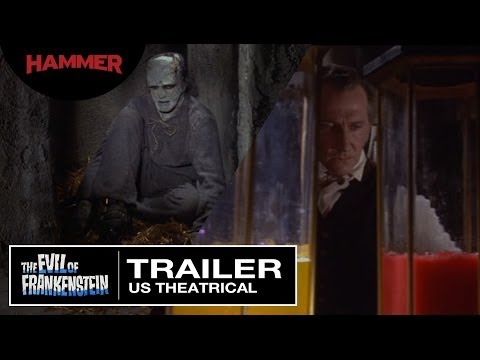
Watch the Trailer
Quick Specs
- Director: Freddie Francis
- Screenplay: Anthony Hinds (credited as John Elder)
- Starring: Peter Cushing (Baron Victor Frankenstein), Peter Woodthorpe (Zoltan), Sandor Elès (Hans), Katy Wild (Rena), Duncan Lamont (Chief of Police), David Hutcheson (Burgomaster), James Maxwell (Priest), Kiwi Kingston (The Creature)
- Music: Don Banks
- Cinematography: John Wilcox
- Editor: James Needs
- Producers: Anthony Hinds
- Production Company: Hammer Film Productions
- Distributor: Universal Pictures (US); Rank Film Distributors (UK)
- Premiered: May 8, 1964
- Runtime: 84 minutes
- Verdict: 2.5 ravens — a glorious laboratory with a cold creature in it.
- Budget: £130,000
- On This Site: The Evil of Frankenstein in the wiki · The Revenge of Frankenstein

The Review
Hammer’s first two Frankenstein films had steered carefully clear of Universal’s copyrighted monster. By 1963 that had changed: Universal was now distributing Hammer’s films in America, and the new arrangement let the studio draw directly on the Universal originals, from Jack Pierce’s famous flat-headed make-up to the crackling laboratory hardware. Anthony Hinds, writing as John Elder, built the story around that freedom, reworking material first developed for Hammer’s aborted 1958 Tales of Frankenstein television series. Terence Fisher, who had directed the first two films, could not take the job, and Freddie Francis, already an Oscar-winning cinematographer for Sons and Lovers, stepped in.
The result begins with the Baron (Cushing) on the run again. Ten years after being driven out of the town of Karlstaad, he is working in secret elsewhere until a priest discovers his laboratory. Broke, he and his loyal assistant Hans (Sandor Elès) return to Karlstaad to sell what is left at the family chateau, only to find that the town’s own officials have looted it, and the Burgomaster is wearing the Baron’s ring. Fleeing through a carnival, the pair are helped by Rena (Katy Wild), a deaf-mute beggar girl, who leads them to a cave in the mountains. There, in the ice, lies the Baron’s first Creature (Kiwi Kingston).
The flashback that explains how it got there is this film’s own invention, and it matches neither The Curse of Frankenstein nor The Revenge of Frankenstein; instead it borrows the frozen-monster finish of Universal’s Frankenstein Meets the Wolf Man. Thawed and revived, the Creature lives but its mind will not wake, so the Baron turns to Zoltan (Peter Woodthorpe), a fairground hypnotist. Zoltan wakes it all right, and then discovers that the Creature answers only to him.
What Works
- Cushing, as ever, is worth the ticket. Even in a weaker script, Cushing gives the Baron fire and wit. His outrage at finding the town’s dignitaries wearing his possessions is a lovely moment of aristocratic fury, and he plays the scientist’s single-mindedness with complete conviction. There is no Hammer Frankenstein in which he coasts.
- Peter Woodthorpe makes a splendid rogue. Zoltan is the best idea in the film: a seedy carnival mesmerist who realises he holds the leash on a monster and uses it to rob the town and settle old scores with the officials who banished him. Woodthorpe plays him with greasy, gleeful menace, and his rivalry with the Baron gives the middle of the film its energy.
- The laboratory is a thing of beauty. Freed to build in the Universal style, the production gives the Baron his most spectacular lab of the series, a crackling cathedral of coils and sparks, and John Wilcox’s colour photography makes it glow. The revival sequence is pure, joyful monster-movie spectacle.
- Rena gives the Creature a soul. Katy Wild’s beggar girl, the only person who is kind to the Creature, gives it a flicker of gentleness. The scenes between them are brief, but they are the closest this film comes to the pathos of the Universal originals it so admires.
What Doesn’t
- The Creature is a stiff. Kiwi Kingston, a New Zealand professional wrestler, certainly has the size, and Roy Ashton’s make-up is a decent approximation of the Karloff design. But Kingston has none of the expressiveness the role needs, and the flat-topped head, under bright colour light, looks more like a mask than a face. The Monthly Film Bulletin welcomed the return to tradition in the make-up and found almost everything else sadly tatty; on the Creature, at least, both halves of that verdict are fair.
- The continuity is thrown in the bin. Viewers who have followed the Baron through Curse and Revenge will find their history simply ignored. Denis Meikle called it a brazen display of contempt for continuity, and that is exactly how it plays. The film works better if you pretend it is a stand-alone remake, which is effectively what it is.
- The second half goes off the rails. The New York Times observed in 1964 that the film has a curious dignity for its first half before it simply goes hog-wild, the monster gets drunk, and it heads for the ash heap. That is harsh but accurate. Once Zoltan’s scheme collapses, the plot hurtles into a burning-laboratory finale with little build-up and less sense.
The ledger has never been kind. The critics of 1964 were lukewarm at best, Variety noting the deft direction over the preposterous patches but also the unintended laughs, and at least one later guide has called it the worst of Hammer’s Frankenstein series. There is a case for the defence, and it rests on Cushing, Woodthorpe and that glorious laboratory: this is a lively, colourful monster picture with real pleasures. But as a Hammer Frankenstein, it is the one that most clearly lost its way.
Harper’s verdict: 2.5 ravens — a glorious laboratory with a cold creature in it.
Spoilers settle here, fiends — the ending is in the trivia below.
Trivia & Facts
- Karloff’s face, by permission. Hammer’s earlier Frankenstein films avoided Jack Pierce’s Universal make-up for copyright reasons. Under the new distribution arrangement with Universal, Roy Ashton was free to create a close approximation of the Karloff design for this film.
- The Creature was a wrestler. Ernest “Kiwi” Kingston was a New Zealand-born professional wrestler, billed at six foot five, who worked the rings of Britain and Europe.
- The director was a cameraman with an Oscar. Freddie Francis had already won the Academy Award for his black-and-white cinematography on Sons and Lovers (1960) before he directed this film. His second Oscar, for Glory, came much later, in 1989.
- America got a longer version. For US television, Universal shot extra scenes in Los Angeles in 1966, with actors who never appear in the theatrical film, to pad out the running time. The longer version was broadcast on NBC in 1968.
- It started life as television. The story descends from material developed for Tales of Frankenstein, a 1958 television series Hammer planned that never went beyond a pilot.
- The Baron dies here, and returns anyway. The film ends with the laboratory exploding and tumbling off a cliff, killing the Baron and the Creature. Frankenstein Created Woman (1967) simply picks up with him alive.
Harper’s Extras
- The Evil of Frankenstein — the full wiki file: the complete case file on Hammer’s Universal-style Frankenstein.
- The Revenge of Frankenstein — the wiki file: the continuity this film throws out.
- Frankenstein Created Woman — the wiki file: the next chapter, with Fisher back in the chair.
- Frankenstein Meets the Wolf Man — the wiki file: the Universal monster rally this film borrows its frozen Creature from.
- Frankenstein (1931) — the wiki file: the Karloff original whose look Hammer was finally allowed to echo.
- Jack Pierce — the wiki file: the make-up genius behind the flat head.
- Peter Cushing — the wiki file: Hammer’s Baron, third time out.
- Crank it: Don Banks’s score. Brassy, bold and full of thunder, it plays the revival scene like a coronation.
Where to Watch
As of November 9, 2026, in the US: The Evil of Frankenstein is not streaming on any subscription or free service, and you can rent or buy it digitally on Amazon Video, Google Play, Apple TV Store or Fandango At Home. It is also available on Blu-ray. Streaming availability can change.
FAQ
Is The Evil of Frankenstein a sequel to The Revenge of Frankenstein?
Not really. It is the third Hammer Frankenstein, but its flashback retells the Baron’s history in a way that contradicts both earlier films. It is best treated as a stand-alone reboot made in the Universal style.
Why does the Creature look like the Universal monster?
Because Universal allowed it. Hammer’s earlier films avoided Jack Pierce’s copyrighted Karloff design, but under Hammer’s new distribution arrangement with Universal, Roy Ashton could create a close approximation of the classic look.
Who plays the Creature in The Evil of Frankenstein?
Ernest “Kiwi” Kingston, a New Zealand-born professional wrestler. Christopher Lee, who played the Creature in The Curse of Frankenstein, does not appear.
Why didn’t Terence Fisher direct The Evil of Frankenstein?
Fisher, who directed the first two Hammer Frankensteins, was unavailable, and Freddie Francis took over. It is the only Cushing Frankenstein film Fisher did not direct.
Until next time, fiends — keep the lights low, keep your heirlooms locked away from the town council, and if a carnival hypnotist offers to help with your monster, say no. Harper will leave a lamp burning for you.
The weekly roundup
One letter a week, from the crypt.
- New reviews, with the ravens
- New wiki entries and news
- Cool stuff worth your night
Weekly. No spam, unsubscribe in one click.