
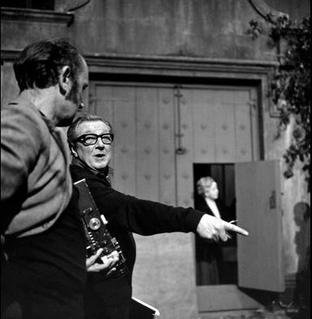
Terence Fisher (1904 to 1980) was the British director who defined Hammer horror with The Curse of Frankenstein and Dracula.
Quick Specs
| Born | February 23, 1904, Maida Vale, London |
| Died | June 18, 1980, aged 76 |
| Before film | five years in the Merchant Navy |
| Started in | 1933, as a clapper boy at Lime Grove Studios; film editor from 1936 to 1947 |
| Directed | 50 films, 29 of them for Hammer, more than any other Hammer director |
| Key horror | The Curse of Frankenstein (1957), Dracula (1958), The Mummy (1959), The Brides of Dracula (1960), The Gorgon (1964), The Devil Rides Out (1968) |
| Final film | Frankenstein and the Monster from Hell (shot 1972, released 1974) |
| Key collaborators | Peter Cushing, Christopher Lee, Jimmy Sangster, Bernard Robinson, James Bernard |
Who He Is
Terence Fisher was born in Maida Vale, London, on February 23, 1904, and raised by his grandmother in a strict Christian Scientist household. He left school at 16 and spent five years in the Merchant Navy. Back on land he drifted through a run of jobs, discovered the cinema, and in 1933 got in at Lime Grove Studios in Shepherd’s Bush as a clapper boy. He was 29, and he called himself “the oldest clapper boy in the business.”
He moved into the cutting room in 1934, took his first editor credit on Tudor Rose (1936) at Gainsborough, and stayed an editor for more than a decade. He spent the Second World War cutting features, not in uniform. His best-known job was editing Leslie Arliss’s The Wicked Lady (1945), with Margaret Lockwood and James Mason, one of the most popular British films of its day. He edited it; he didn’t direct it.
That decade made him. “When I was working in the cutting room as an editor, I learned to cut in the camera,” he said. “I shoot to an average of footage of 3½ to 4 to 1. If you’re working on a moderate budget, anything counts that appears to be a waste. Every shot I ever did was used.”
The Work, and What He Did in It
He was well into his forties when the Rank Organisation gave him his first directing jobs, short dramas at its Highbury talent studio: Colonel Bogey, To the Public Danger and A Song for Tomorrow. To the Public Danger, from a Patrick Hamilton radio play about a drunken night out that turns fatal, is the one critics single out, and some see it as a preview of the horror to come. A young Christopher Lee has a brief part in A Song for Tomorrow, nearly a decade before Fisher made him a star.
At Gainsborough he co-directed four features with Antony Darnborough, ending with So Long at the Fair (1950). Jean Simmons arrives in Paris for the 1889 Exposition with her brother, who vanishes overnight along with his hotel room, which the staff insist never existed. Eight years before the Gothic cycle, Fisher was already directing a period mystery built on something that shouldn’t be possible.
When Gainsborough closed he became a specialist in cheap supporting features, many of them for a small company called Hammer, starting with The Last Page (1951) with George Brent and Diana Dors. Stolen Face (1952), with Paul Henreid as a surgeon who remakes a woman’s face in the image of the lover who left him, and Four Sided Triangle (1953), which Fisher co-wrote, about a scientist who duplicates the woman he loves, show the ambition. Four years before Frankenstein, he was already handling a lab, an obsessive experimenter and a manufactured double.
The Curse of Frankenstein (1957) was Hammer’s first color horror film and its most important project yet. Management picked Fisher because he was reliable. Jimmy Sangster’s script cast TV star Peter Cushing as Baron Frankenstein and the little-known Christopher Lee as the Creature. Fisher refused to watch the Universal films first: “If one is going to make this film, I think one has got to start from a personal concept and what you yourself think.” Universal protected its flat-headed monster, so make-up artist Phil Leakey went back to Mary Shelley and built a Creature visibly stitched together from parts. The film showed eyeballs, severed hands and surgery in a fairly unflinching style, and when the Creature is shot in the head, blood gushes. British critics were horrified. It was an international hit that revitalized the ailing horror genre, made Hammer a brand and made Cushing and Lee horror stars.
Dracula (1958), released in the US as Horror of Dracula, did even better. Sangster compressed Stoker into a tight chiller, and Fisher gave Lee’s Count an animal sexuality no screen Dracula had shown before, with Cushing as Van Helsing. The signature Fisher moment is the reveal: a polite scene, then a hard cut to Lee’s face, eyes red and fangs bloody, as he leaps across a table. The ending is not a staking. Van Helsing tears down a curtain to flood the room with sunlight, makes a cross out of two candlesticks and drives Dracula into the beam, where he crumbles to dust. A shot of the Count peeling the skin from his own face was cut on release and restored for the 2012 Blu-ray from a damaged Japanese print.
He built the Hammer repertory film by film. The Revenge of Frankenstein (1958) has the Baron escaping the guillotine and practicing under an alias. The Hound of the Baskervilles (1959) gave Sherlock Holmes the horror treatment, with Cushing as Holmes, Andre Morell as Watson and Lee as Sir Henry; it was meant to launch a Holmes series, and its box-office failure ended that plan. The Mummy (1959) has Lee as Kharis, rising from a swamp and shrugging off bullets and a spear through the chest. It draws on Universal’s 1940s Kharis sequels, not the 1932 Karloff film.
The Brides of Dracula (1960) is a Dracula film with no Dracula: the vampire is David Peel’s Baron Meinster, kept chained by his own mother, and Cushing carries it. Fisher gives Van Helsing two great moments. Bitten, he burns the wound with a hot iron and douses it with holy water rather than turn. At the climax he swings the sails of a burning windmill so their shadow throws a giant cross over Meinster. Candlesticks in 1958, a windmill in 1960: faith improvised from whatever is in the room.
The Curse of the Werewolf (1961), set in 18th-century Spain and based on Guy Endore’s The Werewolf of Paris, gave Oliver Reed his first starring role. Then The Phantom of the Opera (1962) broke the run. Anthony Hinds wrote it for Cary Grant, who had said he wanted to make a Hammer horror and then never followed through. Herbert Lom played a tragic, wronged composer instead, Fisher directed it as Gothic tragedy rather than a monster shocker, and the expensive film underperformed. Fisher didn’t work for Hammer again for over two years.
He came back with The Gorgon (1964), reuniting Cushing and Lee, and it was one of his personal favorites. It gave Hammer its first female monster. Barbara Shelley plays Carla, the woman possessed; dancer Prudence Hyman plays the Gorgon herself, mostly half-glimpsed. Lee’s verdict: “The only thing wrong with The Gorgon is the gorgon!” Between Hammer jobs Fisher made science fiction, including Island of Terror (1966) and Night of the Big Heat (1967).
Dracula: Prince of Darkness (1966) brought Lee’s Count back after eight years, and he never speaks. Why is still argued. Lee said for decades that he refused to say the lines he was given. Sangster said he never wrote any (“Vampires don’t chat”), Fisher backed Sangster, and the March 1965 shooting script has no Dracula dialogue. Frankenstein Created Woman (1967) turned the Baron metaphysical, moving a dead man’s soul into the body of his drowned lover, and Fisher played it as a tragic fairy tale. It was the last Hammer film made at Bray.
The Devil Rides Out (1968), from Dennis Wheatley’s 1934 novel with a script by Richard Matheson, put Lee on the side of good as the Duc de Richleau against Charles Gray’s satanist Mocata. Censorship worries about Satanism held it up for years. Lee called it his favorite Hammer film, and it was made at his insistence. Fisher directed the black magic with total seriousness. It was not a hit, and the Wheatley series Lee hoped for never happened; its reputation came later. Frankenstein Must Be Destroyed (1969), conceived as the series climax, has Cushing’s Baron at his most ruthless and is often called one of Fisher’s own favorites and his most suspenseful film.
After that, injuries from two road accidents kept him out of work for long stretches. He returned to Hammer once more for Frankenstein and the Monster from Hell, shot at Elstree in 1972 and released in 1974, with Cushing’s Baron running an asylum and building a creature from its inmates. It failed commercially and has since been reappraised as a melancholy last stand for Fisher and for Hammer’s kind of horror. He retired, and when he died on June 18, 1980, at 76, the press barely noticed.
Cool Verified Facts
- He directed 50 films, and 29 of them were for Hammer, more than any other director made for the company.
- He didn’t direct every Hammer monster film. The Evil of Frankenstein and Dracula Has Risen from the Grave are Freddie Francis’s, Kiss of the Vampire is Don Sharp’s, and The Plague of the Zombies and The Reptile are John Gilling’s.
- Hammer submitted The Curse of Frankenstein to the British censors in a black-and-white print, hoping the gore would read softer. The board demanded cuts anyway, then insisted on seeing the color version.
- Martin Scorsese’s list of favorite British films, sent to Edgar Wright, includes three Fisher films: Stolen Face, Four Sided Triangle and The Devil Rides Out.
- His daughter, Micky Harding, wrote the introduction to his authorized biography, Tony Dalton’s Terence Fisher: Master of Gothic Cinema (2021). The key critical study is Peter Hutchings’s Terence Fisher (2001).
Signatures, Habits and Behind the Scenes
- He cut in the camera. “The film always jigsawed together without any pieces left over,” he said. In emotional scenes he cut for “reaction rather than action,” showing the listener, not the speaker.
- Critics called him static. His answer: “There always has to be a reason for moving your camera… But I do move my camera!” Count the moves, he said, and you’d be staggered.
- “I hate what I call tricky shooting, which makes a film look like a long TV commercial.”
- Good against evil was his stated doctrine. In 1973 he said Hammer’s strength was “a conflict between the power of good and the power of evil,” and that he tried to keep sensationalism from becoming the point.
- He called horror “adult fairy tales, no more and no less,” and later added: “grim fairy tale… Grimm wasn’t a gentle storyteller, was he?”
- He trusted actors. “Many directors are rather definite about what they expect, they lay down the rules before the first rehearsal. I think that is ridiculous.”
- He credited his team. He praised designer Bernard Robinson’s “great feel for the emotional impact of a subject,” and said cinematographers Jack Asher and Arthur Grant each brought their own style. The Hammer look was a company effort, with Fisher directing it.
- Lee on working with him: “Terence was a dear… We had a lot of fun.” Asked what Fisher would make of being hailed as an auteur, Lee said: “He’d have laughed!”
Why He Matters
Fisher was the first director to bring Gothic horror to life in full color, and the sex and gore in his films, mild now, were unheard of then. The Curse of Frankenstein launched Hammer’s horror line and made Cushing and Lee stars, and Dracula is still the template. Critics dismissed him for most of his life, he thought of himself as a jobbing filmmaker, and his death went almost unreported. Since then he has been recognized as an auteur whose films pit faith and reason against the charm of evil. He was also more versatile than the monsters suggest: the editor of The Wicked Lady, the director of Noel Coward and a vanishing hotel room, who made the Gothic his own in his fifties.