
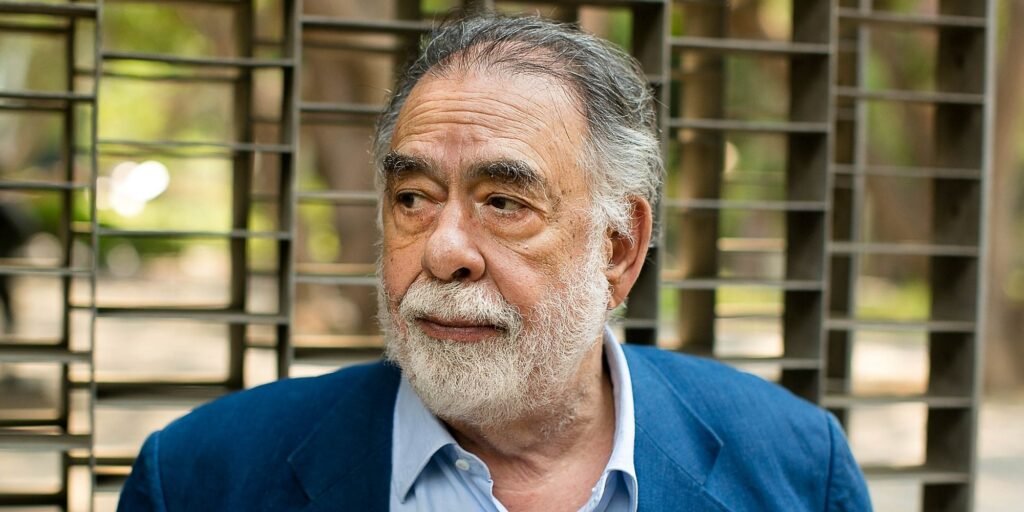
Francis Ford Coppola is the American director who gambled his way from a nine-day Corman horror film to the summit of New Hollywood.
Quick Specs
- Born: 7 April 1939, Detroit, Michigan
- Family: Son of Carmine Coppola, principal flute of the NBC Symphony under Toscanini
- Known for: The Godfather, The Godfather Part II, Apocalypse Now, Bram Stoker’s Dracula
- First mainstream feature: Dementia 13 (1963), for Roger Corman
- Studio: Co-founder, American Zoetrope (1969, with George Lucas)
- Years active: 1963–present
Overview
Here is the shape of the career, and it is a horror story before it is anything else: a bedridden kid with polio staging puppet shows from his sickbed becomes Roger Corman’s fastest apprentice, shoots his first mainstream feature — a Psycho-school horror picture — in nine days in an Irish castle, and within a decade has made The Godfather, The Conversation, The Godfather Part II and Apocalypse Now. Then he spends the next fifty years betting everything he won on staying independent: a studio, a fortune, a winery, and at 85, a $120 million film he paid for himself. Five competitive Oscars. Two Palmes d’Or. And at the centre of the filmography, glowing like a stage trick, sits the most operatic Dracula ever filmed — made with effects Méliès would have recognised, because Coppola insisted on it.
The Life
He was born in Detroit in 1939, second of three children of Carmine Coppola — a flautist who became principal flute of the NBC Symphony Orchestra under Arturo Toscanini — and Italia Coppola, a former actress. The family moved to Queens when he was about two. At nine, polio confined him to bed for over a year, partly paralysed on his left side — and the bedridden boy entertained himself with puppet shows, total worlds controlled from one chair. Recovering, he was making 8mm films by about ten. The puppeteer became the director; the chair became the set.
He took a B.A. in theatre arts from Hofstra in 1959 and went to UCLA film school, where You’re a Big Boy Now (1966) was his thesis film. On Dementia 13 he met Eleanor Neil, who worked in the production; they married in 1963 and had three children — Gian-Carlo, Roman and Sofia. In 1969 he co-founded American Zoetrope in San Francisco with George Lucas: a filmmaker-run studio meant as an alternative to Hollywood, and the through-line of everything after. In 1986 his eldest son Gian-Carlo was killed in a speedboating accident in Annapolis, aged 22; Coppola dedicated Tucker: The Man and His Dream (1988) to him. From the 1970s he built the Napa wine business that bankrolled his independence. Eleanor — who shot the footage that became the Apocalypse Now documentary Hearts of Darkness — died on 12 April 2024, aged 87, after 61 years of marriage; Megalopolis is dedicated to her. His late honours include the honorary Irving G. Thalberg Memorial Award (2010), the Kennedy Center Honors (2024) and the AFI Life Achievement Award (2025).
The Work
Corman’s shop was his real film school, and he did every job in it: re-editing and dubbing the Soviet film that became Battle Beyond the Sun (1962), dialogue director on Tower of London, sound man on The Young Racers, associate producer and one of several uncredited directors on The Terror. Then, on location in Ireland, Roger Corman offered him the leftover money to make a cheap horror picture. Coppola wrote Dementia 13 (1963) in a single night and shot it in nine days for about $40,000; it went out as the lower half of a double bill with Corman’s X: The Man with the X-ray Eyes. Precision matters here: it was his first mainstream feature, and the released cut is not entirely his — Corman demanded changes, including added scenes shot by Jack Hill and Monte Hellman. Coppola’s own cut was restored in 2017. One of the greatest American directors started in horror. Horror is where he started.
By 1970 he was an Oscar-winning screenwriter — Patton, co-written with Edmund H. North, the film of George C. Scott‘s defining performance — who had not yet had a hit as a director. Then came the summit. Paramount hired him cheap, young and Italian-American to direct The Godfather (1972), expecting compliance, and fought him on everything — above all his casting. In his own account, the studio president told him: “Marlon Brando will never appear in this motion picture and I forbid you to bring it up again” — and relented only on conditions (a screen test, scale pay, a $1 million behaviour bond) that Coppola accepted on the spot. He fought the same battle for Al Pacino. The film won Best Picture, Best Actor for Brando and Best Adapted Screenplay for Coppola and Mario Puzo — and get this exactly right, because everyone gets it wrong: the Picture statuette went to producer Albert S. Ruddy, and Coppola was nominated for Best Director, not the winner. The Conversation (1974), his surveillance-paranoia masterpiece, won the Palme d’Or at Cannes. The Godfather Part II (1974) — with Robert De Niro as the young Vito — became the first sequel to win Best Picture, and Coppola personally took home three Oscars for it: Picture (as producer), Director and Adapted Screenplay.
Apocalypse Now (1979) was the ordeal: typhoons destroying sets in the Philippines, Dennis Hopper among the chaos as the photojournalist, Martin Sheen suffering a heart attack, Brando arriving overweight and unprepared, Coppola risking his own money to finish. The unfinished film screened at Cannes and shared the Palme d’Or with The Tin Drum. His line at the press conference is the whole production in one sentence: “My film is not about Vietnam, it is Vietnam.” (In the same decade he was also producer — producer, not director — of Lucas’s American Graffiti.)
The gamble then ate the gambler. One from the Heart (1982), an artificial Las Vegas built on his own lot, ballooned to about $26 million and grossed under $1 million domestically on first release; Zoetrope Studios was lost, and he spent years directing to service the debt — The Outsiders and Rumble Fish (both 1983), The Cotton Club, Peggy Sue Got Married, Tucker, and commercially redemptive The Godfather Part III (1990). Then, the horror summit: Bram Stoker’s Dracula (1992). Screenplay by James V. Hart — Coppola directed and co-produced; say it that way every time. Gary Oldman is the Count, Winona Ryder is Mina, Anthony Hopkins is Van Helsing. Made for $40 million, it grossed $215.9 million worldwide and won three Academy Awards — Costume Design, Makeup and Sound Effects Editing — remaining the only Dracula film ever to win Oscars. Its method is the legend: Coppola resolved to shoot entirely on soundstages with effects done in-camera, as they would have been in 1900 — multiple exposures, forced perspective, reverse photography, miniatures — because Stoker’s novel and cinema itself were born in the same moment; when his effects team balked, he replaced them with his son Roman to run the on-set effects unit. In the same Gothic cycle he produced Kenneth Branagh‘s Mary Shelley’s Frankenstein (1994).
After The Rainmaker (1997) he stepped away from directing for a decade, then returned with small, self-financed personal films — Youth Without Youth (2007), Tetro (2009) — and one more horror film: Twixt (2011), with Val Kilmer as a washed-up horror novelist guided through a small town’s murder mystery by the ghost of Edgar Allan Poe, and Elle Fanning as the ghost “V.” It cost $7 million and grossed $1.3 million; a re-edited director’s cut, B’Twixt Now and Sunrise, followed in 2022. And the circle closed with Megalopolis (2024) — developed since the early 1980s, self-financed at about $120 million raised substantially by selling a share of the wine business, premiered at Cannes, dedicated to Eleanor, grossing about $14.3 million. His own money. His own studio logic. No permission asked.
The Coppola Touch
The method is the gamble, repeated at every scale: $40,000 and nine days; his own money behind Apocalypse Now; a whole studio on one musical; $120 million of his own cash at 85. A line carried in Gene D. Phillips’ biography of him sums it up: “If you don’t bet, you don’t have a chance to win. You can’t be an artist and play it safe.” Family is the other constant — Zoetrope was a family firm: Carmine composed for his films, Eleanor shot the Apocalypse footage, Roman ran Dracula‘s effects at 26, Sofia acted for him before he produced her. Which is why the record needs care: he produced his children’s films; he did not direct them. Critics have described his ambition in Wagnerian terms — the “total work of art,” nothing escaping the director’s scrutiny — and Dracula is its purest horror expression: when the industry went digital, the Corman apprentice went backwards, to stage magic performed live in front of the camera, because Dracula and the movies were born together.
Why He Matters
For horror: the genre is not a footnote in this career, it is the entry point and a recurring home — a founding New Hollywood credit that is also a Corman Psycho-school shocker, the only Oscar-winning Dracula, and a late return to small-scale horror at 72. For cinema: between 1972 and 1979 he directed four films that permanently altered American movies, then spent fifty years and three fortunes trying to keep the independence those triumphs bought. And for the house thesis of this site, his career is the single strongest proof that genre apprenticeship is a complete film education: the man who re-edited Soviet sci-fi for Roger Corman is the man who made The Godfather Part II.
Trivia & Facts
- His five competitive Oscars: Original Screenplay (Patton, shared), Adapted Screenplay (The Godfather, shared), and Picture, Director and Adapted Screenplay for The Godfather Part II. The 2010 Thalberg Award is honorary — a sixth statuette, but not a sixth win.
- Apocalypse Now did not win the 1979 Palme d’Or outright — it shared it with The Tin Drum.
- Bram Stoker’s Dracula is the only Dracula film to win Academy Awards — three of them.
- Nicolas Cage is his nephew, not his son; Talia Shire is his sister, not his wife.
- Coppola’s own cut of Dementia 13 was only restored in 2017 — the version audiences saw in 1963 contained scenes shot by Jack Hill and Monte Hellman at Corman’s demand.
- His daughter Sofia played Mary Corleone in The Godfather Part III; he is a producer of several of Sofia’s and Roman’s films, never their director.
FAQ
Did Francis Ford Coppola win Best Director for The Godfather?
No. He was nominated and lost. His Best Director Oscar is for The Godfather Part II — and the Best Picture statuette for the first film belongs to its producer, Albert S. Ruddy.
How many Oscars does Francis Ford Coppola have?
Five competitive wins — Patton (Original Screenplay), The Godfather (Adapted Screenplay), and The Godfather Part II (Picture, Director, Adapted Screenplay) — plus the honorary Irving G. Thalberg Memorial Award in 2010, which is not a competitive win.
Did Bram Stoker’s Dracula use CGI?
Coppola’s stated method was that there were no digitally generated effects: the film’s effects were achieved in-camera by period methods — multiple exposures, forced perspective, reverse photography, miniatures — under his son Roman’s on-set effects unit. The screenplay, for the record, is by James V. Hart.
Was Dementia 13 Francis Ford Coppola’s first film?
It was his first mainstream feature as writer-director — but he had already re-edited, dubbed and partly directed Corman product, and the 1963 release cut includes scenes Corman had other directors shoot. His own cut dates from the 2017 restoration.